Kangaroo Island, off the coast of South Australia, offers one of Australia's most rewarding wildlife encounters for travellers who prefer substance over spectacle. From guided walks among wild sea lions at Seal Bay to the wind-sculpted granite of Remarkable Rocks, the island moves at a pace that suits those who want to look properly rather than rush. For Victorian couples in their sixties and seventies, this is the kind of interstate trip that earns its place in the memory.
Why Kangaroo Island works so well for travellers in their sixties and seventies
Kangaroo Island is one of those rare destinations where the wildlife comes to you rather than the other way around. Kangaroos graze roadside at dusk, echidnas shuffle across walking tracks, and at Seal Bay, wild Australian sea lions haul themselves up the beach with complete indifference to the small group of visitors standing nearby under a ranger's guidance. For a couple who has spent decades travelling and wants something genuinely different on home soil, this island delivers without requiring extreme fitness or a punishing itinerary.
The island sits roughly 13 kilometres off the Fleurieu Peninsula in South Australia, about 112 kilometres long and up to 57 kilometres wide. It is large enough to feel like a proper destination rather than a day trip, but compact enough that the main attractions are accessible without long drives. Most sealed roads are in reasonable condition, and the key wildlife sites — Seal Bay, Flinders Chase National Park, Hanson Bay Wildlife Sanctuary — are all signposted and manageable for travellers who are not looking for rugged adventure.
For Greek-Australian families based in Victoria, the journey to Kangaroo Island pairs naturally with a few nights in Adelaide beforehand — a city that offers its own pleasures, including the Central Market and a strong café culture, before you head south to Cape Jervis for the ferry. The combination makes for a ten-to-fourteen day trip that feels complete rather than hurried.
Getting there: ferry from Cape Jervis or flight from Adelaide
The most popular route for Victorian travellers is to drive or take a coach to Adelaide, then continue south on the Victor Harbor Road to Cape Jervis, where SeaLink operates a regular vehicle and passenger ferry to Penneshaw on Kangaroo Island. The crossing takes about 45 minutes and runs multiple times daily, though schedules vary by season. Booking ahead is sensible in summer and school holiday periods, though not because of panic — simply because vehicle spots fill and it removes uncertainty from the day. Check current schedules and fares at sealink.com.au.
If driving from Victoria feels like too much, the train and coach combination to Adelaide is comfortable and avoids fatigue entirely. The Overland, operated by Journey Beyond Rail, runs between Melbourne and Adelaide twice weekly and is worth considering as part of the journey itself. From Adelaide, a coach or hire car south to Cape Jervis is straightforward. Travellers who prefer to leave the car behind entirely can take SeaLink as foot passengers and hire a vehicle on the island — several hire car operators are based in Penneshaw and Kingscote.
The alternative is to fly. Rex Airlines operates regular services between Adelaide and Kingscote Airport, with the flight taking around 30 minutes. This suits travellers who want to minimise travel time or who find long drives uncomfortable. The trade-off is that without a vehicle on the island, you will need to book guided tours or a hire car for getting around, as public transport on Kangaroo Island is effectively non-existent. For a couple, hiring a small car from Kingscote is usually the most flexible and economical arrangement once you are on the island.
Seal Bay: walking among sea lions on the beach
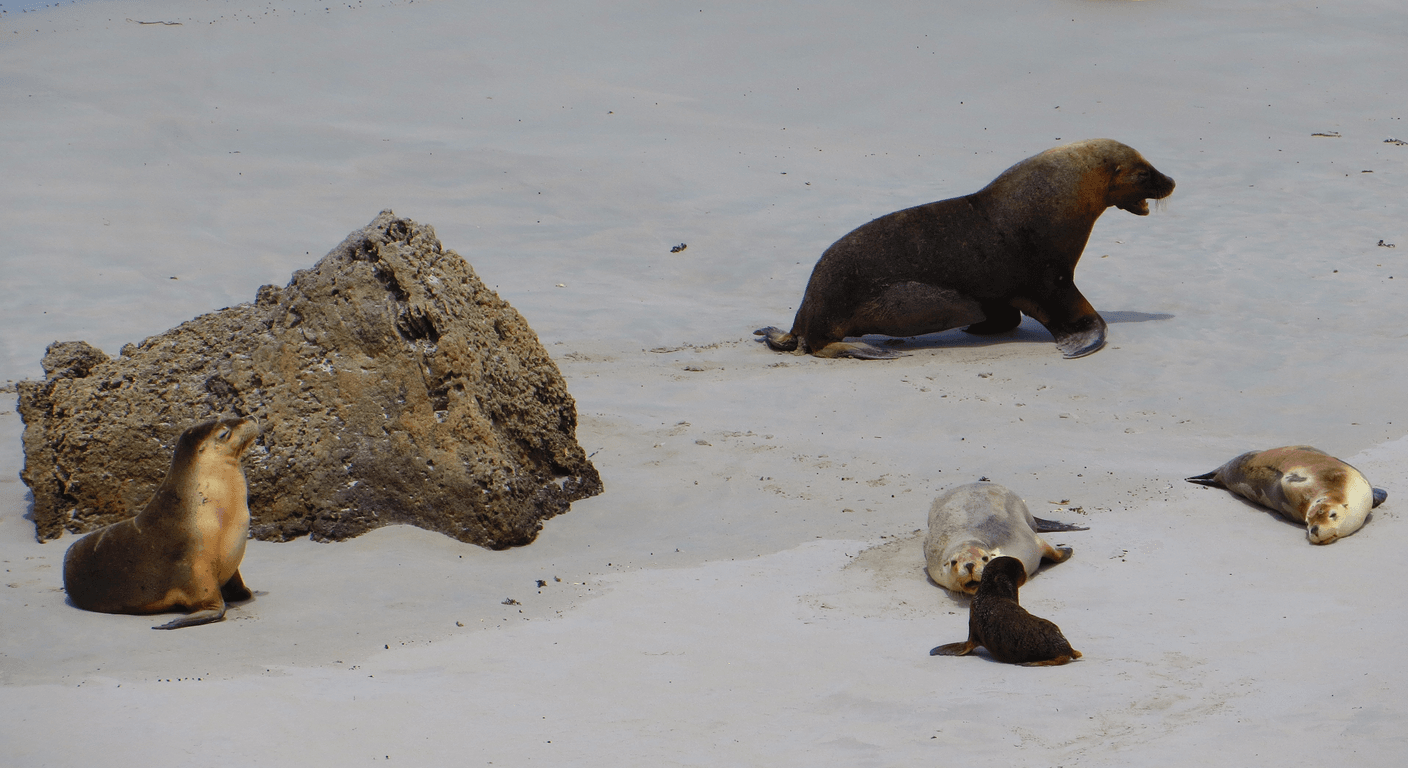
Seal Bay Conservation Park on the island's south coast is the experience most people remember longest. A ranger-guided beach walk takes small groups down to the beach where a colony of Australian sea lions rests, nurses pups, and moves about in the way animals do when they are entirely untroubled by nearby humans. The guided walk lasts around 45 minutes and covers a relatively short, flat distance on the beach itself, though the sand is soft in places, which requires some care underfoot.
The sea lions here are wild, not performing. Rangers maintain a respectful distance and brief the group before descending — no sudden movements, no crouching down to the animals' level, stay with the group. The experience is quietly extraordinary in a way that photographs do not fully capture. You are simply standing on a working beach in the middle of an animal's daily life, and the scale of the creatures up close — an adult male can reach 300 kilograms — is something that registers in the body, not just the eyes.
For travellers with mobility considerations, the boardwalk option (a self-guided elevated walkway above the beach) offers a view of the colony without the soft sand underfoot. It is a good alternative if the beach walk feels uncertain. Confirm current guided tour times and fees with the park before you go, as these can vary by season. The Parks SA website is the reliable source for up-to-date information.
Flinders Chase National Park: Remarkable Rocks and Admirals Arch
At the island's western end, Flinders Chase National Park contains two formations that justify the drive on their own. Remarkable Rocks is a cluster of enormous granite boulders on a dome of rock above the Southern Ocean — weather-worn into shapes that look like something between a sculpture park and a fever dream. The walk from the car park to the rocks is short and mostly flat, around 500 metres return, though the rock surface itself is uneven and can be slippery after rain. Take your time, wear shoes with grip, and the whole experience is manageable for most travellers in their seventies.
Admirals Arch is a short walk of around 700 metres return on a formed path and boardwalk, descending to a natural rock arch under which New Zealand fur seals rest, play, and occasionally stare back at you with what can only be described as mild contempt. The boardwalk has some steps, so travellers with knee concerns should take it steadily. The arch itself is dramatic and the seals are numerous — this is a colony of thousands, and the noise and smell are part of the experience.
Both sites are within Flinders Chase National Park and require a national park entry fee, which is separate from the Seal Bay guided walk fee. South Australia's national parks fees apply — check the Parks SA website for current entry costs. The park roads to both sites are sealed and in good condition. Allow a full day for the western end of the island, including the drive from Kingscote or Penneshaw, which takes around 90 minutes each way. Pack a lunch; there are picnic facilities at both sites but no food outlets nearby.
Honest notes on the bushfire recovery
The 2019-20 bushfires burned roughly half of Kangaroo Island, including large sections of Flinders Chase National Park. That fact is worth acknowledging honestly rather than glossing over. By 2026, the recovery is well advanced — the key visitor sites are open and operating normally, the wildlife population has rebounded considerably, and the island is fully functional as a tourist destination. Travellers will not arrive to find a devastated landscape.
What you will notice, particularly in parts of Flinders Chase, is regenerating bush: new growth coming up through blackened trunks, areas that look young rather than ancient. For some travellers this is moving to witness — the tenacity of Australian bush after fire is remarkable in its own right. For others it may look different from what they expected based on older photographs. Neither reaction is wrong; it is simply the honest state of the landscape in 2026.
Some accommodation options that operated before the fires have not reopened, so choices in the western part of the island are more limited than they were in 2019. Most visitors base themselves in or near Kingscote, the island's main town, or at Penneshaw near the ferry terminal. Both have a reasonable range of accommodation including motels, self-contained units, and some boutique options. Book accommodation ahead if travelling in the summer months of December through February.
Where to stay and how to pace the trip
Three to four nights on the island is a comfortable duration for most couples in this age group — long enough to see the main sites without rushing, and to have a day that is genuinely unscheduled. Kingscote is the practical base, with supermarkets, a hospital, pharmacies, and a selection of restaurants and cafes. The town sits on a bay and is pleasant to walk around in the early morning, when kangaroos are often visible in the parkland near the waterfront.
Indicative accommodation costs in Kingscote run from around $150-$250 per night for a motel or self-contained unit, though this varies considerably by season and property standard. Confirm current rates directly with accommodation providers. The Kangaroo Island Tourism website is a useful starting point for options across the island.
A sensible four-day itinerary might look like this: arrive by ferry in the early afternoon, settle in and explore Kingscote; day two to Seal Bay and the south coast; day three to Flinders Chase for Remarkable Rocks and Admirals Arch, with a picnic lunch; day four as a slower morning before the ferry back in the afternoon. That pace leaves room for a rest when one is needed, which at 73 is not a concession — it is just good travel planning.
Practical matters: health, accessibility, and what to bring
Kangaroo Island has a hospital in Kingscote, which provides reassurance for travellers managing ongoing health conditions. For anything serious, evacuation to the mainland is required, so travellers with significant health considerations should discuss the trip with their doctor and ensure their travel insurance covers medical evacuation. This is standard advice for any island destination and not a reason to avoid the trip — simply something to have organised before you leave.
Accessibility across the main sites is generally reasonable for travellers with moderate mobility. Seal Bay's boardwalk is flat. Remarkable Rocks requires care on uneven granite but the approach path is flat. Admirals Arch has steps on the boardwalk. None of these require high fitness levels, but they do require stable footing and the willingness to take them slowly. Travellers using walking sticks will find them helpful on the beach at Seal Bay and on the granite at Remarkable Rocks.
What to pack: layers, because the island's weather is changeable and the Southern Ocean sends cool winds even in summer; sturdy closed-toe shoes rather than sandals for the walking sites; sunscreen and a hat for the beach at Seal Bay; and a torch for dusk drives when wildlife is most active on the roads. Drive slowly at dawn and dusk — kangaroos and wallabies are genuinely abundant and move suddenly. This is not a warning issued for effect; it is a daily reality on Kangaroo Island roads.
Key takeaways
- Seal Bay's guided beach walk puts you within metres of wild Australian sea lions on a working colony beach — the boardwalk option suits travellers who prefer to avoid soft sand.
- Remarkable Rocks and Admirals Arch in Flinders Chase National Park both involve short, largely flat walks of under one kilometre return, making them accessible for most travellers in their seventies.
- The SeaLink ferry from Cape Jervis to Penneshaw takes around 45 minutes and carries vehicles, making it the most flexible access option for Victorian couples driving to South Australia.
- Kangaroo Island's bushfire recovery is well advanced by 2026 — all major visitor sites are open and wildlife has rebounded, though regenerating bush is visible in parts of Flinders Chase.
- Three to four nights based in Kingscote is a comfortable duration for the island, leaving enough time for the main sites without the fatigue of rushing.
- There is no public transport on Kangaroo Island, so hiring a vehicle — either bringing your own on the ferry or renting from Kingscote — is essential for independent travel.
Recommended partners and links
Indicative prices only — always confirm with the operator before booking.
Frequently asked questions
Is Kangaroo Island suitable for travellers in their seventies with moderate mobility?
Yes, the main wildlife sites are accessible for travellers with moderate mobility. Seal Bay offers a boardwalk alternative to the beach walk, Remarkable Rocks involves a short flat approach path (with uneven granite at the rocks themselves), and Admirals Arch is a formed boardwalk path with some steps. None require high fitness, but stable footwear and a slow pace are recommended.
How do you get to Kangaroo Island from Victoria?
Most Victorian travellers drive or take a coach to Adelaide, then continue south to Cape Jervis where SeaLink operates a vehicle and passenger ferry to Penneshaw on Kangaroo Island. The crossing takes around 45 minutes. Alternatively, Rex Airlines flies from Adelaide to Kingscote Airport in about 30 minutes. Check current schedules and fares at sealink.com.au and rex.com.au.
Has Kangaroo Island fully recovered from the 2020 bushfires?
The major visitor sites including Seal Bay, Remarkable Rocks, and Admirals Arch are fully open and operating normally in 2026. Wildlife populations have recovered well. Travellers will notice regenerating bush in parts of Flinders Chase National Park, with new growth coming through blackened trunks, but the island is fully functional as a destination and the wildlife experience is not diminished.
How much does the Seal Bay guided beach walk cost?
Guided beach walks at Seal Bay Conservation Park are indicatively around $50-$60 per adult, but fees change and should be confirmed directly with the park. The Parks SA website (parks.sa.gov.au) is the reliable source for current pricing and tour times.
Do you need a hire car on Kangaroo Island?
Effectively yes. There is no public transport on Kangaroo Island, so getting between sites requires your own vehicle. You can bring a car on the SeaLink ferry from Cape Jervis, or hire one from operators based in Penneshaw or Kingscote. For a couple, a hire car is usually the most practical arrangement if flying in.
Got a tip, a price update or a story from this route? The community would love to hear it.
Share your views on our Facebook page— Seniors and Solo Traveller Stories