Melbourne's heritage pubs — the grand nineteenth-century hotels that survived the gold rush, the boom years, and a dozen rounds of pokies — still do some of the most satisfying sit-down lunches in the city. For a solo traveller who wants a proper meal, a comfortable seat, and no pressure to linger over a tap water, they remain hard to beat. This guide covers the dining rooms worth knowing, what a main course will set you back, and how to time your arrival before the lunchtime rush.
Why Melbourne's old pubs still make sense for a solo lunch
There is a particular logic to choosing a heritage pub for a solo lunch that has nothing to do with nostalgia. These buildings were designed for exactly this purpose: a single traveller arriving off the street, taking a seat without a booking, ordering something substantial, and leaving without ceremony. The dining rooms in Melbourne's nineteenth-century hotels were built for commercial travellers, for barristers between courts, for anyone who needed a proper meal and a place to think. That function has not really changed.
For a man travelling alone in his late sixties, the pub dining room also sidesteps the mild awkwardness that can attach to solo dining in a contemporary restaurant, where a table for one sometimes feels like an afterthought. At a heritage pub, the bar counter and the dining room both accommodate a solo diner without fuss. The staff have been doing it for generations. You order, you eat, you go.
The other practical advantage is timing. Melbourne's heritage pubs typically open for lunch from around noon and the dining room is quietest between noon and 12.30, before the office crowd arrives at 12.45. Turn up at noon on a Tuesday or Wednesday and you will often have the dining room largely to yourself, with attentive service and no noise competition. That window is genuinely worth knowing about.
Which heritage pubs are worth your time — and why
The Mitre Tavern on Bank Place, tucked into one of the CBD's oldest laneways just off Collins Street, is the most atmospheric choice for a solo lunch. Built in 1837 and claiming the title of Melbourne's oldest surviving pub, it has a courtyard beer garden that is sheltered and quiet at midday, and a menu that leans into the kind of food the building was designed to serve: pies, roasts, and grills done without fuss. The courtyard seating is accessible at ground level from Bank Place; the internal bar area involves no significant steps.
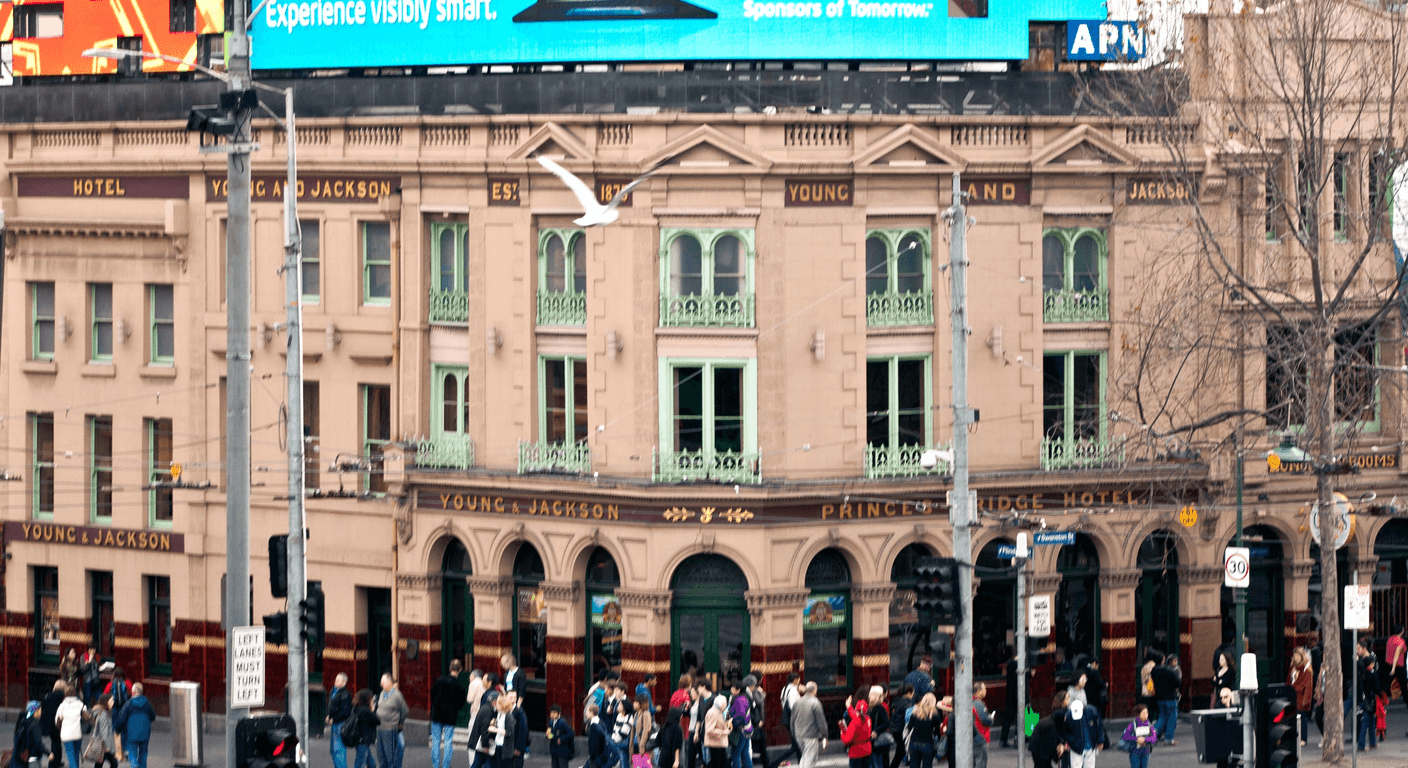
Young and Jackson, facing Flinders Street Station at the corner of Flinders and Swanston, has a first-floor dining room that carries genuine history — the famous Chloe painting has hung there since 1909. The ground-floor bar is louder and more transient, but the upstairs bistro is a proper sit-down operation with tablecloths and a menu that runs to steaks, schnitzels, and daily specials. Access to the upper floor is by staircase only, which is worth knowing before you commit. The ground-floor bar meals are a reasonable alternative if stairs are a concern.
The Windsor Hotel on Spring Street is in a different register — it is a grand hotel rather than a working-man's pub — but its dining room and its afternoon service are worth including here because the building (opened 1883, listed on the Victorian Heritage Register) represents the pinnacle of Melbourne's boom-era confidence, and the menu at lunch is more affordable than the address might suggest. A two-course lunch in the bistro area can be done for a reasonable sum without booking a formal dinner table. Confirm current offerings directly with the hotel.
What does a pub lunch actually cost in Melbourne in 2026?
Indicative main-course prices at Melbourne's heritage pub dining rooms currently sit somewhere in the range of $20 to $45, depending on the establishment and the dish. A counter meal — schnitzel, parma, fish and chips, a roast of the day — will generally come in at the lower end of that range at a traditional pub like the Mitre Tavern or the nearby Cricketers Bar at the Windsor. A sit-down bistro main at Young and Jackson's upstairs room is likely to be somewhere in the middle of that range. These are indicative figures only; always confirm current menu prices directly with the venue before you go, as costs shift with supply and staffing.
Seniors-specific menu pricing is less common in Melbourne's CBD pubs than it once was, and it is worth being honest about that. A handful of suburban and regional Victorian pubs still operate a genuine seniors menu — a reduced portion at a reduced price available on weekday lunchtimes — but most inner-city heritage pubs have moved away from that model. What you do get, reliably, is a weekday lunch special: a main and a drink at a combined price that represents better value than ordering separately. Ask at the bar when you arrive rather than assuming it is printed on the menu.
A glass of house wine or a middy of beer alongside your meal will add roughly $8 to $14 to the bill at most of these venues, again indicatively. Melbourne tap water is served without charge at any pub that serves food — you do not need to order a drink to justify your seat in the dining room at lunchtime, though the lunch specials often make it worth considering.
Timing your visit: the quiet lunch window explained
The practical rhythm of a Melbourne CBD pub lunch is worth understanding before you plan your day. Most heritage pub kitchens open at noon and run until around 2.30 or 3.00 in the afternoon, Monday to Friday. The quietest period is noon to 12.30 — arrive then and you will be seated immediately, served promptly, and able to eat without competition for the staff's attention. From around 12.45 onwards the office and legal-precinct crowd arrives in numbers, the noise level rises, and service slows. If you are catching a train home or have an afternoon commitment, the early window is your friend.
Saturday lunchtimes at heritage CBD pubs are a different experience — generally busier, often with a younger crowd, and sometimes with live sport on screens in the bar area. If you prefer a quieter environment, a Tuesday, Wednesday, or Thursday lunch is the most reliable choice. Some of these venues are closed on Sundays or operate reduced hours; confirm before making the trip, particularly if you are travelling in from regional Victoria on a V/Line service.
If you are arriving by public transport, the central CBD pubs are all within comfortable walking distance of Flinders Street Station or Melbourne Central Station. The Mitre Tavern on Bank Place is roughly a ten-minute walk from Flinders Street along Collins Street — flat, paved footpath the entire way. Young and Jackson is directly opposite Flinders Street Station. The Windsor is at the Spring Street end of Collins, about fifteen minutes' walk from Flinders Street, or a short tram ride on the 86, 96, or City Circle route.
Accessibility: what the heritage buildings actually look like inside
Heritage pubs and accessibility do not always sit comfortably together, and it is better to know the specifics before you arrive. The Mitre Tavern's courtyard and ground-floor bar area are accessible without steps from Bank Place; the internal pub rooms involve a small step at the entrance threshold. Young and Jackson's ground floor is accessible from the Flinders Street corner entrance, but the upstairs dining room — the more atmospheric of the two spaces — is reached only by a traditional wooden staircase with a handrail. If managing a flight of stairs is a concern, the ground-floor bar meals are the practical alternative.
The Windsor Hotel has lift access to its main public areas from the Spring Street entrance, though the building's heritage fabric means the lift is not always immediately obvious; ask at the front desk and staff will direct you. The dining areas on the ground floor involve no significant steps. For any venue where accessibility is a genuine requirement rather than a mild preference, it is worth phoning ahead — not to ask permission, but to confirm the specific route from the entrance to the dining room so there are no surprises on arrival.
Seating comfort is generally good in the established dining rooms of these older hotels: upholstered chairs, tables at a standard height, and enough space between tables to move without difficulty. The bar-stool seating at the counter is less comfortable for an extended lunch and is worth avoiding if you have any lower-back or hip considerations. Most venues will seat you at a table without comment if you simply walk to one and sit down.
Booking, walking in, and the solo-diner question
At most of Melbourne's heritage pubs, a solo diner does not need a booking for a weekday lunch, particularly in the noon-to-12.30 window. Walking in and asking for a table for one is straightforward and will not raise an eyebrow. The exception is if you want a specific table — the window seat at the Mitre Tavern's courtyard, for instance — in which case a phone call the morning of your visit is usually enough to secure it. None of these venues require an online booking deposit for a solo lunch.
If you are planning a visit to the Windsor's dining room, a quick call ahead is sensible simply to confirm current service hours and whether the bistro lunch menu is running on your chosen day. Grand hotels sometimes adjust their lunch service for private functions, and a ninety-second phone call saves a wasted trip. The Windsor's contact details are on their website at thewindsor.com.au.
For a solo traveller who finds the prospect of sitting alone in a busy room mildly uncomfortable, a counter-meal seat at the bar is a genuine alternative — you are facing the bar staff, conversation happens naturally if you want it, and there is no sense of occupying a table that could seat four. The Mitre Tavern's bar counter is particularly good for this: unhurried, staffed by people who have been doing the job for years, and with enough going on to make the time pass pleasantly.
A few more heritage pub dining rooms worth knowing about
Beyond the three main venues covered above, a handful of other Melbourne addresses are worth keeping in mind. The Cricketers Bar at the Windsor Hotel is a separate, more casual space within the same building, with a sports-heritage theme and a pub-meal menu that is a step down in price from the main dining room — worth knowing if you want the address without the formality. The Duke of Wellington on Flinders Lane (near the corner of Russell Street) is a smaller, quieter heritage pub that does a reliable counter lunch in a room that has changed very little since the 1960s; it tends to attract a local legal and media crowd and is rarely overwhelmed.
The Hotel Windsor aside, Spring Street and the eastern end of Collins Street have several other nineteenth-century pub buildings that are architecturally significant even if their food offer is more variable. It is worth separating the building from the menu when making your choice: a beautiful heritage facade does not guarantee a well-executed schnitzel. The venues named in this guide have been chosen because the food and service consistently match the setting.
If you are prepared to walk a little further, or catch a tram north, the Builders Arms Hotel in Fitzroy (on Gertrude Street) and the Napier Hotel nearby are both heritage-listed and do a serious pub lunch in restored Victorian rooms. These are inner-suburban rather than CBD, which means a slightly different crowd and a slightly different pace — often quieter on weekday lunchtimes than the city pubs, and with easier street parking if you have driven in.
Key takeaways
- Melbourne's nineteenth-century heritage pubs remain among the most practical and comfortable solo lunch options in the CBD, with no pressure and no pretension.
- The quietest and most efficient window for a pub lunch is noon to 12.30 on a Tuesday, Wednesday, or Thursday — before the office crowd arrives.
- Indicative main-course prices at heritage pub dining rooms range from roughly $20 to $45 in 2026; always confirm current prices directly with the venue.
- Young and Jackson's upstairs dining room is accessible by staircase only — the ground-floor bar meals are the alternative if stairs are a concern.
- The Mitre Tavern on Bank Place is Melbourne's oldest surviving pub and its courtyard is accessible at ground level from the laneway.
- Genuine seniors-menu pricing is rare in CBD pubs, but weekday lunch specials combining a main and a drink are common and worth asking about at the bar.
Recommended partners and links
Indicative prices only — always confirm with the operator before booking.
Frequently asked questions
Do Melbourne's heritage pubs require a booking for a solo lunch?
In most cases, no. A solo diner walking in at noon on a weekday will generally be seated without a booking at venues like the Mitre Tavern or Young and Jackson. A brief phone call is sensible if you want a specific table or are visiting the Windsor Hotel's dining room, where private functions occasionally affect service.
Are there seniors-priced menus at Melbourne CBD heritage pubs?
Dedicated seniors menus are uncommon in Melbourne's inner-city heritage pubs in 2026. Weekday lunch specials — a main and a drink at a combined price — are more commonly available and represent the practical equivalent; ask at the bar when you arrive rather than assuming it is on the printed menu.
Which Melbourne heritage pub is best for accessibility?
The Mitre Tavern's courtyard and ground-floor bar are accessible at street level from Bank Place with no significant steps. Young and Jackson's ground floor is accessible, but the upstairs dining room involves a staircase. The Windsor Hotel has lift access to its main public areas; phone ahead to confirm the accessible route from the Spring Street entrance.
How do I get to Melbourne's heritage pub dining rooms by public transport?
Young and Jackson is directly opposite Flinders Street Station. The Mitre Tavern on Bank Place is roughly a ten-minute flat walk along Collins Street from Flinders Street Station. The Windsor Hotel on Spring Street is around fifteen minutes' walk from Flinders Street, or a short tram ride on the 86, 96, or City Circle routes. Check ptv.vic.gov.au for current timetables.
What should a pub lunch main course cost at a Melbourne heritage hotel in 2026?
Indicatively, expect to pay roughly $20 to $32 for a counter meal at a traditional heritage pub and $30 to $45 for a sit-down bistro main at a grander hotel dining room. These are indicative figures only — confirm current menu prices directly with the venue before your visit, as costs change.
Got a tip, a price update or a story from this route? The community would love to hear it.
Share your views on our Facebook page— Seniors and Solo Traveller Stories