Australia's major public art galleries offer free entry to their permanent collections, making them one of the most rewarding stops for any capital-city visit. This guide covers one standout free gallery in each state and territory capital, with practical detail on access, pacing, and what to expect — written with older and solo travellers in mind. Note that while general collections are free, ticketed special exhibitions run alongside them at most venues.
Why public galleries are such good value for older travellers
Australia's state and territory public galleries exist because of public funding, and that shows in the access they offer. Every major collection covered in this guide is free to enter for the permanent works — no booking, no membership, no justification needed. You walk in, you look at art, you leave when you are ready. For a traveller on a fixed income or simply watching the budget, that is genuinely useful.
For older travellers, and especially for those travelling solo, galleries also offer something less tangible: a quiet, climate-controlled space where it is perfectly normal to sit alone for twenty minutes in front of a single painting. There is no social pressure, no performance required. You move at your own pace, and nobody finds that unusual. Most of the venues below have seating throughout the galleries, cafes for a mid-visit rest, and accessible bathrooms that are well-signposted.
A practical note before you plan: every gallery on this list charges for special or ticketed exhibitions that run alongside the free permanent collection. Those can be worth it — but they are a separate decision. This guide focuses on what you can see for nothing, which at each of these institutions is considerable.
Melbourne: National Gallery of Victoria (NGV)
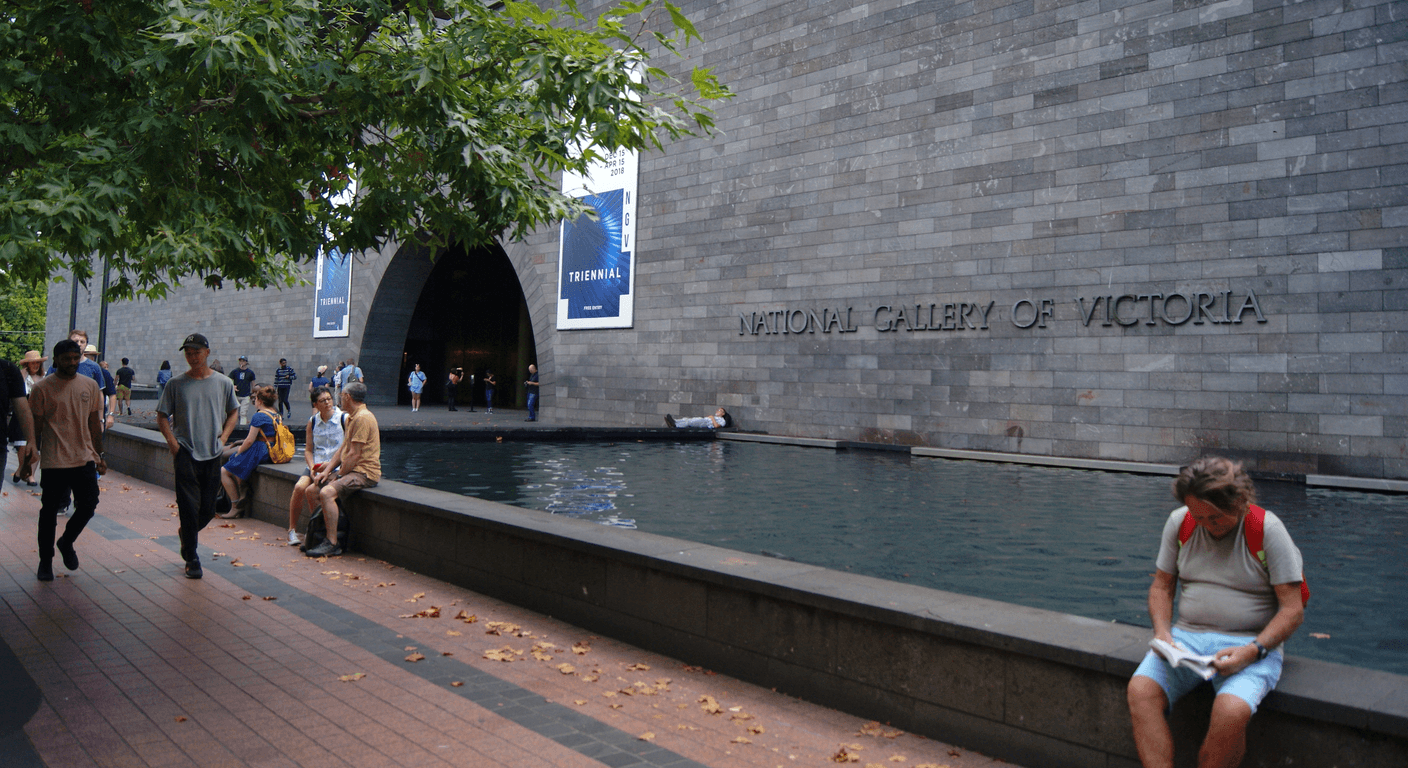
The NGV is Australia's oldest and most visited art museum, and its permanent international collection at NGV International on St Kilda Road is free to enter. The collection spans ancient Egyptian artefacts through to twentieth-century European and Asian works, and the Great Hall — with its famous stained-glass ceiling — is worth the visit on its own terms. NGV Australia, the federation square building, houses Australian and First Nations work and is also free.
St Kilda Road is well-served by trams from the CBD; the number 1, 3, 5, 6, 8, 16, 64, 67, and 72 all stop nearby, and trams within the Melbourne CBD free tram zone cost nothing. The gallery has step-free access at the main entrance, lifts between levels, and wheelchairs available to borrow. Plan at least two hours for the permanent collection; the building itself is large and the galleries spread across multiple floors.
Special exhibitions at the NGV are among the most ambitious in the country and do carry a ticket price — indicatively around $30 or more depending on the show, though prices change and you should confirm on the NGV website before visiting. The permanent collection alone, however, gives you a full and satisfying visit without spending a cent.
Sydney: Art Gallery of New South Wales (AGNSW)
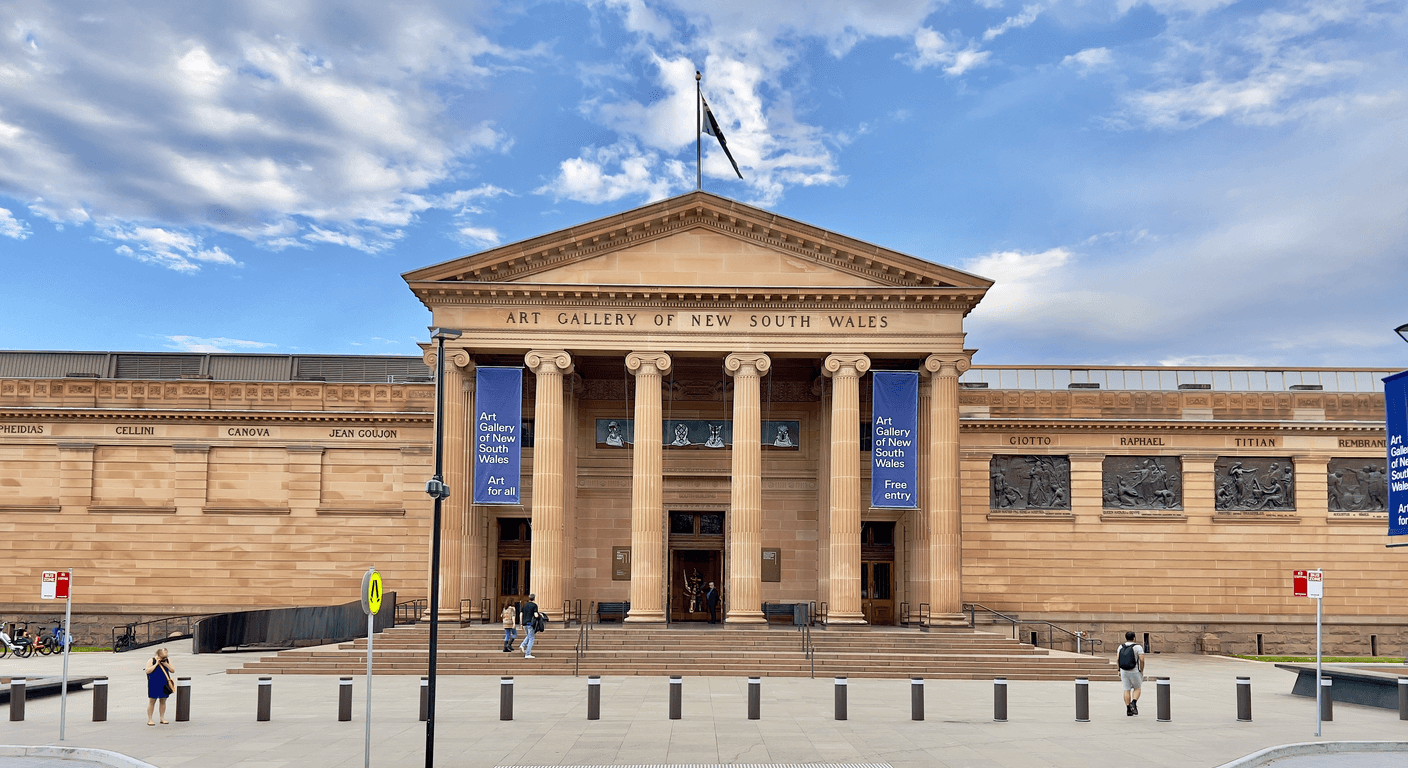
The Art Gallery of New South Wales sits in the Domain parklands, a short walk or free shuttle from the CBD. The original 1897 building has been joined by the Sydney Modern Project — a major new building that opened in late 2022 — which doubled the gallery's space and added significant new galleries for Australian, Aboriginal and Torres Strait Islander, Asian, and international art. The permanent collection across both buildings is free.
Getting there without a car is straightforward: buses serve Art Gallery Road, or you can walk through the Domain from St James or Martin Place stations on the Sydney Metro and train network. The new building is designed with accessibility in mind, with lifts and step-free pathways throughout. The original building has more uneven heritage spaces, though accessible routes exist — it is worth checking the accessibility map on the gallery's website before your visit if mobility is a consideration.
The AGNSW permanent collection is particularly strong in Australian colonial and twentieth-century work, and the Yiribana Gallery for Aboriginal and Torres Strait Islander art is one of the most significant of its kind in the country. Allow a generous half-day if you want to move through both buildings without rushing.
Brisbane: Queensland Art Gallery | Gallery of Modern Art (QAGOMA)
QAGOMA is actually two connected buildings on the South Bank of the Brisbane River — the Queensland Art Gallery (QAG), which opened in 1982, and the Gallery of Modern Art (GOMA), which opened in 2006. Together they form one of the largest gallery complexes in Australia, and the permanent collection across both is free. GOMA in particular has a strong contemporary and Asia-Pacific focus that sets it apart from the other state galleries.
South Bank is easy to reach by train (South Bank station is a short walk), by ferry on the CityCat service, or on foot across the Kurilpa or Goodwill bridges from the CBD. Both buildings are fully accessible with lifts and flat internal pathways. There is a café at each building, and the riverfront location means you can break up a gallery visit with time outside at the South Bank Parklands — a pleasant option in cooler months.
QAGOMA hosts the Asia Pacific Triennial of Contemporary Art (APT), one of the most significant recurring exhibitions in the southern hemisphere. The APT runs in ticketed form for major exhibitions but the permanent collection is always free. Check the QAGOMA website for what is currently showing and whether any ticketed components apply to your visit.
Perth, Adelaide, Hobart, and Darwin: smaller capitals, serious collections
The Art Gallery of Western Australia (AGWA) sits in the Perth Cultural Centre in Northbridge, a short walk from Perth Underground station. Its permanent collection covers Australian, Aboriginal, and international work, and entry is free. AGWA has undergone significant renewal work in recent years; the building is accessible and well-laid-out, and the Cultural Centre precinct also includes the WA Museum Boola Bardip and the State Library, making it a full day of free culture if you want it. Confirm current access and any ticketed exhibitions at agwa.net.au.
The Art Gallery of South Australia (AGSA) on North Terrace in Adelaide is one of the older state galleries and has a particularly strong collection of Australian decorative arts and crafts alongside its fine art holdings. North Terrace is Adelaide's cultural boulevard — the South Australian Museum and State Library are next door — and the gallery is accessible by free city trams. AGSA's permanent collection is free; check agsa.sa.gov.au for current exhibitions. In Hobart, the Tasmanian Museum and Art Gallery (TMAG) on Dunn Place in the CBD combines natural history, Aboriginal cultural heritage, and a significant art collection under one roof. It is free to enter and sits within walking distance of Salamanca Place. TMAG is a smaller venue than the mainland state galleries but the collection is thoughtfully curated and the building is genuinely interesting — partly housed in a nineteenth-century bonded store. See tmag.tas.gov.au for details.
In Darwin, the Museum and Art Gallery of the Northern Territory (MAGNT) at Bullocky Point, Fannie Bay, is the standout cultural venue in the Top End. It is a short drive or bus ride from Darwin CBD — not a walkable distance for most visitors — but the collection of Aboriginal and Torres Strait Islander art, including an exceptional Tiwi Islands collection, is nationally significant. Entry to the permanent collection is free. MAGNT also holds the Cyclone Tracy memorial display, which is a sobering and well-presented piece of Northern Territory history. Check magnt.net.au for current hours and any access notes, and confirm transport options via the Darwin Bus Service.
Canberra: National Gallery of Australia (NGA)
The National Gallery of Australia on Parkes Place in Canberra's Parliamentary Triangle holds the country's national art collection, and the permanent collection galleries are free to enter. The NGA has the most comprehensive collection of Australian art anywhere in the country, including a dedicated Aboriginal Memorial installation — 200 hollow log coffins made by Ramingining artists — that is quietly one of the most affecting works of art in any Australian gallery.
Canberra is not the easiest capital to navigate without a car, but the NGA is reachable by bus from the city centre (check transport.act.gov.au for current routes). The gallery is fully accessible, with step-free entry, lifts, and mobility aids available to borrow. There is a café on site, and the Sculpture Garden alongside the building is free to walk through and pleasant in good weather. Allow at least two to three hours for the permanent collection; the building is large and the galleries are spread over multiple levels.
The NGA runs major ticketed special exhibitions — indicatively from around $25, though prices vary and you should confirm at nga.gov.au. The permanent collection, however, is substantial enough that many visitors find a full day passes without touching a ticketed show. For a solo traveller with a serious interest in Australian and First Nations art, Canberra and the NGA make a very worthwhile overnight trip from Melbourne or Sydney.
Practical tips for gallery visits as an older or solo traveller
Pacing matters more than coverage. Every gallery on this list is larger than it looks on a map, and trying to see everything in one visit is a reliable way to end the day exhausted rather than satisfied. A useful approach is to identify one or two areas of the collection that genuinely interest you before you arrive, spend proper time there, and treat anything else as a bonus. Most galleries publish their floor plans online — worth downloading before you go.
Weekday mornings are generally the quietest time at all of these venues, which matters if you find crowds tiring or if you use a mobility aid. School holidays bring families and groups; opening weekend of a major ticketed exhibition brings queues. If you have flexibility in your travel dates, mid-week visits in term time are noticeably calmer. Several galleries also offer guided tours of the permanent collection at no extra cost — worth checking on each gallery's website as these are often run by experienced volunteer guides and can give you a much richer experience than walking through alone.
For solo female travellers, all of these galleries are safe, well-staffed public spaces. Gallery staff and volunteers are generally helpful and used to assisting visitors of all ages and mobilities. If you have a specific access need — seating in a particular gallery, a quieter entry time, assistance with stairs — it is always worth calling or emailing the gallery in advance. Most have a dedicated access or visitor services contact on their website.
Key takeaways
- Every Australian state and territory capital has at least one major public gallery where the permanent collection is free to enter.
- Special and ticketed exhibitions run alongside free permanent collections at most venues — always check the gallery's website before your visit to understand what is free and what is not.
- The NGV in Melbourne, AGNSW in Sydney, and NGA in Canberra hold the largest collections, but QAGOMA in Brisbane and MAGNT in Darwin have distinctive strengths in Asia-Pacific and Aboriginal art respectively.
- Weekday mornings in school term are the quietest time to visit most of these galleries, which makes a real difference for older travellers who prefer a calmer pace.
- All galleries listed are accessible with step-free entry and lifts, though it is worth checking each gallery's accessibility page for specific detail before travelling.
- A solo visit to a public gallery — at your own pace, with no social obligation — is one of the most cost-effective and genuinely pleasurable ways to spend a day in any Australian capital city.
Recommended partners and links
Indicative prices only — always confirm with the operator before booking.
Frequently asked questions
Are Australia's major public galleries really free to enter?
Yes — the permanent collections at the NGV (Melbourne), AGNSW (Sydney), QAGOMA (Brisbane), AGWA (Perth), AGSA (Adelaide), TMAG (Hobart), NGA (Canberra), and MAGNT (Darwin) are all free to enter. Ticketed special exhibitions run alongside the free collections at most venues; always check the gallery's own website before your visit to confirm what is currently free and what requires a ticket.
Which Australian gallery has the best collection of Aboriginal and First Nations art?
The National Gallery of Australia in Canberra holds the most comprehensive national collection of Aboriginal and Torres Strait Islander art, including the Aboriginal Memorial installation. MAGNT in Darwin has an exceptional Tiwi Islands collection. QAGOMA in Brisbane is particularly strong in contemporary Aboriginal and Asia-Pacific work. All three are worth visiting if this area of art matters to you.
Are these galleries accessible for older travellers with mobility considerations?
All galleries listed in this guide have step-free entry, lifts, and accessible bathrooms. Mobility aids such as wheelchairs are available to borrow at most venues. The level of accessibility varies in older heritage buildings, so it is worth checking the specific accessibility page on each gallery's website before your visit if you have particular needs.
What is the best time of day and week to visit a major public gallery as a senior traveller?
Weekday mornings during school term are generally the quietest time at all of Australia's major public galleries. Weekends and school holidays are busier, and opening days of major ticketed exhibitions can bring crowds. If you have flexibility, a Tuesday or Wednesday morning visit gives you the most comfortable experience.
Do any of these galleries offer free guided tours of the permanent collection?
Several do — including the NGV, AGNSW, and NGA — though tour schedules change. Check the 'visit' or 'tours' section of each gallery's official website before you go, as free volunteer-led tours of the permanent collection are often available on specific days and times and can significantly enrich your visit.
Got a tip, a price update or a story from this route? The community would love to hear it.
Share your views on our Facebook page— Seniors and Solo Traveller Stories
- National Gallery of Victoria
- Art Gallery of New South Wales
- Queensland Art Gallery | Gallery of Modern Art (QAGOMA)
- Art Gallery of Western Australia (AGWA)
- Art Gallery of South Australia (AGSA)
- Tasmanian Museum and Art Gallery (TMAG)
- National Gallery of Australia (NGA)
- Museum and Art Gallery of the Northern Territory (MAGNT)
- Public Transport Victoria (PTV) — for Melbourne transport
- Transport Canberra — ACT bus services