Sydney's major cultural institutions offer a genuinely rewarding day out without touching your wallet, particularly welcome on a humid summer afternoon or a grey winter's day. The Art Gallery of New South Wales, the Australian Museum, and the State Library of NSW sit within easy reach of Central Station and between them cover millennia of art, natural history, and literary heritage. This guide walks you through each venue, the practical detail that matters for travellers in their sixties and seventies, and how to pace a full day comfortably.
Why this particular day works so well for travellers over 60
A culture day built around free permanent collections is not a compromise — it is simply a smarter way to travel. Sydney's cultural precinct around the Domain and College Street has been designed over many decades to welcome the public without a gate fee for its core offerings, which means you can linger as long as you like, step outside when the air conditioning gets too cold, and return without worrying about getting value from a ticket.
For couples travelling together, or for anyone hosting a friend or family member in Sydney, this itinerary is particularly practical when the weather turns. Sydney summers can be genuinely oppressive, and the reading rooms and gallery halls of these three institutions are cool, quiet, and filled with things worth looking at slowly. The pacing suits travellers who prefer depth over distance — you are not rushing between suburbs or worrying about timetables.
The three venues are not identical in character, which keeps the day interesting. The Art Gallery of NSW leans toward the contemplative and the beautiful. The Australian Museum is more active in its storytelling and has a strong connection to First Nations and Pacific cultures. The State Library reading rooms offer something quieter still — a chance to sit with history in a building that has been serving readers since the nineteenth century.
Getting there: train and bus access from Central Station
Central Station is the most practical starting point for visitors arriving from interstate or from Sydney's outer suburbs. From Central, the Art Gallery of New South Wales is reachable by bus along College Street — the 311 and several other routes service this corridor — or by a gentle walk of roughly 15 to 20 minutes through Hyde Park, which is flat and shaded along the central path. The walk through Hyde Park is pleasant in mild weather, though on very hot or wet days the bus is the sensible choice.
The Australian Museum on College Street is a short distance south of the Art Gallery, making it straightforward to visit both on the same day without retracing your steps unnecessarily. The State Library of NSW sits on Macquarie Street, close to Martin Place and accessible from St James Station on the City Circle line — one stop from Museum Station, which itself is directly beneath Hyde Park. If you are using an Opal card, tapping on and off for short hops is straightforward; Transport for NSW's trip planner at transportnsw.info will give you real-time options based on your starting point.
Accessibility note: all three venues have step-free entry at their main or secondary entrances, with lifts to upper levels. That said, the terrain around the Domain and College Street involves some gentle gradients. If walking any distance on uneven footpaths is a concern, catching a bus or rideshare directly to each venue is entirely reasonable and will not add much to the day's cost. Confirm current accessible entry points with each venue before your visit, as building works can occasionally redirect access temporarily.
The Art Gallery of New South Wales: how to make the most of the free collection
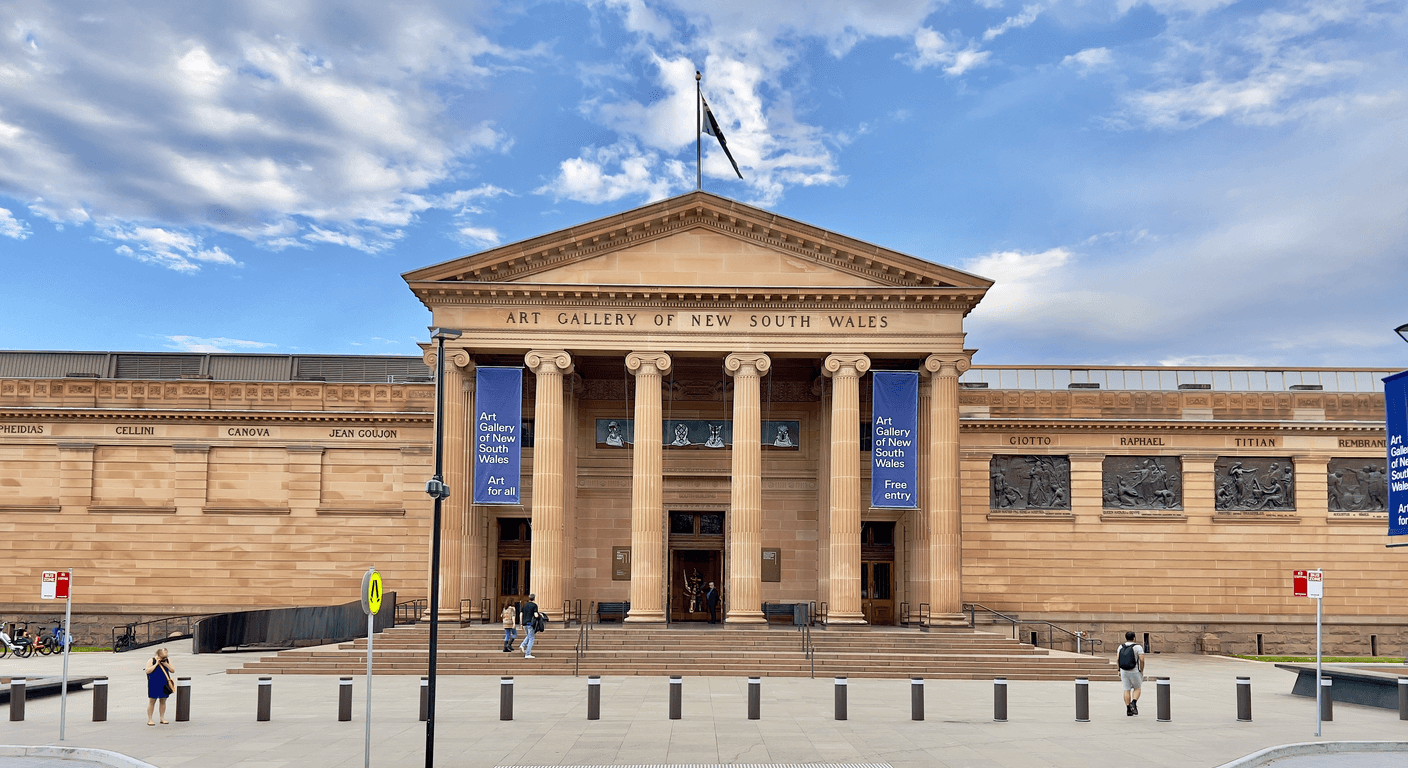
The Art Gallery of NSW on Art Gallery Road in the Domain holds one of Australia's most significant permanent collections, and access to those galleries costs nothing. The collection spans Australian art from the colonial period through to contemporary practice, an Asian art wing, and European works going back centuries. The Sydney Modern building, connected to the original Grand Courts building by an underground Art Passage, added significant space for twentieth and twenty-first century works and includes a rooftop terrace with harbour views.
For visitors who want to avoid the busiest periods, arriving when the gallery opens — currently at 10am on most days, though you should confirm current hours on the gallery's website — gives you the quietest experience in the Grand Courts. The older building has high ceilings, wide galleries, and plenty of seating on benches throughout. The Sydney Modern building also has rest seating, though its open-plan design can feel busier. The Yiribana Gallery, dedicated to Aboriginal and Torres Strait Islander art, is worth setting aside real time for — it is one of the most considered permanent presentations of First Nations work in the country.
Check the gallery's website before your visit to understand which exhibitions are part of the free permanent collection and which require a ticket. Ticketed special exhibitions rotate, and it is genuinely easy to walk in thinking something is free when it carries an entry charge. The gallery's café overlooks the Domain and is a comfortable spot to rest mid-morning, though prices are on the higher side — budget-friendly alternatives are noted further in this guide.
The Australian Museum: what is free and what is ticketed
The Australian Museum on College Street, a short walk south from the Art Gallery, is one of the oldest natural history and cultural museums in the Asia-Pacific region. Its collection covers natural science, First Nations cultures, Pacific cultures, and world cultures, and the building itself — with its grand sandstone exterior — has a presence worth pausing to appreciate before you go inside.
It is important to check the Australian Museum's website at australian.museum before your visit to understand the current entry structure. As of 2025, the museum operates a mixed model in which some permanent galleries are accessible without charge while others, particularly major travelling or featured exhibitions, carry an entry fee. The breakdown can shift over time, so confirming what is free on the day you plan to visit avoids any surprises at the door. The Pacific Cultures and First Nations galleries have historically been among the stronger free offerings.
Accessibility at the Australian Museum is generally solid — there are lifts throughout, and the main entrance on College Street has step-free access. Rest seating is available in several gallery areas. The museum has a café on the ground floor, and there are lockers near the entrance if you are carrying bags and want to move more freely through the galleries. For couples, the museum works particularly well as a second stop after the Art Gallery — the contrast in tone and subject matter keeps the day varied.
The State Library of NSW: reading rooms worth visiting as a destination in themselves
The State Library of NSW on Macquarie Street is less frequently mentioned in travel guides for visitors, which is a genuine oversight. The Mitchell Reading Room, with its ornate ceiling and long timber reading tables, is one of the most beautiful interior spaces in Sydney and is open to the public. You do not need a library card to enter and look around, though you will need to register if you want to access the collections.
The library also holds a program of free exhibitions drawn from its vast collection of maps, photographs, manuscripts, and historical documents relating to Australian history. These change regularly and are often genuinely absorbing for anyone with an interest in colonial history, exploration, or the social history of New South Wales. The gallery spaces off the main foyer are worth checking as you enter. Confirm current exhibition details and opening hours at sl.nsw.gov.au before your visit.
The building is step-free at the main Macquarie Street entrance and has lift access to upper levels. The reading rooms are quiet by nature — they are working research spaces — which makes them a particularly good choice if you want to sit down somewhere calm and cool for an extended period. There is a café in the library building, and the surrounding Macquarie Street precinct, including the Royal Botanic Garden directly across the road, offers gentle walking if you want fresh air between venues.
Where to have lunch without spending a lot
The area around the Domain and Hyde Park has a range of options for a mid-day break that will not derail a budget-conscious day. The Hyde Park Barracks café on Macquarie Street, near the State Library, offers a pleasant setting in the courtyard of a UNESCO World Heritage-listed convict building — worth checking opening hours and current prices directly, as hospitality tenancies in heritage sites can change. The nearby St James precinct and Elizabeth Street have several casual lunch spots including bakeries and sandwich shops that are considerably more affordable than the gallery cafés.
For travellers who prefer to bring lunch, the Domain itself — the parkland surrounding the Art Gallery — has picnic tables and shaded seating, and Hyde Park has plenty of benches under its grand fig trees. On a mild day, a simple packed lunch in Hyde Park between the Art Gallery and the Australian Museum is one of the more pleasant ways to spend an hour in central Sydney. There are also several food courts in the Pitt Street and George Street area, accessible by a short walk or bus, if you prefer more variety.
Indicative lunch costs in the area range from around $15 to $25 for a casual café meal, though this will vary — always confirm current prices at the venue. Tap water is freely available at all three cultural institutions, and staying hydrated on warm days is important, particularly if you are moving between buildings in summer heat.
Pacing the day: a practical suggested order
A sensible order for this day is to begin at the Art Gallery of NSW when it opens, allowing an hour and a half to two hours for the permanent collection without rushing. From there, walk the short distance south along College Street to the Australian Museum for a mid-morning to early afternoon visit — another one to one and a half hours depending on your pace and interest. Take lunch either at one of the museum's internal options, in Hyde Park, or at a nearby café before making your way to the State Library in the early afternoon.
The State Library works well as a final stop because it is quieter and more restful in character — a good way to wind down the day before heading back to your accommodation. St James Station, one stop from Museum Station on the City Circle, is a short walk from the library on Elizabeth Street. If you are returning to the southern suburbs or to Central, Museum Station is also walkable from the library via Hyde Park.
Build in rest time deliberately. Each venue has seating throughout, and there is no merit in pushing through galleries when your feet or back are telling you to sit down. The best way to experience a day like this is slowly, with room to stop in front of something that catches your attention and stay there as long as you like. That is, after all, one of the real advantages of a free entry day — there is no sense of needing to extract value from a ticket.
Key takeaways
- The Art Gallery of NSW's permanent collection is free to enter, though special exhibitions carry a separate ticket price — check the website before you go.
- The Australian Museum operates a mixed free and ticketed model; confirm which galleries are free on the day of your visit at australian.museum.
- The State Library of NSW's Mitchell Reading Room is open to the public and is one of Sydney's most beautiful interior spaces at no cost.
- All three venues have step-free entry and lift access, making them workable for travellers with mobility considerations.
- Central Station and St James Station on the City Circle line give easy, affordable train access to the full itinerary.
- A full culture day across all three venues is achievable without any entry costs, making it one of the most rewarding free days available in central Sydney.
Recommended partners and links
Indicative prices only — always confirm with the operator before booking.
Frequently asked questions
Is the Art Gallery of NSW completely free to enter?
The permanent collection galleries at the Art Gallery of NSW are free to enter. Special and ticketed exhibitions run alongside the permanent collection and carry a separate entry fee. Always check the gallery's website at artgallery.nsw.gov.au to confirm what is free before your visit, as the ticketed program changes regularly.
Does the Australian Museum charge for entry?
The Australian Museum uses a mixed model where some permanent galleries are free and others, including major featured exhibitions, require a paid ticket. The balance can change over time. Check the current entry details at australian.museum before you visit to know exactly what you will and will not need to pay for.
Is the State Library of NSW open to visitors who are not researchers?
Yes. Members of the public are welcome to visit the State Library of NSW, including the Mitchell Reading Room, without needing a library card or research appointment. Free public exhibitions drawn from the library's historical collections are also regularly on display. Check current opening hours and exhibition details at sl.nsw.gov.au.
How accessible are these venues for travellers with limited mobility?
All three venues — the Art Gallery of NSW, the Australian Museum, and the State Library of NSW — have step-free entry points and lift access to upper levels. Rest seating is available throughout each building. It is worth confirming current accessible entry arrangements directly with each venue before your visit, as temporary building works can occasionally affect access routes.
Can you do all three venues in one day without feeling rushed?
Yes, with sensible pacing. Allowing one to two hours at each venue, taking a proper lunch break, and building in seated rest time throughout the day makes all three venues manageable in a single day. Starting at the Art Gallery when it opens and finishing at the State Library in the early afternoon is a natural and unhurried sequence.
Got a tip, a price update or a story from this route? The community would love to hear it.
Share your views on our Facebook page— Seniors and Solo Traveller Stories