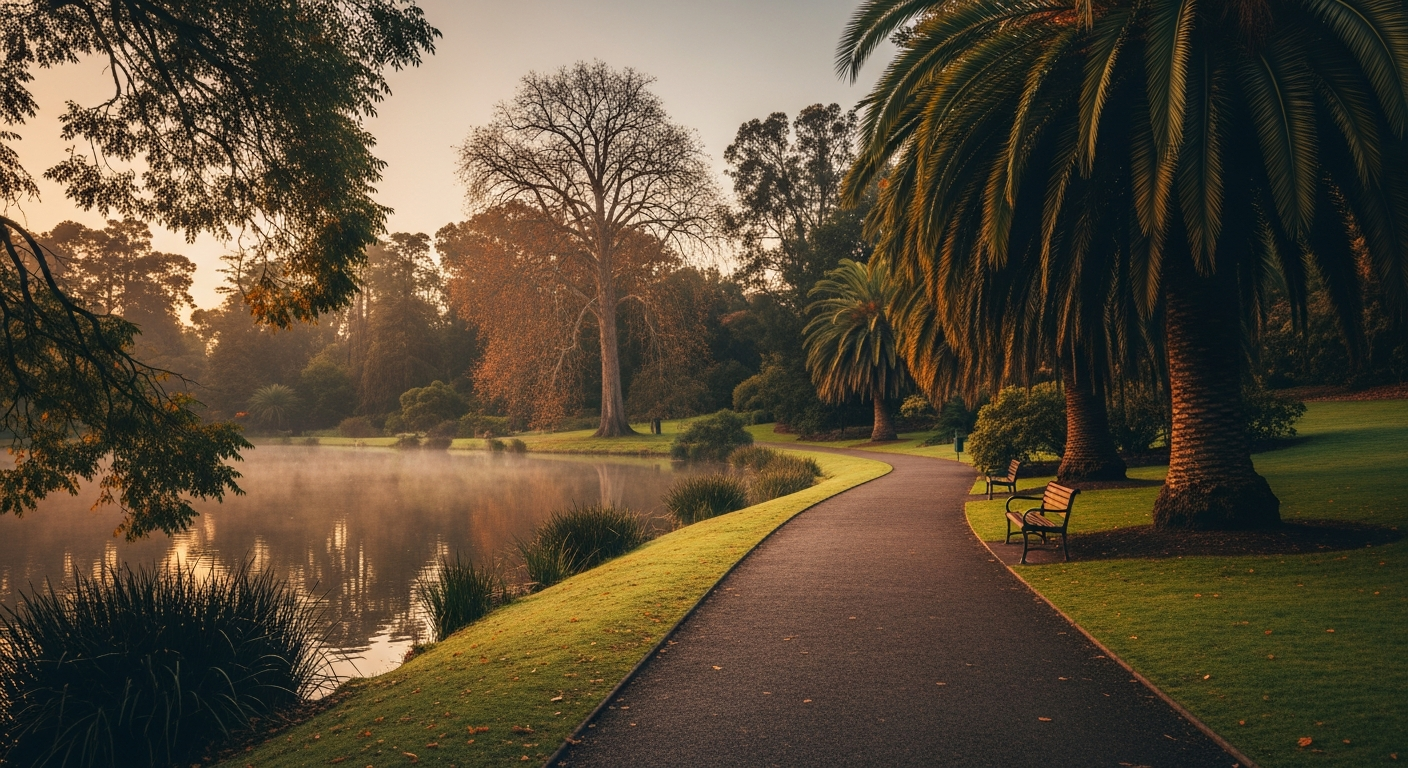
The Royal Botanic Gardens Melbourne in July offers something that the warmer months rarely do: genuine quiet. The crowds thin, the paths open up, and features like Guilfoyle's Volcano and the Fern Gully reveal a slower, more contemplative side of one of Melbourne's great green spaces. For travellers over 60 who prefer to walk at their own pace without navigating school groups and weekend picnickers, winter is worth considering.
Why July is worth considering at the Botanic Gardens
There is a particular kind of pleasure in visiting a popular place when most people have decided to stay home. The Royal Botanic Gardens Melbourne, which draws well over a million visitors a year, becomes a noticeably different place in July. The wide central lawn holds only a handful of walkers at a time. The paths around the ornamental lake are unhurried. You can stop at a bench, look out over the water, and not feel that you are holding anyone up.
For travellers over 60 — especially those who find summer crowds exhausting or who simply prefer to move at a reflective pace — this seasonal shift matters. Winter in Melbourne is mild by most standards: July daytime temperatures typically sit between 8 and 14 degrees Celsius. A warm layer, a weatherproof jacket, and comfortable walking shoes are all you need. The garden itself is free to enter every day of the year.
Be honest with yourself about what July looks like. The deciduous trees — European elms, oaks, and planes — are bare or nearly so, and some of the ornamental beds that look lush in spring appear sparse now. That is the trade-off, and it is worth naming plainly. What you gain in return is solitude, clear sightlines through the tree canopy, and a garden that feels genuinely yours for a few hours.
Getting there: tram access and arrival options
The gardens sit on the south bank of the Yarra River, roughly two kilometres from the Melbourne CBD. For most visitors arriving from the city, the most straightforward tram option is Route 3 or Route 5 from Swanston Street, alighting at the Domain Interchange stop on St Kilda Road. From there, the Gate D entrance on Alexandra Avenue is a short, flat walk of around two to three minutes. Tram routes and stop details can be confirmed through the Public Transport Victoria website at ptv.vic.gov.au.
Victorian seniors holding a Seniors Myki card travel free on metropolitan trams, trains, and buses at any time — confirm your eligibility and card activation through PTV before travel. For those arriving by car, parking is available along Alexandra Avenue and nearby side streets, though it is metered and fills on weekday lunchtimes despite the season. The gardens have multiple gates; Gate A on Birdwood Avenue and Gate D on Alexandra Avenue are both accessible and commonly used.
If you are combining the gardens with a broader city day, the walk from Flinders Street Station along the south bank of the Yarra and into the gardens via the Alexandra Avenue path takes roughly twenty minutes on flat ground and is a pleasant approach in itself. There are rest benches at intervals along this route.
A flat, accessible loop: where to walk and what to see
The gardens cover around 38 hectares and contain a network of sealed and compacted-gravel paths. Not every path is equally accessible in wet weather — some of the inner lawn edges and informal tracks can become soft after rain — but the main perimeter circuit and the paths around the central ornamental lake are sealed and manageable for most walkers. The full perimeter loop is roughly 4.5 kilometres; a shorter inner circuit focusing on the lake, the Guilfoyle's Volcano area, and the Fern Gully comes in at around 2.5 to 3 kilometres depending on detours.
For a comfortable winter walk without overextending, consider entering at Gate D, following the path along the edge of the ornamental lake toward the central lawn, then circling around toward Guilfoyle's Volcano before looping back through the Fern Gully and returning toward the Terrace cafe. This route keeps you on mostly sealed surfaces, includes the garden's two most interesting winter features, and allows for natural stopping points with seating along the way.
Wheelchairs and mobility aids can navigate the main sealed paths well. The Fern Gully section has some gentle inclines but is generally manageable; the path into Guilfoyle's Volcano involves a short climb to the viewing platform, which some visitors with mobility limitations may choose to skip in favour of viewing it from the base. The Royal Botanic Gardens Victoria website at rbg.vic.gov.au includes an accessibility map — worth checking before you visit if you have specific mobility considerations.
Guilfoyle's Volcano and the Fern Gully in winter
Guilfoyle's Volcano is one of those features that surprises people who have not visited before. It is a circular, banked reservoir built in the 1870s under director William Guilfoyle, planted with succulents, aloes, and drought-tolerant species that hold their colour and structure across the cooler months. In winter, when much of the garden has retreated, the Volcano is arguably at its most interesting — the architectural form of the mound is clearly visible without competing foliage, and the aloes in particular can be flowering in July, adding unexpected colour to an otherwise muted palette.
The Fern Gully sits in a shallow depression in the gardens' northern section and creates its own microclimate. Tree ferns, mosses, and shade-tolerant groundcovers remain lush throughout winter — this is one of the few spots in the gardens that looks genuinely green and alive in July, and it is worth the detour. The gully has an enclosed, sheltered quality that makes it a pleasant place to pause even on a cooler day. The sound of the water feature and the density of the planting give it a different atmosphere to the open lawns.
Both features have interpretive signage that gives historical and botanical context. The Gardens are in the process of updating signage across several precincts as part of their ongoing biodiversity and conservation work, so there is often something new to read even for repeat visitors. Take your time in these two spots — they are the heart of a worthwhile winter visit.
Free guided walks: what to know before you go
The Royal Botanic Gardens Melbourne offers free volunteer-guided walks on most days of the year. These typically depart from the Visitor Centre near Gate A on Birdwood Avenue. Walk times and availability vary by season and day — the most reliable way to confirm current winter schedules is to check the Events and Guided Walks section of the official website at rbg.vic.gov.au, or to phone the Visitor Centre directly. Walks are generally around 90 minutes and cover a circuit of the gardens with commentary on plant collections, history, and garden design.
For solo travellers, a guided walk offers something beyond information — it provides structure to the visit and a natural way to share the experience with other people without any prior planning. The volunteer guides are knowledgeable and tend to pitch their commentary for general adult audiences rather than specialist horticulturalists. No booking is required for the standard free walks; you simply meet at the Visitor Centre at the advertised time.
In winter, the guides often focus on the structural and historical aspects of the garden — the design of Guilfoyle's layout, the lake system, the significance of particular specimen trees — which can be more illuminating than a spring walk focused on flowering plants. If a guided walk is not running on your visit day, the Visitor Centre has printed self-guided walk maps available at no cost.
Warming up at the Terrace cafe
The Terrace at Royal Botanic Gardens sits near the centre of the gardens and is open daily. In winter it is one of the most agreeable spots in the gardens: the interior is warm, the views across the lawn are wide, and the pace is unhurried on a weekday. Coffee, tea, light meals, and cake are available. Indicative prices for coffee and a slice of something run around $6 to $14 in total, though you should confirm current pricing when you visit — cafe menus change seasonally.
For solo travellers, the Terrace is comfortable to visit alone. There are tables for one or two, and the setting is relaxed without the self-consciousness that some cafes can create for a person dining solo. It is a natural midpoint or endpoint for a winter walk — a place to sit for twenty or thirty minutes, look out at the garden, and let the morning settle.
There is also a smaller kiosk near the ornamental lake that operates on reduced hours in winter; do not rely on it being open. The Terrace is the safer choice for a guaranteed warm drink. Details on food and drink options across the gardens can be found at rbg.vic.gov.au under visitor information.
Practical notes for a comfortable winter visit
Dress in layers. Melbourne's July weather is variable — a morning that starts at 8 degrees can reach 13 or 14 by midday, and the open lawns of the gardens offer little wind protection. A lightweight down or fleece layer under a weatherproof outer shell is a reliable combination. Comfortable, grippy walking shoes are preferable to smooth-soled shoes, particularly if the paths are damp after overnight rain.
The gardens open daily at 7:30 am and close at sunset, which in July falls around 5:15 to 5:30 pm. There is no entry fee at any time of year for the general garden — the free entry applies to the full visit. Some special exhibitions or events within the gardens may carry a separate ticket cost; confirm on the website if you are planning around a specific event.
Carry a small water bottle and any medication you need, as the gardens are a self-contained environment and the cafe is the only food and drink option reliably open in winter. Toilets are located near the Visitor Centre and at several points along the main paths — the facilities are generally well-maintained. Mobile phone reception is good throughout the gardens.
Key takeaways
- The Royal Botanic Gardens Melbourne is free to enter every day of the year, including all of winter.
- July brings noticeably smaller crowds, making it one of the most peaceful times to walk the gardens at your own pace.
- Guilfoyle's Volcano and the Fern Gully are the two features that hold the most visual interest in winter, when many other beds appear sparse.
- Free volunteer-guided walks depart from the Visitor Centre near Gate A — check current times at rbg.vic.gov.au before your visit.
- Victorian seniors with a Seniors Myki card travel free on trams, making the journey from the city straightforward and low-cost.
- A comfortable inner circuit covering the lake, Guilfoyle's Volcano, and the Fern Gully is roughly 2.5 to 3 kilometres on mostly sealed, accessible paths.
Recommended partners and links
Indicative prices only — always confirm with the operator before booking.
Frequently asked questions
Is the Royal Botanic Gardens Melbourne free to visit in winter?
Yes. General entry to the Royal Botanic Gardens Melbourne is free every day of the year, including all winter months. Some special events or ticketed exhibitions held within the gardens may have a separate cost — check rbg.vic.gov.au for details of anything specific you plan to attend.
Are the paths at the Royal Botanic Gardens accessible for older visitors or those with mobility aids?
The main sealed paths around the ornamental lake and the central perimeter circuit are accessible for most walkers and for wheelchairs and mobility aids. Some informal grass paths and the short climb to the top of Guilfoyle's Volcano may not be suitable for all mobility levels. The Royal Botanic Gardens Victoria website at rbg.vic.gov.au provides an accessibility map.
What is actually worth seeing at the Royal Botanic Gardens in July?
Guilfoyle's Volcano is particularly worthwhile in winter — its succulent and aloe plantings hold structure and colour when much of the garden is bare, and aloes can be in flower in July. The Fern Gully remains lush year-round due to its sheltered microclimate. The ornamental lake and the open lawns offer a sense of space and quiet that is harder to find in the busier warmer months.
How do you get to the Royal Botanic Gardens by tram from the Melbourne CBD?
Tram routes 3 and 5 run along Swanston Street and St Kilda Road and stop at the Domain Interchange, which is a short flat walk from Gate D on Alexandra Avenue. Confirm current routes and stops through the Public Transport Victoria website at ptv.vic.gov.au. Victorian seniors with a Seniors Myki card travel free on metropolitan trams — confirm eligibility with PTV.
Are the free guided walks at the Royal Botanic Gardens available in winter?
Free volunteer-guided walks are offered on most days throughout the year, including winter. Walk schedules and departure times vary by season, so confirm current availability on the Royal Botanic Gardens Victoria website at rbg.vic.gov.au or by contacting the Visitor Centre near Gate A on Birdwood Avenue before your visit. No booking is required for the standard free walks.
Got a tip, a price update or a story from this route? The community would love to hear it.
Share your views on our Facebook page— Seniors and Solo Traveller Stories