Kangaroo Island sits off the Fleurieu Peninsula in South Australia and rewards travellers who pace themselves wisely. This guide walks through a realistic week on the island for couples aged 60 and over, with indicative AUD costs for the SeaLink ferry, car hire, accommodation, and wildlife encounters at Seal Bay and Flinders Chase National Park. It is candid about the island's limited public transport and the physical demands of a place where distances are longer than they first appear on a map.
Why Kangaroo Island suits the over-60 traveller — and what to know before you go
Kangaroo Island is not a resort destination. It is a working island of around 4,500 permanent residents, covering roughly 4,400 square kilometres, where sealed roads eventually give way to gravel, phone signal can vanish mid-sentence, and the wildlife is genuinely wild. That honesty is part of its appeal. For a couple in their sixties or seventies who have done the standard resort circuit, a week here feels grounded and real in a way that a beach hotel simply does not.
The island sits about 13 kilometres off the tip of the Fleurieu Peninsula. You reach it by the SeaLink vehicle ferry from Cape Jervis, a drive of roughly 110 kilometres south of Adelaide. The crossing takes approximately 45 minutes. There are no commercial flights that operate in the way a regular airline route would; the ferry is the practical way in for most visitors bringing a vehicle. That single access point shapes everything about how you plan the week.
The most important thing a prospective visitor needs to accept early is this: there is no meaningful public transport on Kangaroo Island itself. A handful of shuttle services exist, and SeaLink offers some package tours, but if you want to move freely between Kingscote, Penneshaw, Seal Bay, Vivonne Bay, and Flinders Chase, you need either a hire car or a pre-arranged guided coach itinerary. For couples where one partner is comfortable driving on quiet rural roads, self-driving is very manageable. For those who prefer not to drive, a guided small-group tour is genuinely worth the premium.
Getting there: the SeaLink ferry and what it realistically costs
The SeaLink ferry departs Cape Jervis multiple times daily. Schedules vary by season, so checking sealink.com.au well ahead of travel is essential. As an indicative guide only — and you should confirm all current prices directly with SeaLink — a return crossing for two adult passengers plus a standard small hire car has been in the range of roughly $500 to $700 return in recent years. Concession rates apply for seniors with eligible cards; ask SeaLink directly about current concession eligibility when booking.
The drive from Adelaide to Cape Jervis takes around 90 minutes to two hours depending on where in Adelaide you start and whether you stop along the Fleurieu Peninsula. It is a pleasant drive through McLaren Vale wine country and along the coast, and building in a lunch stop at Victor Harbor or Goolwa adds almost nothing to the travel time while breaking the journey nicely. The Cape Jervis terminal has basic facilities and parking if you choose to leave your car on the mainland and hire a vehicle on the island instead.
Hiring a car on the island rather than bringing one across can sometimes simplify the logistics and reduce the ferry cost, since passenger-only fares are lower. Kangaroo Island has a small number of car hire operators based in Kingscote and Penneshaw; availability is limited, particularly in peak season (December to February and school holidays), so booking ahead is not optional. A compact automatic hire car runs indicatively around $90 to $130 per day, though rates vary by operator and season. Confirm all current pricing before committing.
Where to stay: accommodation from $150 to $300 a night
Kingscote is the island's largest town and the most practical base for a couple who want to be close to a supermarket, a pharmacy, and a choice of restaurants. Accommodation here ranges from motel-style rooms at around $150 to $180 per night (indicative) to comfortable self-contained units at roughly $200 to $250. The advantage of a self-contained option is that you can buy groceries at the IGA in Kingscote and cook some meals yourself, which meaningfully reduces the daily budget on a week-long stay.
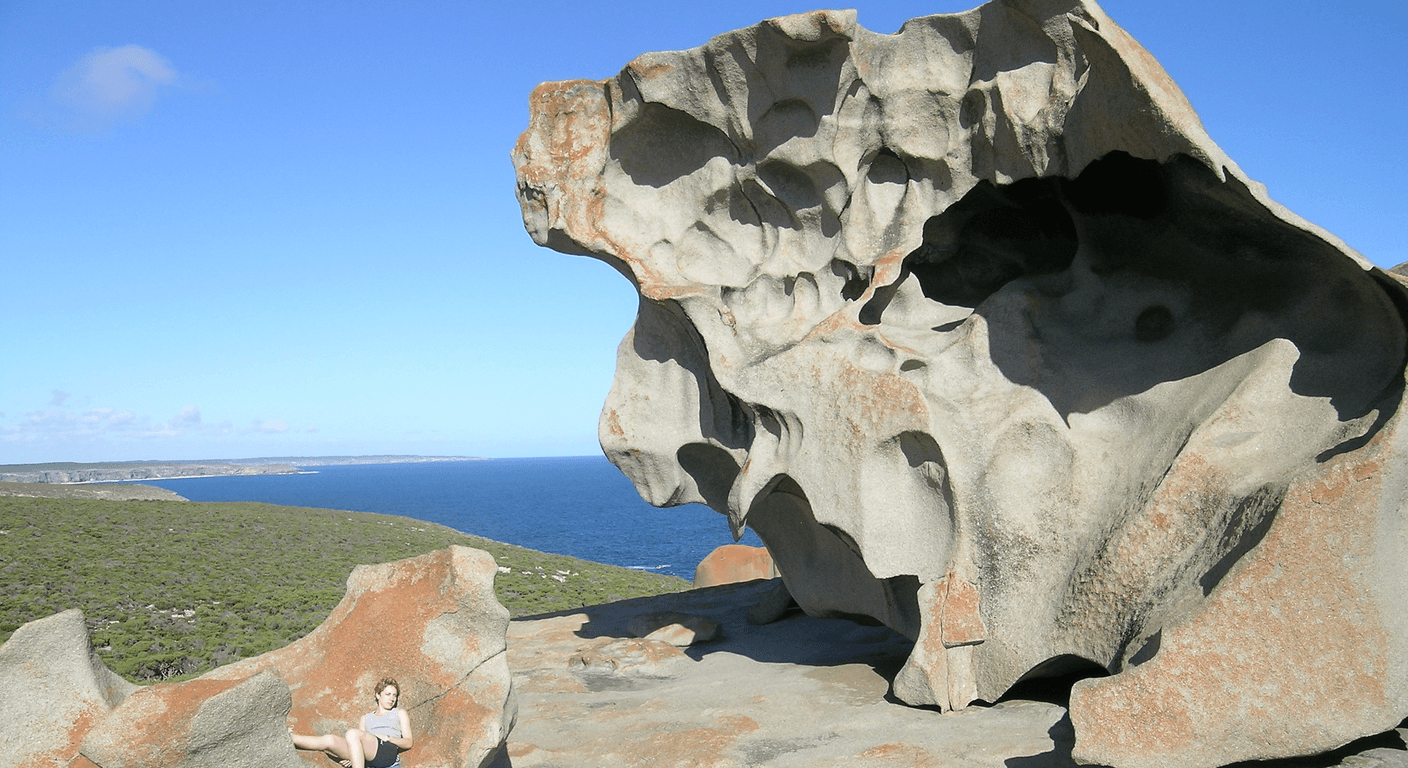
For those who want to be closer to the wildlife of the island's south and west, Flinders Chase and the Vivonne Bay area have a smaller number of cottages and eco-lodges, some of which sit within or adjacent to national park land. These tend to run from around $220 to $300 per night and often book out months ahead because supply is genuinely limited. The trade-off is proximity — you can be at Remarkable Rocks for dawn light without a long drive — but you will need to stock up on supplies before leaving Kingscote, as there are no large shops in the island's west.
A practical approach for a couple spending seven nights is to split the stay: three or four nights in Kingscote to settle in and explore the east of the island, then move to a cottage or lodge in or near Flinders Chase for the remaining nights. This reduces daily driving distances considerably and means neither partner is exhausted by the time the most spectacular scenery appears. Websites such as tourkangarooisland.com.au list accommodation options across the island with contact details for direct booking.
Day-by-day itinerary with indicative costs
Day 1 — Travel day: Drive from Melbourne or fly to Adelaide the previous day (a flight from Melbourne to Adelaide is indicatively $150 to $350 per person return, confirm with airlines). Drive to Cape Jervis, take the SeaLink ferry, and settle into Kingscote. Keep this day gentle; the ferry crossing and drive is enough. Budget indicatively: ferry (two passengers, car) roughly $500–$700 return, accommodation $150–$200. Day 2 — Kingscote and Emu Bay: Explore Kingscote's waterfront, the Penguin Centre (where little penguins return at dusk — entry fee applies, confirm at the centre), and drive north to Emu Bay beach. Flat, easy walking. Budget indicatively: $30–$50 for entry and meals. Day 3 — Seal Bay Conservation Park: This is the centrepiece of many visits. Ranger-guided beach walks allow you to observe Australian sea lions at close range on a guided tour. A National Parks Discovery Pass covers entry to multiple parks across the week and is worth calculating against single-entry fees; indicatively around $25–$35 per adult at time of writing, confirm at parks.sa.gov.au. The beach walk involves uneven sand; it is manageable for most, though anyone with significant knee or hip issues should speak to the ranger before booking. Allow a full morning. Budget indicatively: $50–$80 for two including park fees.
Day 4 — Transfer day and Vivonne Bay: Drive west, stopping at Vivonne Bay (rated among Australia's finest beaches and relatively flat for a short walk). Check in to western accommodation. This is a driving day of around 90 minutes; take it slowly and stop when you want to. Budget indicatively: accommodation $220–$300. Day 5 — Flinders Chase National Park: Remarkable Rocks and Admirals Arch are the two anchor experiences. Remarkable Rocks involves a short but uneven walk over granite; the surface is solid but not paved, and wind can be strong. Admirals Arch requires a boardwalk descent to a coastal arch — the boardwalk is accessible but has steps at the lower section. Allow a full day and bring your own lunch, as there are no cafes inside the park. Budget indicatively: park pass (already purchased) plus $20–$30 for provisions. Day 6 — Rest and local exploration: Build a slow day into the itinerary. The island's honey and eucalyptus oil producers (several are open to visitors), a quiet beach, or simply sitting on a verandah are all legitimate uses of a day. Over-scheduling is the most common mistake on Kangaroo Island. Budget indicatively: $20–$40 for tastings and a meal.
Day 7 — Return east and ferry: Drive back to Penneshaw, browse the town, and take the afternoon or evening ferry to Cape Jervis. Drive back to Adelaide or to your overnight stop on the Fleurieu. Day 7 costs are absorbed in the return ferry already accounted for. Total indicative budget for two people for seven nights, self-driving, mid-range accommodation: roughly $3,500 to $5,500 all up including transport, accommodation, park fees, fuel, and meals. This is indicative only and will vary considerably based on your accommodation choices, dining habits, and how much you drive. Fuel on the island is more expensive than Adelaide prices; fill up when you can.
Car hire versus guided tour: an honest comparison
Self-driving gives you complete flexibility over pace, which for a couple in their sixties or seventies is genuinely valuable. If one of you needs a slower morning, you take a slower morning. If you want to sit at Vivonne Bay for two hours watching waves, nobody is waiting. The island's sealed roads are quiet and in reasonable condition; driving is not difficult. The honest downside is that distances are longer than they look. Driving from Penneshaw to Flinders Chase and back in a single day is around 220 kilometres of round trip — manageable, but tiring if you are also walking and looking at wildlife.
Guided small-group tours, such as those offered by Kangaroo Island Odysseys or through SeaLink's own packages, remove the driving burden entirely. A knowledgeable local guide adds genuine context to wildlife encounters that a self-guided visit simply cannot replicate. The cost is higher — indicatively $1,200 to $2,000 per person for a multi-day guided itinerary, confirm current rates with operators — but for a couple where neither wants to drive on unfamiliar roads, or where one partner has limited mobility and benefits from a guide's assistance, the premium is worth considering seriously.
A middle path is to self-drive for the easier eastern days around Kingscote and Emu Bay, then join a day tour from your western accommodation for the Flinders Chase section. Some operators offer single-day guided experiences that can be booked independently of a full package. Check tourkangarooisland.com.au for a current list of licensed tour operators on the island.
Pacing wildlife encounters without overdoing it
The temptation on Kangaroo Island is to try to see everything in one sweep: sea lions in the morning, koalas at lunchtime, echidnas on the way to Remarkable Rocks, penguins at dusk. That itinerary exists, and it will leave you exhausted. Wildlife on this island is genuinely abundant — you will see kangaroos and wallabies grazing at the roadside almost every evening without trying — so the pressure to tick every encounter in a single day is worth resisting.
Seal Bay is best visited on a morning ranger walk before the midday heat builds. The guided beach walk takes around 45 minutes and involves walking on soft sand for several hundred metres. It is not strenuous by most standards, but anyone with balance concerns or difficulty on uneven ground should take a walking pole and inform the ranger before the tour begins. The rangers are experienced and genuinely helpful. Flinders Chase is best given an early start on a separate day; the park is large and the light on Remarkable Rocks is better before noon.
Koalas are easy to spot in the eucalyptus trees around Hanson Bay Wildlife Sanctuary and in several roadside reserves; this requires no particular physical effort, just slow driving and patience. Echidnas and Cape Barren geese appear regularly along roadsides in the island's interior. The evening penguin return at Kingscote is a short, flat, after-dark walk. Spreading these encounters across the week rather than concentrating them means each one feels unhurried and genuinely enjoyable rather than another box to tick.
Practical details: health, connectivity, and what to pack
Kangaroo Island has a hospital in Kingscote and a small number of general practitioners, but specialist medical services are limited and serious emergencies require evacuation to the mainland. Travel insurance that covers medical evacuation is strongly recommended for any visitor, and particularly sensible for those over 60. Carry an adequate supply of any prescription medication for the full trip plus a few days' buffer; the island's pharmacy in Kingscote has reasonable stock but cannot always fill unusual prescriptions quickly.
Mobile phone coverage on the island is patchy. Telstra has the broadest coverage but even on Telstra there are dead zones in the island's west and interior. Download offline maps before you leave Kingscote and do not rely on real-time navigation in Flinders Chase. If you use a medical device that requires regular connectivity or charging, plan accordingly. Most accommodation provides reliable power, but remote cottages may run on solar with limited evening capacity.
Pack layers regardless of the season. The island's southern coast faces the Southern Ocean and wind is a constant; even on a warm summer day, the clifftops at Admirals Arch can be genuinely cold. Sturdy walking shoes with ankle support are more practical than sandals for any of the park walks. A wide-brimmed hat and high-SPF sunscreen are not optional — the UV index on the island is high and shade at many outdoor sites is limited.
Key takeaways
- There is no public transport on Kangaroo Island; a hire car or pre-arranged guided tour is essential for any meaningful exploration.
- The SeaLink vehicle ferry from Cape Jervis is the practical entry point — indicative return fares for two passengers and a car run roughly $500–$700; confirm current pricing at sealink.com.au.
- Accommodation runs indicatively from around $150 per night for motel-style rooms in Kingscote to $300 per night for eco-lodges near Flinders Chase; book well ahead as supply is limited.
- Splitting the stay — a few nights in Kingscote, then a few nights in the island's west — reduces daily driving distances and makes the week far less tiring.
- A National Parks Discovery Pass covers Seal Bay and Flinders Chase entry and is worth comparing against individual entry fees; confirm current pricing at parks.sa.gov.au.
- A full indicative week for two people, self-driving with mid-range accommodation, runs roughly $3,500 to $5,500 all up — treat this as a planning guide only and confirm all current costs before travelling.
Recommended partners and links
Indicative prices only — always confirm with the operator before booking.
Frequently asked questions
Do you need a car to visit Kangaroo Island?
Yes, in practical terms you do. There is no scheduled public bus service on Kangaroo Island. Your options are to bring your own vehicle on the SeaLink ferry, hire a car on the island (book well ahead as availability is limited), or join a guided tour that provides transport. Relying on taxis or rideshare is not realistic for reaching Seal Bay or Flinders Chase.
How long is the SeaLink ferry crossing to Kangaroo Island?
The SeaLink vehicle ferry runs between Cape Jervis on the Fleurieu Peninsula and Penneshaw on Kangaroo Island. The crossing takes approximately 45 minutes. Cape Jervis is roughly 110 kilometres south of Adelaide, about a 90-minute to two-hour drive. Current timetables and fares are at sealink.com.au.
Is Kangaroo Island accessible for travellers with mobility limitations?
Some parts of the island are accessible and some are not. The ranger-guided beach walk at Seal Bay involves soft, uneven sand for several hundred metres; it is manageable for many but not for everyone. Remarkable Rocks in Flinders Chase involves walking on uneven granite. The Admirals Arch boardwalk has steps at the lower section. Kingscote township is relatively flat. Travellers with significant mobility concerns should contact Parks SA and individual operators directly before booking to discuss specific needs.
What is the best time of year to visit Kangaroo Island for older travellers?
Autumn (March to May) and spring (September to November) are generally the most comfortable seasons. Summer (December to February) can bring extreme heat and fire risk, and is also the busiest period with the highest accommodation prices. Winter is mild but some days are cold and windy on the southern coast. Wildlife is present year-round.
Are there senior or concession discounts on the SeaLink ferry and park entry fees?
SeaLink does offer concession pricing for eligible seniors; check current eligibility and rates directly at sealink.com.au when booking. Parks SA also has concession rates for national park entry fees; confirm current details at parks.sa.gov.au. Always ask about concession pricing at the point of booking rather than assuming it applies automatically.
Got a tip, a price update or a story from this route? The community would love to hear it.
Share your views on our Facebook page— Seniors and Solo Traveller Stories