Queen Victoria Market's Winter Night Market runs on Wednesday evenings through July and August, offering free entry, live music, and a wide spread of hot food stalls in the heart of Melbourne. For couples who enjoy a relaxed evening out without the pressure of bookings or entry fees, it fits the bill — provided you dress warmly and time your arrival to avoid the thickest crowds. This guide covers everything a traveller aged 60 and over needs to know to get there comfortably, eat well, and head home without worn-out legs.
What is the Winter Night Market at Queen Victoria Market?
Every Wednesday evening through July and August, Queen Victoria Market transforms its sheds and open areas into a winter night market. Entry is free, which is reason enough to go — but what keeps people coming back is the combination of live music, a genuine variety of hot food, and the particular atmosphere of a heritage market lit up on a cold Melbourne night.
The market has been running this winter format for a number of years and has settled into a reliable rhythm. Expect around 100 stalls covering street food from a wide range of cuisines, warming drinks including mulled wine and hot chocolate, and a central stage with live acts. It is not a quiet, boutique affair — it draws a genuine crowd — but for a couple who enjoy being out among people without the formality of a restaurant, it works very well.
The Winter Night Market is a separate event from the regular daytime market. Stall holders are a mix of Queen Victoria Market's permanent traders and guest vendors brought in specifically for the evening. Check the Queen Victoria Market website at qvm.com.au closer to your visit to see the current stall list and confirmed dates for the season.
Getting there: tram access and the easiest approach for older travellers
Queen Victoria Market sits on the corner of Elizabeth and Victoria Streets in Melbourne's CBD, roughly a ten-minute walk from the top of the Bourke Street Mall. For most visitors coming from the city, the tram is the most practical option. Tram Route 19 (North Coburg) runs along Elizabeth Street and stops directly at the market — alight at Stop 7, Queen Victoria Market. Route 57 (West Maribyrnong) along Flinders Street and Elizabeth Street also connects well. Confirm current routes and your specific stop on the PTV Journey Planner at ptv.vic.gov.au before you travel.
If you are travelling from the suburbs by train, Melbourne Central Station is around a ten-minute walk. That walk involves some footpath gradient and crossing busy intersections, so if either of you has any knee or hip concerns, the tram from the city is the better option — it drops you closer and keeps the walking to a minimum. There is no dedicated parking on site, and the surrounding streets are heavily congested on Wednesday evenings, so driving is genuinely not recommended.
The main pedestrian entrances to the night market are on the Elizabeth Street side and the Victoria Street side. The Elizabeth Street entrance is generally the more straightforward one to navigate — it is well-lit, has a flatter approach from the footpath, and is close to where the tram stops. The Queen Street entrance on the western side is less crowded but involves a slightly longer walk through the open section of the market before you reach the food and music. For anyone with a walking frame or who tires easily, aim for the Elizabeth Street entrance and head directly into the covered sheds.
When to arrive: the difference between 5pm and 7pm
The Winter Night Market typically opens at 5pm and runs until around 10pm, though confirm the exact hours at qvm.com.au for your visit. Arriving between 5pm and 6pm is the most practical choice for older travellers. The crowd is noticeably thinner in that first hour, queues at food stalls are shorter, and you can take your time reading the menus and finding a seat before the post-work rush arrives.
Between 6pm and 7:30pm the market is at its busiest. This is when crowd navigation becomes genuinely effortful. The aisles between stalls narrow quickly when people stop to queue, and the combination of slow-moving groups, prams, and uneven ground underfoot can make moving around more tiring than it looks on paper. If either of you finds crowded spaces difficult — whether because of balance, hearing aids that amplify background noise, or just a preference for not being jostled — the early arrival strategy is not just convenient, it is the right call.
Arriving at 5pm also means you get to hear the live music from a good position near the stage before the area fills up. By 6:30pm the space in front of the stage can be standing-room only. The music is typically a mix of acoustic acts and small bands — the volume is reasonable and the genre tends toward familiar territory rather than anything that requires earplugs.
The ground underfoot and what to wear
Be honest with yourself about the ground conditions before you go. Inside the covered sheds the surface is a mix of old bluestone cobbling, concrete, and wooden boards — none of it is particularly even, and some sections have low lips between surfaces that catch the toe if you are not watching. Wear flat, closed-toe shoes with a sole that grips. This is not the night for dress shoes or anything with a heel.
The sheds are undercover, which protects from rain, but they are not heated. July and August nights in Melbourne are genuinely cold — temperatures often drop to between four and nine degrees Celsius by early evening. Layers are essential. A base layer, a warm mid-layer, and a wind-resistant outer jacket will serve you well. A scarf and a beanie are not excessive. Gloves are worth having in your bag even if you do not think you will need them — once you are standing still eating, the cold comes through.
The open sections between sheds are colder still and more exposed to wind. If either of you feels the cold acutely or has circulation concerns, plan your route to stay within the covered areas as much as possible and sit down regularly. There is no shame in treating the market as a sit-down-and-eat experience rather than a full lap of every stall.
Food and drink: what to expect and what it costs
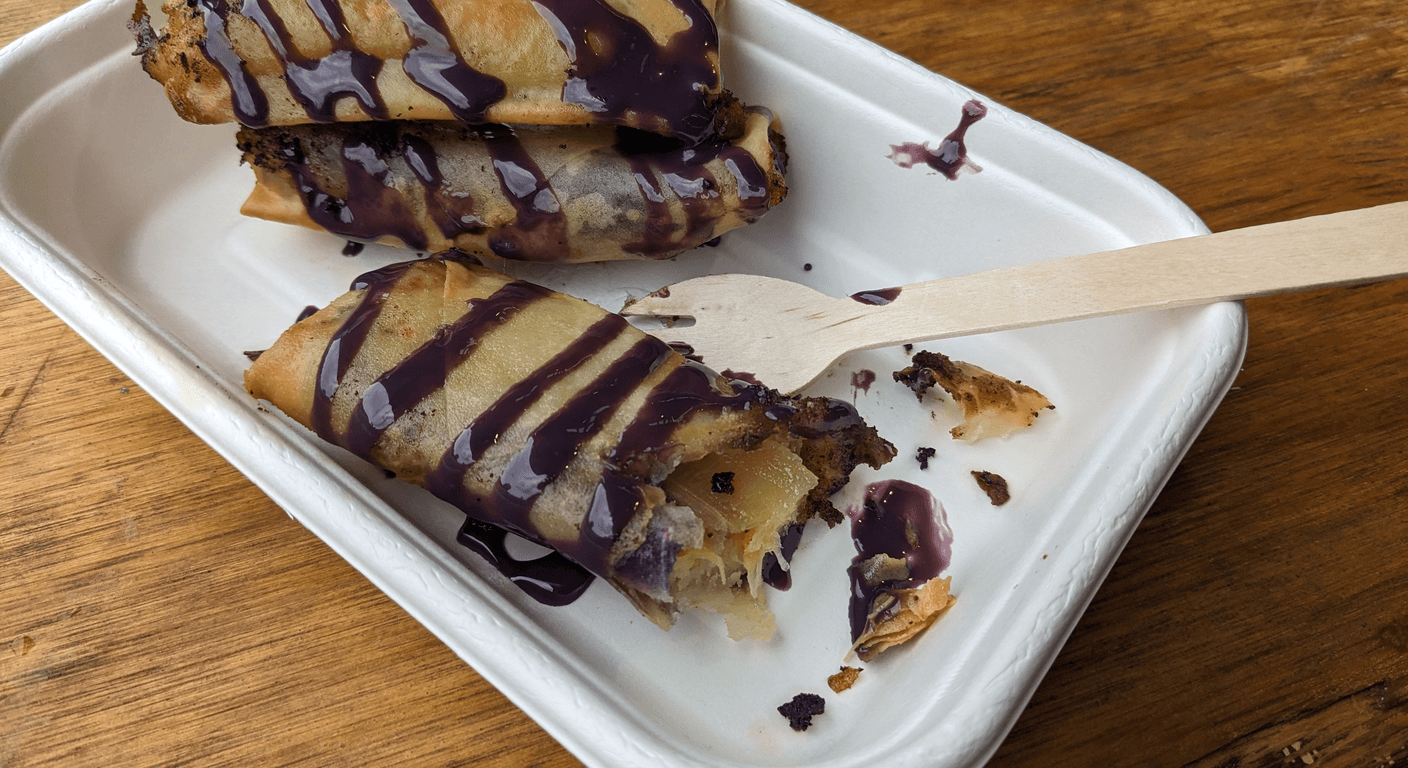
The food at the Winter Night Market is the main draw, and it is genuinely varied. On any given Wednesday you can expect to find Greek souvlaki, Japanese ramen, wood-fired pizza, Vietnamese bánh mì, South American empanadas, Turkish gözleme, and a rotating cast of other cuisines depending on the season's guest vendors. For a Greek Australian couple, the souvlaki and grilled meat options tend to be a reliable benchmark — and the quality varies stall to stall, so a slow walk past the options before committing is worthwhile.
Hot dishes are indicatively priced around $10 to $20 per item, with some premium options sitting higher. Drinks including mulled wine, hot chocolate, and craft beer are available from separate stalls and run roughly $8 to $14 for a serve. These are indicative figures only — confirm current pricing on the night or check qvm.com.au. Budget roughly $40 to $60 for a couple to eat a main dish each, share a dessert, and have a warm drink, though your actual spend will depend entirely on what you choose.
Seated eating areas are available inside the sheds — look for the communal bench tables and the dedicated seating zones near the stage. These fill up quickly after 6pm, so if sitting down to eat is important to you rather than standing or balancing a plate on your lap, arriving early and claiming a table before you queue for food is the smarter approach. Staff and volunteers are generally around to help with directions if you are not sure where the seating is.
Stamina and pacing: an honest read for the over-50s
A full circuit of the Winter Night Market — visiting multiple food stalls, watching some live music, and browsing the non-food vendors — involves more walking than it might appear from the map. The market covers a substantial footprint, and the combination of slow-moving crowds, uneven ground, and standing in queues adds up. For most reasonably active couples in their 60s and early 70s, an evening of two to three hours is comfortable. Beyond that, fatigue tends to set in, and the cold does not help.
A practical approach is to decide in advance what you actually want to do: eat, hear some music, and have a warm drink. Do those things without feeling obliged to see every stall. The market will always have more than you can reasonably cover in one visit, and there is no prize for doing the full loop. Sit down when you feel like it, and do not queue for anything that requires standing more than five minutes — the variety of food means there is almost always a shorter queue nearby for something equally good.
If one of you uses a walking stick or has balance concerns, the market is navigable but requires some care. There is no formal accessibility map published for the night market specifically — check with Queen Victoria Market directly at qvm.com.au or call their customer service line if you have specific mobility questions before attending. Wheelchair access is possible in most areas, though the cobbled surfaces make it harder going than a smooth floor would.
Making a full evening of it: what else is nearby
The Winter Night Market works well as a standalone evening, but if you are coming in from the suburbs and want to make the most of the trip, the surrounding neighbourhood has a few easy additions. Hardware Lane and Lonsdale Street are a short walk south and have good cafes and wine bars for a pre-market coffee or a post-market sit-down if you want something quieter after the crowds. The State Library of Victoria on Swanston Street is open until 9pm on weekdays and is worth a look if you arrive in the city early — it is warm, free to enter, and has comfortable seating.
For the return journey, the trams on Elizabeth Street run regularly into the evening and the walk back to the stop from the market entrance is straightforward. If you are heading to a suburban train line, Melbourne Central Station is the most practical interchange and is a manageable walk north along Swanston Street. Plan your return journey before you leave home using the PTV Journey Planner so you are not working it out on a cold footpath at 8:30pm.
Key takeaways
- Entry to the Winter Night Market at Queen Victoria Market is free every Wednesday evening in July and August — confirm dates at qvm.com.au.
- Arriving at 5pm rather than 6:30pm means shorter queues, easier access to seating, and a less crowded experience overall.
- Tram Route 19 on Elizabeth Street stops directly at the market — use the PTV Journey Planner at ptv.vic.gov.au to plan your trip.
- The sheds are undercover but not heated — Melbourne winter nights are genuinely cold, so layers, a scarf, and a beanie are practical necessities.
- Ground surfaces inside the market include uneven bluestone cobbling; flat, grip-soled shoes are strongly recommended.
- Hot dishes are indicatively $10–$20 per item — budget roughly $40–$60 for two to eat and drink comfortably, and confirm current prices on the night.
Recommended partners and links
Indicative prices only — always confirm with the operator before booking.
Frequently asked questions
Is the Queen Victoria Market Winter Night Market free to enter?
Yes, entry to the Winter Night Market at Queen Victoria Market is free. You pay only for food, drinks, and anything you choose to purchase from stalls. Confirm this remains the case for the current season at qvm.com.au.
What nights does the Winter Night Market run?
The Winter Night Market runs on Wednesday evenings through July and August. It does not operate on other nights of the week. Check qvm.com.au for the confirmed schedule for the current season, as specific dates can vary year to year.
Is the Winter Night Market suitable for people with mobility concerns or who use a walking stick?
The market is navigable for most people with mobility aids, but the ground surfaces include uneven bluestone cobbling and transitions between surfaces that require care. Wheelchair access is possible in most areas. Contact Queen Victoria Market directly via qvm.com.au before your visit if you have specific accessibility questions.
What is the best time to arrive to avoid the biggest crowds?
Arriving when the market opens, around 5pm, gives you the best chance of shorter food queues and available seating. The busiest period is generally between 6pm and 7:30pm, when crowd navigation becomes considerably more effortful.
How do you get to Queen Victoria Market by public transport?
Tram Route 19 (North Coburg) runs along Elizabeth Street and stops at Stop 7, Queen Victoria Market, which is the most direct tram option from the city centre. Route 57 also connects via Elizabeth Street. Use the PTV Journey Planner at ptv.vic.gov.au to plan your specific journey from your starting point.
Got a tip, a price update or a story from this route? The community would love to hear it.
Share your views on our Facebook page— Seniors and Solo Traveller Stories