Starting snow travel after 50 — or after 70 — is more achievable than most people expect, provided you go in with realistic expectations and a sensible plan. This guide covers the main Victorian and NSW resorts, beginner lesson options, no-ski alternatives like snowshoeing and scenic lift rides, what everything costs (honestly), and the practical detail that makes the difference between a great trip and an exhausting one. It is aimed squarely at over-50 first-timers who want to experience the snow without pretending they are 25.
Why over-50 first-timers are well suited to a snow trip
There is a common assumption that skiing and snowboarding are for the young, and that starting after 50 is somehow too late. That assumption does not hold up. Over-50 travellers typically bring patience, a willingness to take instruction, and the self-awareness to stop when tired — all of which make for better beginners than teenagers who push through exhaustion and end up injured. The ski schools at every major Australian resort teach adult beginners every single day of the season.
The key is to arrive without ego and with a clear plan. You are not there to conquer the mountain. You are there to experience it — the cold air, the white landscape, the particular quiet that snow brings, the warmth of a good meal at altitude after a morning outside. All of that is available to you whether or not you ever put on a ski boot. And if you do choose to ski or snowshoe, the beginner infrastructure at Australian resorts is genuinely good.
For a 73-year-old travelling with a partner, the snow can feel daunting simply because it is unfamiliar. The practical reality is that modern resorts are well set up for people who want to move at a measured pace, take breaks, and combine active time with time simply sitting and watching the mountain. You do not have to commit to a full day on the slopes to make the trip worthwhile.
Victorian resorts: Falls Creek, Mt Buller and Mt Hotham compared
Victoria's three main alpine resorts each have a distinct character. Mt Buller, roughly three hours from Melbourne via the Hume Freeway and Mansfield, is the most accessible and the busiest. It has a large beginner area called Bourke Street and a well-organised ski school. The village is compact and relatively walkable once you are there, which matters when you factor in snow boots and unfamiliar terrain underfoot. Mt Buller suits first-timers who want convenience and do not mind a livelier atmosphere.
Falls Creek, about four hours from Melbourne via the Snow Road through Bright, is widely regarded as one of the most beginner-friendly resorts in Australia. It is a fully self-contained village — no cars once you arrive — and the terrain is genuinely gentle across a large portion of the mountain. The resort has good lift infrastructure and the village layout means you can move between accommodation, lessons, and the slopes without covering large distances. For couples who want a quieter, more village-like experience, Falls Creek is worth the slightly longer drive.
Mt Hotham sits at the highest elevation of the three and has a different layout — the main road runs through the resort rather than below it, so access between different parts of the village requires some navigation. It tends to attract intermediate and advanced skiers and is perhaps less ideal as a first-timer base, though it has a beginner area and the scenery is genuinely open and impressive. If you are combining a snow trip with time in the Ovens Valley or Bright, Hotham fits naturally into that itinerary. All three resorts charge a resort entry fee on top of lift passes — confirm current fees directly with each resort before you go.
NSW resorts: is Perisher or Thredbo worth the extra distance?
For Victorians, getting to Perisher or Thredbo means either a long drive (Albury then the Snowy Mountains Highway) or flying to Canberra and driving from there — roughly two to two-and-a-half hours from the airport. It is a bigger logistical commitment, which is worth acknowledging honestly. That said, the NSW resorts are larger and in some respects more developed than their Victorian counterparts.
Perisher is Australia's largest ski resort by skiable area and has a dedicated beginner zone called the Skitube terminal area, accessible via a cogwheel train from Bullocks Flat — a genuinely useful feature that removes the need to drive up the mountain road in snow conditions. Thredbo has a more European village feel, with the Kosciuszko Express chairlift carrying people up to near the summit of Australia's highest mountain regardless of whether they ski. That lift ride and the walk to the summit is one of the more memorable experiences available at any Australian alpine resort, and it is entirely accessible without skis.
For a first-timer from Victoria who wants to keep things manageable, the Victorian resorts are the sensible starting point. But if you have always wanted to see Kosciuszko, building a snow trip around Thredbo and combining it with a few days in the Snowy Mountains region is a legitimate and rewarding option for a longer winter holiday.
First-timer lessons and beginner areas: what to expect
Every major Australian resort offers adult ski and snowboard lessons through its ski school. Group lessons for beginners typically run for two hours and are taught by instructors who are accustomed to working with people of all ages and fitness levels. A half-day group lesson is the recommended starting point — it gives you enough time to get comfortable with the basics without exhausting yourself. Private lessons cost more but allow the pace and focus to be tailored to you specifically, which many older beginners find worthwhile for the first session.
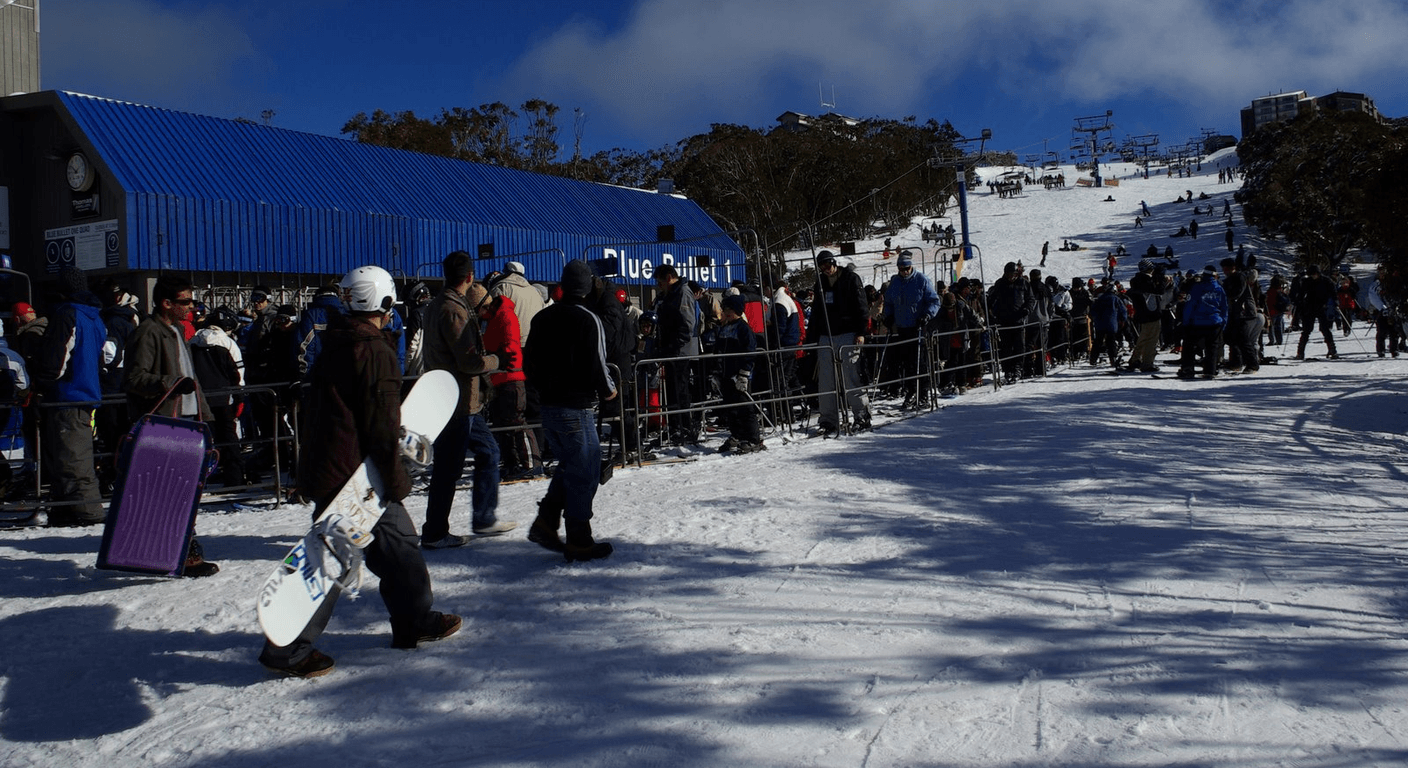
Beginner areas at Australian resorts use slow-moving conveyor lifts (often called magic carpets) rather than chairlifts, which removes one of the early anxieties about the sport. You stay on gentle, flat terrain with other beginners, and the ski school controls who accesses what runs. There is no pressure to go faster or higher than you are comfortable with. If you decide after one lesson that skiing is not for you, that is a completely reasonable outcome — the experience of being on snow, moving through it, understanding the equipment, is itself worthwhile.
Snowboarding is generally harder on the body for first-timers than skiing — more falls, more wrist strain — and most instructors would suggest skiing as the better starting point for people over 50. That said, the choice is yours and ski schools teach both. Whatever you choose, wear wrist guards and consider padded shorts for the first session. These are available to hire at most resort hire shops and are not expensive.
No-ski options: snowshoeing and scenic lift rides honestly described
Snowshoeing deserves more attention than it typically gets in mainstream ski media. It is walking — slow, deliberate walking through snow — using wide frames strapped to your boots that distribute your weight so you do not sink. It requires no prior training, no particular fitness level beyond being able to walk for an hour or two, and the equipment hire is straightforward at most resorts. Guided snowshoe tours are available at Falls Creek and Mt Buller and are genuinely excellent ways to see parts of the alpine environment you would not reach on skis.
Scenic chairlift or gondola rides are available at several resorts and are worth doing simply for the perspective they offer. At Thredbo, the Kosciuszko Express takes non-skiers up to 1,937 metres and from there a well-maintained boardwalk leads toward the summit of Mt Kosciuszko — a walk that is achievable for most reasonably mobile people and one of the more significant experiences available in the Australian alps. At Mt Buller, the Summit chairlift gives views across the Victorian high country that are worth the ride even in still air. Check with each resort for current non-skier lift access options and pricing, as these vary.
Cross-country skiing (Nordic skiing) is another option worth knowing about, particularly at Falls Creek which has an extensive Nordic trail network. It is lower impact than downhill skiing, moves at your own pace, and covers beautiful open terrain. Falls Creek Nordic has introductory lessons available. If you or your partner have any joint concerns that make downhill skiing feel risky, cross-country is a sensible alternative to investigate.
Gear hire versus buying: the honest advice for a first trip
Hire everything on your first trip. This is not a controversial position — it is what most experienced alpine travellers recommend to anyone who has not skied before. Ski boots, skis, poles, a helmet — hire all of it from the resort hire shop or from a pre-resort hire outlet (which is often cheaper) in towns like Mansfield, Bright, or Jindabyne. Buying ski gear before you know whether you enjoy the sport, whether your body tolerates it, and what size and style suits you is simply premature.
Ski hire for a day is indicatively around $60–$90 for a full ski package (skis, boots, poles), though prices vary by resort and season — confirm current rates directly. Helmet hire is usually separate and around $15–$25 per day. Some hire shops offer multi-day rates that reduce the daily cost if you are staying for three or more days. Pre-resort hire in towns below the mountain tends to be noticeably cheaper than on-mountain hire and you collect before you drive up, which simplifies the morning.
The one item worth buying rather than hiring is good thermal base layers and a waterproof outer jacket and pants. These are the things that determine whether you are comfortable in the cold and can be used for years. A decent waterproof jacket does not need to be a ski-specific garment — any good rain jacket with a hood will work for a beginner's first trip. Good quality merino wool base layers are worth the investment and are available at outdoor retailers like Kathmandu or Paddy Pallin across Victoria. Ski goggles are worth hiring the first time and then buying if you return.
Costs, midweek savings, driving realities and village accessibility
The cost of a snow trip is one of the most honest conversations to have. Lift passes at Australian resorts are expensive by international comparison. A single-day adult lift pass at the major resorts runs roughly $140–$200 depending on the resort and the date — weekend and school holiday pricing is higher. Multi-day passes reduce the daily rate. Some resorts offer concession pricing for seniors aged 65 or older, and some discount further for those 70 and over — the thresholds and discount amounts vary and change season to season, so check directly with each resort rather than relying on any figure printed here. Resort entry fees (charged separately from lift passes at most Victorian resorts) add further cost and are indicatively $30–$50 per car per day — again, confirm before you go.
Midweek travel makes a meaningful difference. Lift passes and accommodation are both cheaper Monday to Thursday, the mountain is less crowded, and ski school class sizes are smaller. If your schedule allows any flexibility at all, avoid weekends and school holidays. Accommodation in resort villages is expensive; staying in Bright, Mansfield or Myrtleford for a Victorian resort trip and driving up day by day is a cost-effective alternative that many older travellers prefer — it also means a comfortable bed in a warmer setting each night.
Driving to alpine resorts in winter requires carrying snow chains and knowing how to fit them — this is a legal requirement in alpine areas when conditions demand it, not a suggestion. If you have not fitted chains before, practice in your driveway before you go. The alternative is to use a coach service: several operators run seasonal coach transfers from Melbourne to the major Victorian resorts, and Perisher is accessible via coach from Canberra. Village accessibility within resorts varies. Falls Creek's car-free village is in some respects easier to navigate on foot once you are there, but snow underfoot is inherently slippery and uneven. Walking poles (different from ski poles) are useful for stability and can be brought from home or hired. Most resort buildings have accessible entries and most accommodation providers can describe their specific layout — ask before you book.
Key takeaways
- Starting skiing or snowshoeing after 50 is achievable — adult beginner lessons run every day of the season at all major Australian resorts.
- Falls Creek is widely considered the most beginner-friendly of Victoria's three main alpine resorts, with a car-free village and gentle terrain.
- Hire all ski equipment on your first trip — boots, skis, poles and helmet — and only consider buying after you know the sport suits you.
- Lift passes at Australian resorts are genuinely expensive, roughly $140–$200 per adult per day; midweek travel is the most effective way to reduce costs.
- Snowshoeing and scenic chairlift rides are legitimate, rewarding alternatives to skiing and are available at most major resorts without any prior experience.
- Some resorts offer senior concession lift passes for those aged 65 or 70 and over — check directly with each resort for current thresholds and pricing before booking.
Recommended partners and links
Indicative prices only — always confirm with the operator before booking.
Frequently asked questions
Is it too late to learn to ski at 65 or 70?
No. Ski schools at all major Australian resorts teach adult beginners across a wide age range every day of the season. Older beginners often progress steadily because they listen carefully and do not take unnecessary risks. The key is to take proper lessons, hire appropriate equipment, and be honest with yourself about how much time on snow per day is comfortable.
Do Australian ski resorts offer senior discounts on lift passes?
Some resorts do offer concession pricing for seniors, with thresholds that have varied at different resorts between ages 65 and 70 and above. These discounts and their eligibility ages change from season to season, so you should check directly with each resort — Falls Creek, Mt Buller, Mt Hotham, Perisher and Thredbo — before purchasing a pass.
What are the best snow trip options for someone who does not want to ski?
Snowshoeing guided tours, scenic chairlift and gondola rides, cross-country Nordic skiing, and the walk to Mt Kosciuszko via the Kosciuszko Express at Thredbo are all worthwhile non-skiing experiences. A snow trip does not require skiing to be enjoyable — simply being in the alpine environment, eating well, and watching the mountain is a legitimate reason to go.
Do you need to know how to fit snow chains to drive to Victorian ski resorts?
Yes. Carrying snow chains and being able to fit them is a legal requirement when alpine authorities declare chain conditions on resort access roads. Practice fitting your chains before you leave home. If you are not comfortable driving in alpine conditions, coach services from Melbourne to the major Victorian resorts are available each season and remove the driving concern entirely.
Is it cheaper to stay in the resort village or in a nearby town?
Staying in nearby towns — Bright or Myrtleford for Falls Creek or Hotham, Mansfield for Mt Buller — is substantially cheaper than on-mountain accommodation and many older travellers prefer the comfort and warmth of a lower-altitude base. You drive up each day, pay the resort entry fee, and return to a more relaxed setting each evening. Hiring ski equipment from a pre-resort hire shop in these towns is also generally cheaper than on-mountain hire.
Got a tip, a price update or a story from this route? The community would love to hear it.
Share your views on our Facebook page— Seniors and Solo Traveller Stories