Australia's ocean pools and sea baths offer something that lap pools rarely can: the horizon, the salt air, and a community of swimmers who have been showing up for decades. From the iconic Bondi Icebergs to the ancient Bogey Hole in Newcastle and Victoria's heated St Kilda Sea Baths, most of these pools cost nothing or next to nothing to enter. This guide covers the best sites along the NSW coast, in Victoria, and beyond — with honest notes on access, water temperature, and what to expect when you lower yourself into the sea.
Why older swimmers love ocean pools
There is a reason the regulars at most ocean pools tend to be over fifty. Salt water provides more natural buoyancy than a freshwater lap pool, which means less strain on joints that have earned their wear. The resistance of moving water gives a genuine workout without impact, and the temperature — cool to cold depending on season and site — is increasingly understood to support circulation and mood, though this guide is not medical advice and you should speak with your GP before making significant changes to your exercise routine.
The social dimension matters too. Ocean pool communities are self-organising and quietly welcoming. There are no membership forms at most rock pools, no bookings, no lanes assigned by a lifeguard with a clipboard. You arrive, you swim, you dry off on the rocks or a bench, and you chat with whoever else has turned up. For a solo traveller, especially one travelling alone for the first time, that low-key human contact — a nod from a regular, a word about the swell — can be one of the genuinely nourishing parts of a coastal trip.
The view, of course, is the other thing no indoor pool can replicate. Swimming toward the open sea from within the safety of a rock pool — watching a tanker on the horizon, or a pelican landing two metres away — is a particular pleasure. It does not get ordinary, even after years of it.
Bondi Icebergs: the icon worth the hype
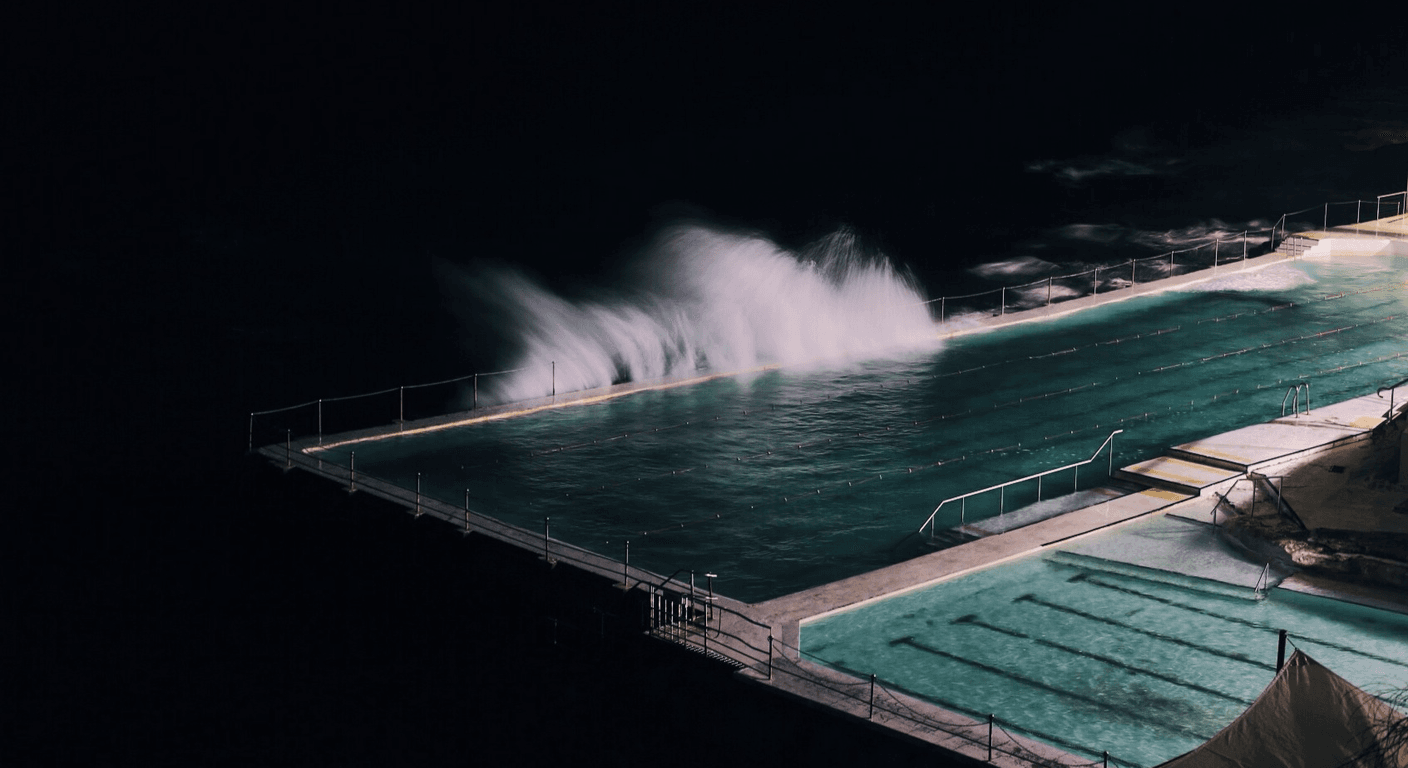
The Bondi Icebergs pool at the southern end of Bondi Beach in Sydney is probably the most photographed swimming pool in Australia, and for good reason — it sits right at the edge of the ocean, waves breaking over the wall on a big swell day. The pool is 50 metres long, operated by the Bondi Icebergs Swimming Club, and open to the public on most days except Thursdays when it is closed for cleaning. Entry for non-members costs around $8-$10 — confirm the current rate at icebergs.com.au before you go.
Access is a fair question here. The pool is reached via a staircase down from the promenade level, and the change rooms involve some steps. The pool itself has a ladder entry and a ramp at the shallow end, which makes it manageable for many swimmers, but if you have significant mobility limitations it is worth calling ahead to ask about current conditions. The water is not heated — in winter it can sit around 15-17°C, which is bracing but swimmable for those accustomed to it. In summer it rises to around 20-22°C. Lap swimmers share the pool with casual swimmers; mornings tend to be quieter and more orderly.
Even if you do not swim a stroke, the walk along the Bondi to Coogee coastal path passes several other ocean pools — Mackenzies Bay pool, Clovelly, and the Giles Baths at Coogee — making it one of the most rewarding half-day walks on the Sydney coast. The path is paved and well-maintained, though there are some steps and elevation changes that require reasonable fitness.
Bronte Baths, the Bogey Hole, and Blue Pool: three pools worth travelling for
Bronte Baths, a short walk south of Bondi along the coastal path, is a different character entirely. It is a smaller, more sheltered tidal pool carved into the sandstone shelf at the northern end of Bronte Beach. Entry is free, there are no lanes, and it fills and empties with the tides. The surrounding rocks are flat enough to sit on comfortably, and the atmosphere is gentle rather than sporty. There are no formal handrails for pool entry — you lower yourself in from the edge — so it suits swimmers who are steady on their feet. The Bronte Baths Trust maintains the site; check with Waverley Council for current access information.
The Bogey Hole in Newcastle is one of Australia's oldest ocean baths, hand-carved by convict labour in the early nineteenth century into the rock platform below King Edward Park. It is dramatic — a deep, rectangular cut in the rock, exposed to the open Pacific, filling with each wave. Entry is free and always has been. The approach involves walking down a graded path and then negotiating uneven rock surfaces, so it is best suited to travellers who are comfortable on rough ground. There are no handrails in the pool itself. Newcastle City Council manages the site; visitnewcastle.com.au has current information.
Blue Pool at Bermagui on the Sapphire Coast of NSW is a quieter, less-visited gem about four hours south of Sydney. It is a natural rock pool on the headland, free to enter, with a ladder and some flat rock surrounds. The water is exceptionally clear. Bermagui is the kind of small coastal town — fishing boats, a pub, a bakery — that rewards a slower pace. It is worth a night or two if you are driving the Princes Highway between Sydney and Melbourne. The Sapphire Coast Tourism website has practical visitor information.
Victoria: St Kilda Sea Baths and the case for year-round swimming
Victoria does not have the sandstone rock platforms of the NSW coast, but it has St Kilda Sea Baths — and the heated pool there is a genuine asset for year-round swimming. The St Kilda Sea Baths complex on Jacka Boulevard sits right on Port Phillip Bay and has been on this site in various forms since 1860. The current building houses a 25-metre heated indoor pool, spa facilities, a gym, and a café. A day pass costs roughly $20-$30 indicative — check stkildaseabaths.com.au for current pricing and any concessions for seniors.
The pool is accessible by tram from the Melbourne CBD — the 96 tram runs from Bourke Street to St Kilda, stopping a short walk from the baths — which makes it practical for a day trip without a car. The facilities are modern and the change rooms are well-maintained. It is not the same experience as swimming in an open rock pool, but on a cold Melbourne morning when the bay is choppy, there is something to be said for heated salt water and a view of the pier.
For those who want the outdoor experience in Victoria, the Mornington Peninsula has several beach entry points with relatively calm water in summer, and the region's proximity to the Peninsula Hot Springs at Fingal adds the option of pairing a sea swim with a thermal soak on the same day. The Peninsula Hot Springs is a well-established facility with accessible entry options — see peninsulahotsprings.com for current details and pricing.
Queensland and Western Australia: warmer water, different rhythms
Queensland's ocean pool tradition is less developed than NSW's, partly because the climate allows beach swimming for much of the year and partly because the northern coast has stinger seasons that push swimmers into netted enclosures rather than rock pools. The Mowbray Park Baths in Brisbane (also known as the Colmslie Recreation Reserve pool) and the Currumbin Rock Pools on the Gold Coast hinterland are worth knowing about — though the Currumbin site is a freshwater creek pool rather than a sea bath. For coastal Queensland swimming, the patrolled beaches between the flags remain the safest and most practical option for visitors.
Western Australia's Cottesloe Beach in Perth has a long tidal pool history, and the Indiana Tea House end of the beach has flat rock platforms that function as informal sea baths at high tide. Fremantle's Bathers Beach is another sheltered option with calm water. WA's water temperatures are warmer than the NSW south coast — in summer the Indian Ocean at Perth beaches sits around 21-23°C, which is comfortable for extended swimming. The Tourism Western Australia website at westernaustralia.com has current beach and pool information.
What connects all of these places, regardless of state, is a culture of unhurried, repetitive, restorative swimming. You do not need to be a serious athlete. You do not need to train for it. You need a swimsuit, a towel, a pair of shoes that can handle wet rocks, and a willingness to get in.
Practical matters: entry, access, temperature, and etiquette
Most of Australia's ocean pools and rock baths are free or charge a gold coin or small entry fee. The exceptions are managed facilities like Bondi Icebergs and St Kilda Sea Baths, which have modest entry charges. Always confirm current pricing directly with the operator before you go, as these figures change. For tidal pools, check the local tide chart before visiting — many pools are best swum at mid-tide, when they hold a good depth of water but are not being actively washed by swell. The Bureau of Meteorology at bom.gov.au provides tide times for all Australian coastal locations.
Water temperature is worth taking seriously. The NSW south coast in winter (June-August) can see ocean temperatures around 14-16°C, which is cold enough to cause gasping and, for those with certain heart conditions, genuine risk. The general guidance from open-water swimming communities is to enter slowly, never dive in cold water, and get out if you feel any chest discomfort. Again, this is not medical advice — talk to your GP about what is appropriate for your situation. Wetsuits are increasingly common and entirely sensible; a 3mm shorty wetsuit extends the comfortable swimming season significantly and adds buoyancy.
Lap etiquette at managed pools like Bondi Icebergs is similar to any pool: keep left, don't stop in the middle of a lane, and let faster swimmers pass. At free tidal pools there are no formal rules, but the social convention is to be aware of other swimmers, especially children, and to take up only as much space as you need. Most regulars are generous with information about conditions — if someone local tells you the swell is too big today, it is worth listening.
Planning a coastal pool trip from Victoria
A drive up the NSW coast from Melbourne is one of the classic Australian road trips, and stringing ocean pools along the route gives it a genuine purpose beyond the scenery. From Melbourne, the Princes Highway reaches the NSW border at Genoa in around five to six hours of driving. From there, Merimbula, Tathra, Bermagui, and Narooma are all within a day's drive of each other, each with accessible beaches and the Blue Pool at Bermagui as a highlight. Sydney is a further four hours north, putting the Bondi and Bronte pools within reach on a week-long trip.
If driving is not the preference, NSW TrainLink operates coach and rail services from Melbourne to Sydney via the Hume Highway corridor, though direct coastal access is limited by public transport. For the south coast stops, a hire car from Sydney or Canberra is the most practical option. V/Line services from Melbourne reach some Gippsland coastal towns — see vline.com.au for current timetables — though the Sapphire Coast of NSW is beyond the V/Line network.
Accommodation along the NSW south coast ranges from holiday parks with accessible cabins to small motels and holiday rentals. Booking ahead in school holiday periods is sensible; outside those windows the coast is quieter and prices are lower. The NRMA Holiday Parks network (nrmaparksandresorts.com.au) has several properties on the south coast with accessible facilities, and many Airbnb listings now include accessibility filters. As always, call ahead to confirm what 'accessible' actually means for the specific property.
Key takeaways
- Most of Australia's ocean pools and rock baths are free or charge only a small entry fee — Bondi Icebergs and St Kilda Sea Baths are the main exceptions, with modest day-pass rates.
- Salt water provides more natural buoyancy than freshwater pools, making ocean swimming gentler on joints for many older swimmers.
- Water temperatures on the NSW south coast can drop to 14-16°C in winter — a wetsuit is a practical and sensible option for extending the comfortable swimming season.
- St Kilda Sea Baths in Melbourne offers a heated, year-round indoor salt-water pool accessible by tram from the CBD.
- The Bogey Hole in Newcastle and Blue Pool at Bermagui are free, historic, and worth travelling for — but both require comfort on uneven rock surfaces.
- Always check tide times via bom.gov.au before visiting a tidal pool, and confirm current entry prices directly with each operator.
Recommended partners and links
Indicative prices only — always confirm with the operator before booking.
Frequently asked questions
Are Australia's ocean pools suitable for older swimmers with limited mobility?
It depends on the specific pool. Some managed pools like Bondi Icebergs have a ramp at the shallow end and change room facilities, while free rock pools like the Bogey Hole in Newcastle involve uneven surfaces and no handrails. St Kilda Sea Baths in Melbourne is the most accessible option, with a modern facility, heated water, and lift access. Always call ahead to confirm current access conditions at any site you plan to visit.
How much does it cost to swim at Bondi Icebergs?
Public entry to the Bondi Icebergs pool costs around $8-$10 per adult as an indicative figure — confirm the current rate at icebergs.com.au, as pricing can change. The pool is closed on Thursdays for cleaning.
What is the water temperature at NSW ocean pools in winter?
Ocean temperatures along the NSW coast typically sit around 14-16°C in the cooler months (June to August), which is cold by most standards. At Sydney's Bondi and Bronte pools, winter water sits in the 15-17°C range. A 3mm wetsuit makes this temperature much more manageable and adds useful buoyancy.
Is there an ocean pool experience accessible by public transport from Melbourne?
Yes. St Kilda Sea Baths on Jacka Boulevard in St Kilda is reachable by tram from the Melbourne CBD — the 96 tram runs from Bourke Street to St Kilda. The baths have a heated indoor salt-water pool, spa facilities, and a café. Check stkildaseabaths.com.au for current day-pass pricing and opening hours.
What is Blue Pool at Bermagui and is it worth the trip?
Blue Pool is a natural rock pool on the headland at Bermagui on NSW's Sapphire Coast, around four hours south of Sydney. It is free to enter, has a ladder for pool entry, and is known for exceptionally clear water. Bermagui is a small fishing town that suits a slower travel pace, and the pool is best visited at mid-tide. It is a genuine highlight of a south coast road trip and well suited to travellers who are comfortable on rock surfaces.
Got a tip, a price update or a story from this route? The community would love to hear it.
Share your views on our Facebook page— Seniors and Solo Traveller Stories
- Bondi Icebergs Swimming Club — official site
- St Kilda Sea Baths — official site
- Visit NSW — Coastal Experiences
- Visit Victoria — Active Travel
- Bureau of Meteorology — Tide Times
- Peninsula Hot Springs — official site
- V/Line — train and coach services Victoria
- Tourism Western Australia
- NRMA Parks and Resorts — NSW south coast holiday parks
- Sapphire Coast Tourism — Bermagui and surrounds