Japanese onsen bathing is one of the most genuinely restorative experiences available to travellers, and for Australians over 50 it offers something rare: a wellness tradition with centuries of depth, accessible by train and designed around slowing down. This guide walks through the etiquette step by step, explains what a ryokan stay actually involves, and names the onsen towns worth building a trip around. Costs, accessibility realities, and the tattoo question are all addressed honestly.
Why onsen travel suits the over-50 traveller particularly well
There is a reason Japanese people have been soaking in hot-spring water for more than a thousand years. The minerals — sulphur, sodium bicarbonate, iron, radium depending on the source — are said to ease joint pain, improve circulation, and settle the nervous system. Whether you accept the therapeutic claims or simply enjoy the warmth and quiet, the practical effect is the same: you feel better after an onsen than before. For travellers in their 60s and 70s dealing with the ordinary aches of long-haul flights and full days of sightseeing, that is not a small thing.
Onsen culture is also built around patience and stillness, which aligns well with how many older travellers prefer to move. You are not rushing anywhere. You are sitting in warm water, looking at a garden or a mountain, and doing nothing in particular. The pace of a ryokan — the traditional Japanese inn where onsen bathing is central to the stay — is deliberately unhurried. Breakfast and dinner are served in a set rhythm, the room is arranged for rest, and the baths are available morning and evening. It is structured leisure, and it suits people who have earned the right to slow down.
For a traveller who has spent decades balancing work, family, and the occasional rushed holiday, a ryokan stay in an onsen town can feel like a genuine reset. The cultural distance is real — this is not a day spa in the Yarra Valley — but the welcome is genuine, and the rituals are learnable. This guide exists to make that learning curve as gentle as possible.
Onsen etiquette step by step: what actually happens when you walk in
The single most important rule is this: you wash your body thoroughly before you enter the communal bath. Every onsen, from the humblest public bathhouse to the finest ryokan, provides a row of low shower stations along one wall. You sit on a small stool, use the provided soap and shampoo, and clean yourself from head to foot before approaching the water. The bath is for soaking, not cleaning. This is not negotiable, and understanding it removes most of the anxiety first-timers carry.
You enter the bath naked. Swimwear is not permitted in traditional onsen because it is considered unhygienic and defeats the purpose of the mineral water. You will be given a small modesty towel — roughly the size of a face washer — which you can fold and place on your head while soaking, or hold in front of you while walking between the shower station and the bath. Most bathers over a certain age simply stop worrying about it within about two minutes. The atmosphere is matter-of-fact, not voyeuristic. People are there for the water, not to look at each other.
Keep your voice low, your movements slow, and your phone in the locker. Photography inside the bathing area is strictly prohibited everywhere. Rinse the shower station after you use it, and if you have long hair, tie it up so it does not trail in the water. When you are ready to leave the bath, do not drain it — it is communal and continuously maintained. Dry off in the changing room before re-entering the rest of the inn. These are the basics, and once you have done it once, the sequence becomes entirely natural.
The tattoo question: is it still a problem for international visitors?
Tattoos have historically been associated with organised crime in Japan, which is why many onsen establishments banned them outright. That policy is shifting, particularly in facilities that cater to international guests, but it has not disappeared entirely. The honest answer is: it depends on the establishment, and you need to check before you arrive.
A growing number of ryokan and public bathhouses now permit tattoos if they are covered with waterproof bandaging for smaller pieces, or if the guest books a private bath (discussed below). Some establishments in tourist-heavy areas have dropped the restriction entirely. The JNTO website and individual ryokan booking pages usually state the policy clearly, and Rakuten Travel allows you to filter for tattoo-friendly properties. If you or your travel companion has significant tattoo coverage, book a private bath or a tattoo-friendly property and the issue is resolved.
It is worth approaching this practically rather than emotionally. Japanese bathhouse culture has its own logic, and the rules exist within a specific cultural context. Travellers who engage respectfully and make enquiries in advance almost always find a workable solution. The experience is worth the small amount of advance planning it requires.
Private family baths (kashikiri): the option for those who prefer privacy
A kashikiri buro, or private reserved bath, is a self-contained bathing room that a couple or small group books exclusively for a set period — usually 45 minutes to an hour. You lock the door, the water is the same mineral-rich onsen water as the communal baths, and you have complete privacy. Many ryokan offer kashikiri as a standard option, sometimes included in the room rate and sometimes charged separately at around AUD 20–50 per session (indicative; confirm with your property).
For couples travelling together, the private bath also solves the separation issue. Traditional onsen are gender-segregated, which means partners bathe in different sections. Some travellers find this a pleasant independent interlude; others prefer to share the experience. The kashikiri removes the question entirely. For travellers who feel self-conscious about their bodies, or who simply value privacy, it is an excellent starting point before trying the communal baths.
Many higher-end ryokan now include a private open-air bath (rotenburo) attached directly to the guest room. These in-room baths are filled with genuine onsen water piped to the room and are considered among the most luxurious options available. They come at a price — room rates at properties with private rotenburo can reach AUD 600–900 per person per night with meals (indicative) — but for a special occasion they represent an extraordinary level of comfort and privacy.
The best onsen towns for first-time visitors from Australia
Hakone, roughly 90 minutes from Tokyo by the Romancecar express train from Shinjuku station, is the most accessible onsen town for travellers who are combining a Japan trip with time in the capital. The town sits within a national park and looks out toward Mount Fuji on clear days. Ryokan range from modest to very grand, and the range of bathing options — indoor, outdoor, private — is extensive. It is a well-worn tourist route, which means English signage is reasonable and staff at established ryokan are experienced with international guests. The JR Pass does not cover the Romancecar supplement, so factor in a small additional fare (indicative; confirm with Odakyu Railway).
Kinosaki Onsen, on the Sea of Japan coast in Hyogo Prefecture, operates on a different model entirely. The town has seven distinct public bathhouses, each with a different design and mineral composition, and guests staying at any registered ryokan receive a pass to visit all seven during their stay. You walk between them in a yukata (cotton robe) provided by your inn, wooden sandals clicking on the old street. It is one of the most charming small-town experiences in Japan and the town's compact scale — you can walk end to end in about fifteen minutes — makes it manageable for travellers who tire easily. Access is by shinkansen to Kyoto then a limited express on the JR San'in line; the JR Pass covers both.
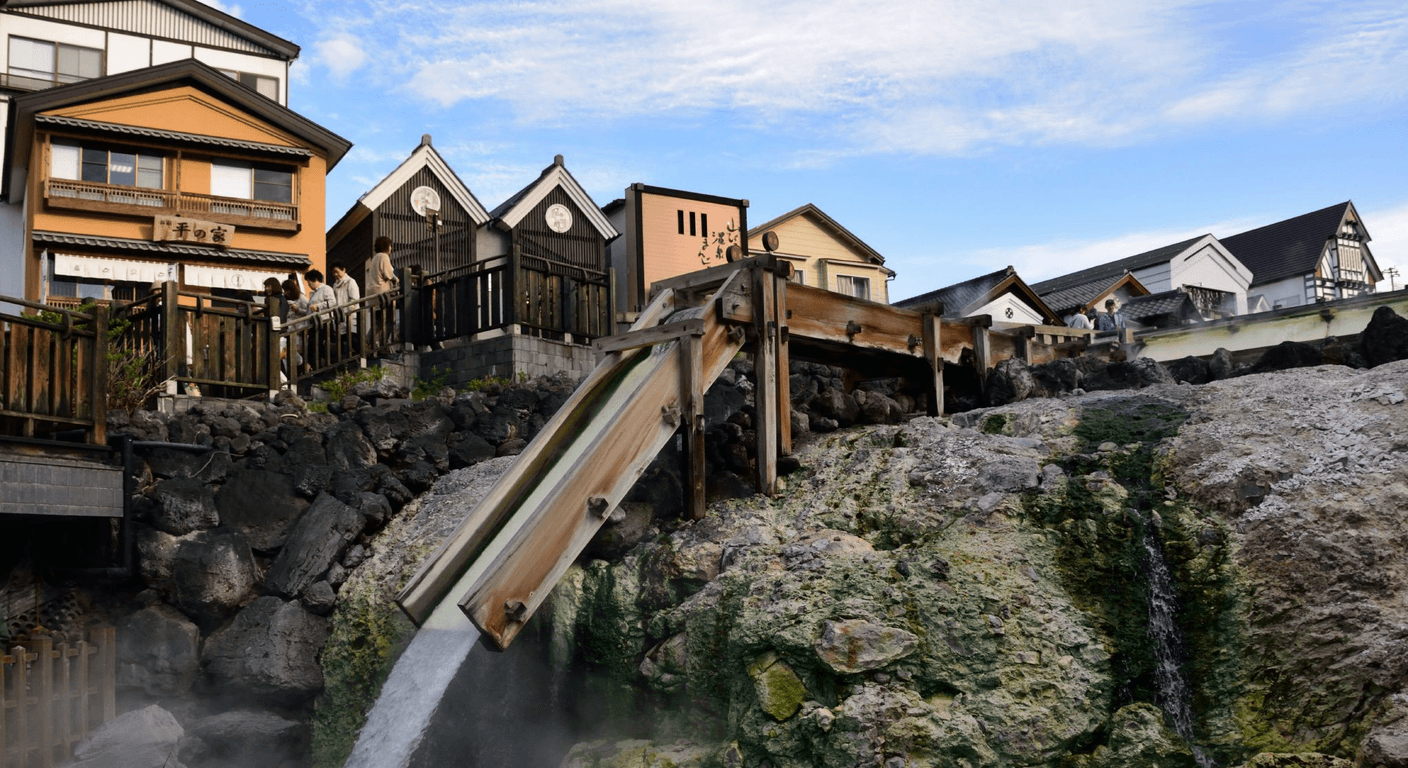
Beppu, on the island of Kyushu, is Japan's highest-volume hot-spring city by water output and has a slightly rougher, more working-class character than the polished ryokan towns. It suits travellers who want variety and don't mind a less curated atmosphere. The famous 'hells' — coloured boiling pools that are viewed rather than bathed in — are a tourist attraction worth an hour or two, and the public sand baths, where attendants bury you up to the neck in naturally heated volcanic sand, are a genuinely unusual experience. Access from Osaka or Fukuoka by shinkansen and limited express is straightforward and covered by the JR Pass.
Staying at a ryokan: what the full experience involves
A ryokan is not a hotel with Japanese décor. It is a distinct form of hospitality with its own rhythm and expectations. You remove your shoes at the entrance and exchange them for slippers. Your room will typically be a tatami-floored space with a low table, floor cushions, and a futon that staff lay out while you are at dinner. The room is quiet by design. There is usually a small garden view, a kettle for green tea, and a yukata robe for wearing around the inn.
Kaiseki dinner — the multi-course meal served in your room or a private dining space — is the culinary centrepiece of the ryokan stay. It is a seasonal, considered meal: small portions of beautifully prepared local ingredients, arriving in sequence over an hour or more. For travellers accustomed to a substantial evening meal, the portion sizes can take adjustment, but the overall quantity across eight to twelve courses is sufficient. Dietary requirements can usually be accommodated with advance notice; communicate clearly when booking. Breakfast the following morning is similarly elaborate, often a mix of grilled fish, rice, miso soup, pickles, and egg dishes.
Most mid-range ryokan with two meals included will cost roughly AUD 250–450 per person per night, with higher-end properties reaching AUD 500 or more (all figures indicative; confirm current pricing when booking). This is not cheap, but the meals, bathing access, and the level of attentive service are included. Comparing it directly to a hotel room rate is misleading. One or two nights at a quality ryokan mid-trip, rather than the entire itinerary, is a practical approach for travellers managing a budget.
Accessibility realities: what to know before you go
Onsen bathing involves genuine physical considerations that are worth stating plainly. Floors in wet bathing areas are often slippery despite the presence of grip mats; take your time and use the handrails where they exist. The low shower stools require you to sit close to floor level and rise again, which can be difficult for travellers with knee or hip problems. Some ryokan offer higher stools on request — it is worth asking when booking. The water itself is hot, typically 40–43 degrees Celsius, and entering too quickly can cause light-headedness, particularly if you have blood pressure concerns. Ease in slowly and limit your first soak to ten or fifteen minutes.
Ryokan rooms with tatami floors and futon bedding are beautiful but low to the ground. Rising from a futon repeatedly over a few days can be hard on the lower back and knees. Many ryokan now offer Western-style bed options in at least some rooms; request this specifically when booking if you know it will be an issue. Meals served at low tables on floor cushions present a similar challenge; some establishments will provide a chair and table if asked. Staff at good ryokan are experienced with older guests and will accommodate reasonable requests without fuss.
Major onsen towns and their railway stations have improved accessibility infrastructure in recent years, with lifts and ramp access more common than they were a decade ago. That said, some older inn buildings are multi-level with stairs and no lift, and some public bathhouse streets are uneven. Travelling with a compact walking stick is a sensible precaution. Review the specific property's accessibility information before booking, and do not hesitate to contact the ryokan directly — many have English-speaking staff or will respond clearly to a written enquiry.
The JR Pass question and best seasons for onsen travel
The JR Pass remains one of the most useful tools for independent rail travel in Japan, covering the shinkansen network (excluding Nozomi and Mizuho services), limited express trains, and many local JR lines. For a trip that combines Tokyo, Hakone (partially), Kyoto, Kinosaki, and Kyushu, a 21-day pass represents good value. For a shorter trip focused on one or two regions, a regional pass — such as the JR Kansai-Hokuriku Arch Pass or the JR Kyushu Pass — may be more cost-effective. The JNTO website and the JR Pass official site both provide current comparison tools. Passes must be purchased before departure from Australia; confirm current pricing and rules as they have changed in recent years.
Autumn (late October to late November) and spring (late March to early April) are the classic seasons for Japan travel and onsen visits alike. Autumn foliage around Hakone and Kinosaki is genuinely beautiful, and the cooler air makes the contrast of stepping into a hot outdoor bath particularly satisfying. Spring brings cherry blossoms but also larger crowds. Winter is an underrated season for onsen travel — sitting in an outdoor rotenburo while snow falls around you is a memorable experience — and accommodation is often easier to secure outside the peak cherry-blossom window. Summer is warm and humid, which makes the hot-spring experience less appealing for most travellers and crowds at popular towns can be significant.
For Australian travellers flying from Melbourne, direct or one-stop services to Tokyo (Narita or Haneda) and Osaka (Kansai) are the standard entry points. From Osaka, both Kinosaki and Beppu are within practical rail distance. From Tokyo, Hakone is a half-day trip. Building an itinerary that enters through one city and exits through the other — flying Melbourne to Tokyo, travelling by train, flying home from Osaka — avoids backtracking and makes the most of the rail pass.
Key takeaways
- Wash thoroughly at the shower station before entering any onsen bath — this is the non-negotiable first rule of Japanese bathing culture.
- Private baths (kashikiri) are available at most ryokan and solve both the privacy concern and the gender-separation issue for couples.
- Tattoo policies vary by establishment and are improving for international guests; check the specific property before booking.
- A mid-range ryokan with two kaiseki meals typically costs roughly AUD 250–450 per person per night (indicative; confirm current pricing).
- Kinosaki Onsen's seven public bathhouses, explored on foot in a yukata, represent one of the most complete onsen-town experiences available to first-time visitors.
- Slippery floors, low stools, and floor-level futons are real accessibility considerations; most good ryokan will accommodate requests for adjustments if asked in advance.
Recommended partners and links
Indicative prices only — always confirm with the operator before booking.
Frequently asked questions
Do you have to be naked in a Japanese onsen?
Yes, in traditional Japanese onsen, bathing naked is the standard practice and swimwear is not permitted. A small modesty towel is provided and can be held or placed on your head while moving between the shower station and the bath. Private baths (kashikiri) are available at most ryokan for travellers who prefer full privacy.
Can travellers with tattoos use Japanese onsen?
Policies vary. Many establishments that cater to international guests now permit tattoos if covered with waterproof bandaging for smaller pieces, or allow tattooed guests in private baths. Some venues have dropped the restriction entirely. Check the specific property's policy before booking; Rakuten Travel and JNTO both provide filtering options.
What is a ryokan and how much does it cost?
A ryokan is a traditional Japanese inn where guests sleep on futons in tatami rooms, eat multi-course kaiseki meals, and access onsen baths as part of the stay. Costs are typically around AUD 250–500 per person per night with two meals included at mid-range properties, though premium inns with private outdoor baths can cost more. These are indicative figures; confirm current pricing when booking.
Is the JR Pass worth buying for an onsen-focused Japan trip?
For a trip covering multiple regions — say, Tokyo, Hakone, Kyoto, Kinosaki, and Kyushu — a 21-day JR Pass generally represents good value. For a shorter or more concentrated trip, a regional rail pass may be more economical. Purchase before leaving Australia and confirm current pricing and pass rules through the official JR Pass site or JNTO, as conditions have changed in recent years.
What is the best time of year to visit an onsen town in Japan?
Autumn (late October to late November) and winter are particularly well suited to onsen travel. The cooler and colder air makes hot-spring bathing most enjoyable, autumn foliage is beautiful around Hakone and Kinosaki, and winter offers the classic experience of soaking outdoors while snow falls. Spring is also popular but brings larger crowds around the cherry-blossom period.
Got a tip, a price update or a story from this route? The community would love to hear it.
Share your views on our Facebook page— Seniors and Solo Traveller Stories