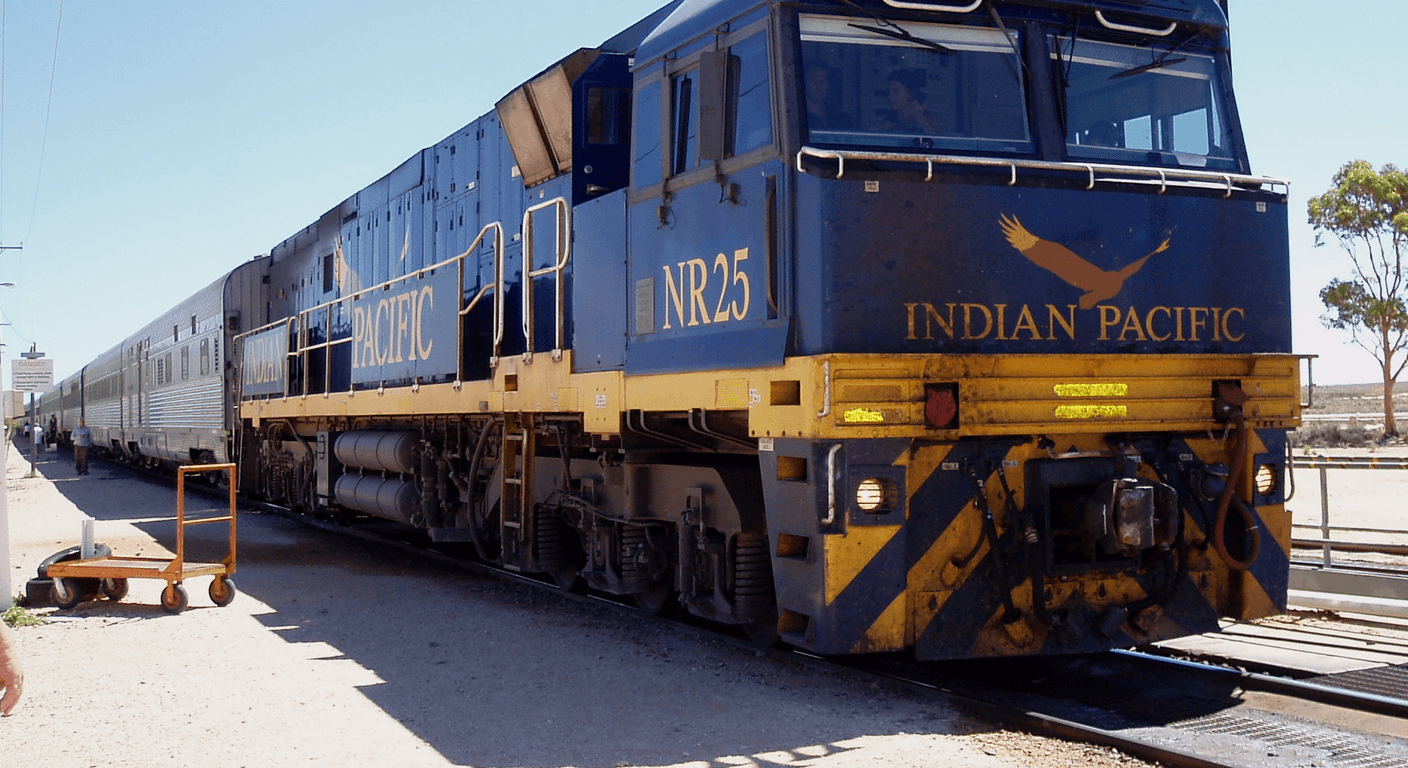
The Indian Pacific runs roughly 4,352 kilometres from Perth to Sydney over three nights, crossing the Nullarbor Plain and passing through Adelaide and Broken Hill. For an over-50 couple wanting a bucket-list rail journey without the fatigue of flying, it offers a self-contained pace that suits older travellers well. This guide covers cabin classes, what is included, accessibility, and how to make the most of the off-train stops.
Why the Indian Pacific suits an over-50 couple
There is something genuinely different about crossing Australia at ground level. The Indian Pacific takes you from the Indian Ocean at Perth to Sydney Harbour over roughly 65 hours, passing through the ancient, flat expanse of the Nullarbor, the red hills around Broken Hill, and the wine-country outskirts of Adelaide. For couples who want a shared experience that unfolds slowly, without airport queues or connecting flights, this journey delivers exactly that.
The appeal for travellers in their 60s is partly about pace. You are not rushing between attractions or hauling luggage through terminals. Your cabin is your base, the dining car is a few carriages away, and the landscape outside the window changes on its own schedule. Many couples find that three nights on the train feels restorative rather than tiring — provided they go in with realistic expectations about cabin size and connectivity.
For a couple based in regional Victoria, the journey works well as a one-way trip. You can fly into Perth, spend a few days exploring the city or the Swan Valley, then board the Indian Pacific eastbound and disembark in Sydney before flying or taking a connecting train home. That structure gives you two destinations plus the journey itself, without retracing your steps.
Gold Service versus Platinum Service: which cabin is right for you?
The Indian Pacific offers two main classes for couples: Gold Service and Platinum Service. Gold is the most popular choice and the better value for most over-50 travellers. A Gold twin cabin is compact — roughly the size of a ship's cabin — with two berths that convert between a daytime sofa configuration and night-time bunk or twin beds depending on the cabin type. You have an ensuite with a toilet and shower, though the shower requires a little coordination in the tight space. Gold includes all meals in the Queen Adelaide Restaurant, all house beverages, and the off-train excursions.
Platinum Service offers a larger cabin with a separate toilet and shower, a wider berth, and more generous storage. The dining experience in Platinum is also more refined, with a dedicated carriage and a slightly elevated menu. Indicatively, Platinum fares run considerably higher than Gold — confirm exact current pricing with Journey Beyond Rail directly, as fares vary by departure date and availability. For most couples, Gold Service is genuinely comfortable and represents the better balance of experience and cost.
One honest note: if either of you has mobility concerns, the Gold cabin's bunk configuration may require climbing up to the top berth. Ask specifically about lower-berth twin Gold cabins when booking, as these are more suitable for those who prefer not to climb. Platinum cabins generally avoid this issue. Either way, book early — the configuration you want may not be available on your preferred departure if you leave it late.
What are the indicative fares and what is included?
Gold Service fares run indicatively from around $2,500 to $4,500 per person in twin share, depending on departure date, season, and how far in advance you book. Platinum Service fares are indicatively higher again. These are rough figures only — always confirm current pricing and what promotions may apply directly with Journey Beyond Rail at journeybeyondrail.com.au. Fares are quoted per person and the twin share rate assumes two people sharing one cabin.
Included in both Gold and Platinum fares are all onboard meals from your first dinner to your final breakfast, house wines, beers, spirits and non-alcoholic beverages served throughout the journey, and the off-train excursions at Adelaide, Broken Hill, and the ghost town of Cook on the Nullarbor. These excursions are a genuine highlight and are curated specifically for the train's passengers, so you are not joining a general public tour.
What is not included: premium beverages beyond the house selection, any personal spending at off-train stops, travel insurance (strongly recommended for this age group and this length of trip), and transfers to and from the train terminals in Perth (East Perth Terminal) and Sydney (Central Station). Budget for a taxi or rideshare at each end, or arrange accommodation within walking distance of those terminals if you prefer.
The off-train excursions: Adelaide, Broken Hill and Cook
Adelaide is the first major stop, reached on the second morning. The excursion options here typically include a city highlights tour, a visit to the Central Market, or a trip into the Adelaide Hills wine region. The stops are a few hours long and well-organised. Adelaide's CBD is flat and walkable for those with reasonable mobility, and the excursion guides are accustomed to passengers of varying fitness levels. This is a good chance to stretch your legs properly and feel sunlight on your face after a night in the cabin.
Broken Hill arrives on the second afternoon and is one of the more memorable stops on the journey. This is a genuine outback city with a strong artistic tradition — the Pro Hart Gallery and the Broken Hill Regional Art Gallery are both within reach of the station area, and the town's wide, quiet streets are easy to navigate. The light in Broken Hill in the late afternoon is exactly what painters have been chasing for a century. Allow yourself to simply walk slowly and look.
Cook, on the Nullarbor Plain, is a ghost town that once housed the maintenance workers for this very railway line. The train stops here in the middle of the night or in the early hours depending on the schedule, and passengers are invited to walk through the abandoned streets under extraordinary outback skies. It is an eerie, genuinely moving experience. Wear layers — the Nullarbor can be cold at night regardless of season — and wear flat, comfortable shoes as the ground is uneven.
Accessibility and boarding: what to organise in advance
Journey Beyond Rail asks passengers with mobility requirements to notify them at the time of booking, not on the day of travel. If either of you uses a walking frame, a cane, or has difficulty with steps, contact the reservations team directly to discuss cabin placement and boarding assistance. East Perth Terminal and Sydney Central Station both have staff who can assist with boarding, but this needs to be arranged ahead of time. Do not assume it will be available on request at the platform.
The train itself has some accessible features, but it was not designed to modern accessibility standards throughout. Corridors are narrow, and moving between carriages requires stepping over joins that can feel unsteady when the train is moving at speed. If balance is a concern, hold the handrails and move between carriages during daylight hours when you can see the path clearly. The dining car and lounge car are accessible for most passengers who can manage narrow corridors.
For couples where one person has significant mobility limitations, it is worth having an honest conversation with the Journey Beyond Rail team before booking. They have handled passengers across a wide range of physical abilities and can advise on whether the journey is genuinely suitable for your situation. Better to know beforehand than to find the cabin layout difficult once you are underway.
Pacing tips for multi-day rail travel
If neither of you has done a multi-day train journey before, the first night can feel a little disorienting. The motion of the train, the sounds of the carriages, and the narrow bunk take some adjustment. Most passengers find their rhythm by the second day. Pack an eye mask and earplugs regardless of how well you normally sleep — they make a genuine difference. The train's motion is generally smooth across the Nullarbor, where the track is famously straight, but can feel more pronounced through the hills of South Australia.
Build in time for doing very little. The lounge car is a good place to sit with a book, watch the landscape, and have a conversation with fellow passengers. Many couples find the social aspect of the journey unexpectedly enjoyable — the dining car seats you with other passengers, and there is a natural camaraderie that develops over three nights. You are not obliged to socialise, but the opportunity is there if you want it.
Bring your own entertainment for the long Nullarbor crossing, which is genuinely vast and visually repetitive in the best possible way. Download podcasts, audiobooks, or films before you depart, because phone signal is patchy to non-existent across much of the Nullarbor Plain. Wi-Fi is not available on the Indian Pacific. This is not a criticism — it is part of the experience — but it surprises passengers who are not prepared for it. Let your family know you will be out of contact for stretches of the journey.
Practical matters: packing, timing and getting there
Luggage storage in a Gold cabin is limited. Pack a medium-sized soft bag rather than a hard suitcase — it fits under the berth or in the overhead storage more easily. You do not need formal attire; smart casual is the tone in the dining car. Comfortable layers are more useful than anything else, given that the train's interior temperature and the off-train excursion conditions can vary considerably. A small day bag for excursions is worth packing separately.
The Indian Pacific departs Perth on Wednesdays and arrives in Sydney on Saturdays, with the eastbound journey taking approximately 65 hours. There is also a westbound service. Departure times are subject to change, so confirm your schedule with Journey Beyond Rail when booking. East Perth Terminal is not in the city centre — allow time for a transfer, and do not schedule a tight arrival at the terminal. Arriving 30 to 45 minutes before departure is sensible.
Travel insurance is not optional for this trip at this age. Look for a policy that covers trip cancellation, medical evacuation, and pre-existing conditions, and read the fine print carefully. The train crosses remote country where medical facilities are limited. For couples based in Victoria, check whether your existing private health cover has any interstate provisions, and supplement it with dedicated travel insurance for the journey.
Key takeaways
- The Indian Pacific covers roughly 4,352 kilometres from Perth to Sydney over three nights, with off-train excursions included in the fare.
- Gold Service twin cabins include all meals and beverages; indicative fares run from around $2,500 per person twin share, but confirm current pricing directly with Journey Beyond Rail.
- Passengers with mobility requirements should notify Journey Beyond Rail at the time of booking, not on the day, to arrange boarding assistance and suitable cabin placement.
- Phone signal is patchy to non-existent across the Nullarbor Plain and there is no Wi-Fi on board — download entertainment before departure.
- The off-train stop at Cook is a ghost town on the Nullarbor and often takes place at night, so pack layers and flat-soled shoes for uneven ground.
- A one-way eastbound journey pairs well with a few days in Perth beforehand and time in Sydney afterwards, making it a full interstate holiday without retracing your route.
Recommended partners and links
Indicative prices only — always confirm with the operator before booking.
Frequently asked questions
How much does the Indian Pacific cost for a couple in Gold Service?
Gold Service fares are indicatively around $2,500 to $4,500 per person in twin share, depending on departure date and availability. This is a rough guide only — always confirm current fares directly with Journey Beyond Rail at journeybeyondrail.com.au, as pricing varies and promotional fares are sometimes available.
What is included in the Indian Pacific fare?
Both Gold and Platinum fares include all meals in the dining car, house wines, beers, spirits and non-alcoholic beverages throughout the journey, and the off-train excursions at Adelaide, Broken Hill and Cook. Transfers to and from the train terminals, premium beverages, and personal spending at stops are not included.
Is the Indian Pacific accessible for passengers with limited mobility?
The train has some accessible features but was not designed to modern accessibility standards throughout. Corridors are narrow and moving between carriages requires stepping over joins. Passengers who use a walking frame or have balance concerns should contact Journey Beyond Rail at the time of booking to discuss cabin options and arrange boarding assistance at East Perth Terminal or Sydney Central Station.
Will there be phone signal or Wi-Fi on the Indian Pacific across the Nullarbor?
Phone signal is patchy to non-existent across much of the Nullarbor Plain, and the Indian Pacific does not offer Wi-Fi. Passengers should download podcasts, audiobooks, films or other entertainment before boarding, and let family know they may be unreachable for stretches of the journey.
What is the difference between Gold and Platinum Service on the Indian Pacific?
Gold Service twin cabins are compact with an ensuite and include all meals and beverages. Platinum Service offers a larger cabin with more generous storage and a more refined dining experience, at a higher indicative fare. For most over-50 couples, Gold Service provides a comfortable and well-included experience at a better price point. Confirm the specific cabin layout, including whether lower berths are available, when booking.
Got a tip, a price update or a story from this route? The community would love to hear it.
Share your views on our Facebook page— Seniors and Solo Traveller Stories