Hobart's Salamanca Place on a Saturday morning is one of the most rewarding half-days you can spend in Tasmania — a flat, walkable precinct where a working harbour, a historic market, and some of the country's best fresh produce all sit within five minutes of each other. For couples who enjoy taking their time over food, conversation, and a slow wander through sandstone-lined streets, this guide lays out a practical Saturday from market open to afternoon rest. Costs are modest if you pace yourself, and the terrain is genuinely manageable for most mobility levels.
Why Saturday Is the Only Day That Matters Here
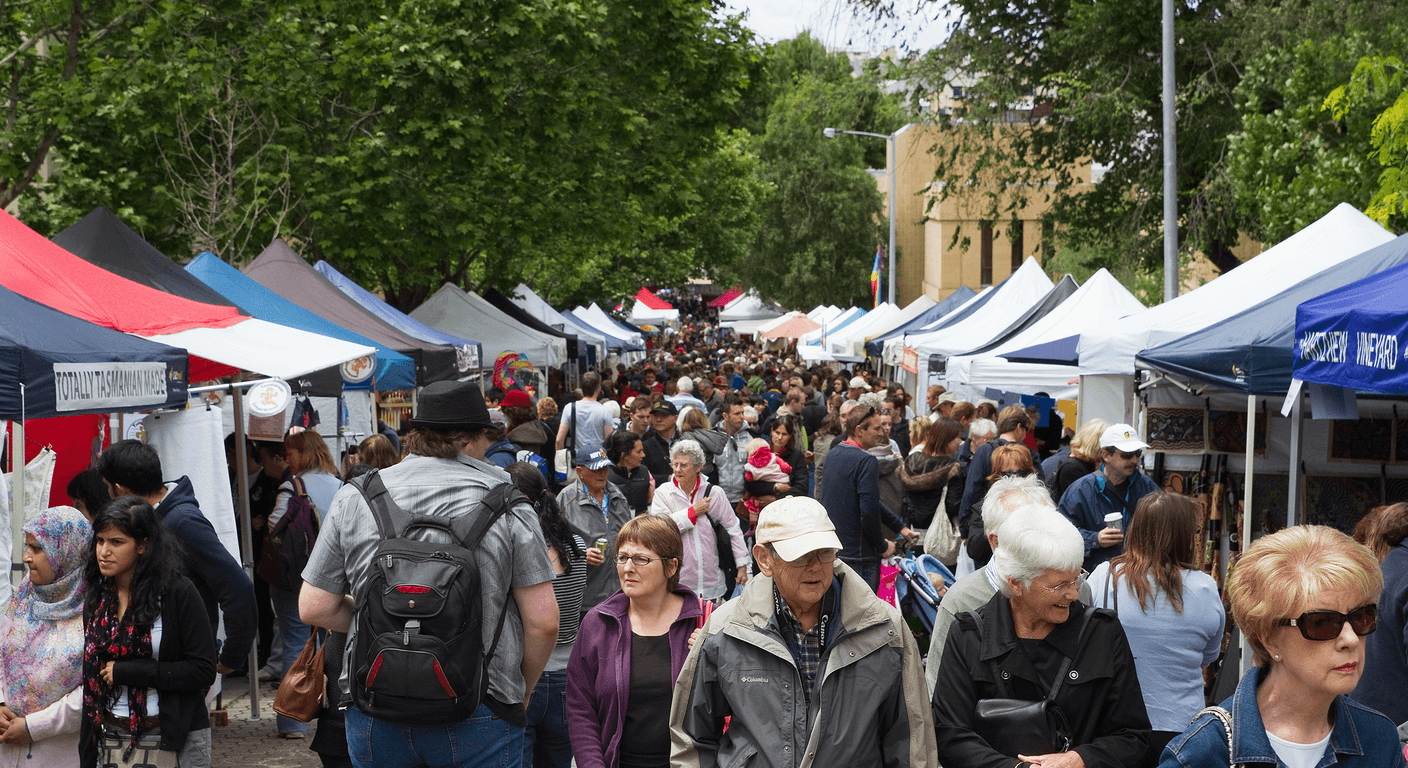
Salamanca Market runs every Saturday morning, rain or shine, from 8:30am to 3pm. That is the entirety of its weekly life. The market does not operate on Sundays, does not have a midweek version, and cannot be replicated by wandering Salamanca Place on another day — the sandstone warehouses are handsome any day of the week, but without the stalls, the atmosphere is entirely different. If your Hobart visit does not include a Saturday, reorganise it so that it does.
For a couple travelling at a considered pace, arriving between 8:30am and 9:30am is the practical sweet spot. The crowd is thin, the produce is fully stocked, and the stallholders have time to talk. By 11am the place is genuinely busy — not unpleasantly so, but navigating with a bag of purchases and a coffee in hand becomes more of a project. Hobart's weather in any season can turn quickly, so a light waterproof layer in the bag is sensible regardless of the morning forecast.
The market draws around 300 stalls across produce, craft, clothing, and food. The honest advice for a food-focused Saturday is to resist buying everything in the first ten minutes. Do one full walk-through first, note the stalls that interest you, then circle back with intention. Tasmanian honey, Atlantic salmon, local cheeses, and handmade pastries are genuinely worth seeking out. The craft stalls are good for browsing even if you are not buying — there is real skill on display, and many of the makers are happy to explain their work.
Getting There: Flat, Accessible, and Straightforward
Salamanca Place sits on the southern edge of Hobart's CBD, roughly a fifteen-minute flat walk from the city centre along Davey Street or through Sullivan's Cove. If you are staying in the CBD, the walk is entirely manageable on level ground. The waterfront path from the Brooke Street Pier area to Salamanca is paved, wide, and has no significant gradient — it is one of the more genuinely accessible urban walks in any Australian city.
Metro Tasmania operates bus services into Hobart's city centre, and from there the waterfront walk is the most direct route. For anyone who prefers not to walk the full distance, a short taxi or rideshare from the CBD to Salamanca Place is straightforward and inexpensive. Confirm current Metro Tasmania routes and fares at metrotas.com.au before travelling.
Parking is available in the area but Saturday morning competition for street spots near the market is real. If you are driving from accommodation outside the centre, the Salamanca Place car park on Montpelier Retreat or the waterfront area off Morrison Street are worth checking. Arriving before 9am gives you a reasonable chance of a spot without circling. The precinct itself — Salamanca Place, the adjacent lawns, and the waterfront path — is on flat ground throughout, which matters for anyone managing a hip, knee, or balance concern.
Working the Market: What to Eat and What to Buy
The food stalls at Salamanca are the heart of the Saturday experience for a food-focused traveller. Tasmanian Atlantic salmon — smoked, fresh, or in a roll — is available from several vendors and is genuinely of a different quality to what most mainland visitors are used to. Local cheeses, including some excellent cloth-aged varieties from small Tasmanian producers, are worth sampling before committing. Freshly baked sourdough, Tasmanian leatherwood honey, and handmade pastries round out the produce picture.
For a light breakfast at the market, the coffee queue at the established espresso vans is steady but moves well. A flat white and a pastry or a savoury tart from one of the baking stalls will run you roughly $10–$14 — confirm current prices with the vendor. The market lawn area has bench seating and low stone walls where couples can sit comfortably. There is no formal seating structure, but finding a spot to perch with a coffee is rarely difficult in the first hour.
Greek-Australian food instincts will find something to appreciate in the olive and preserved goods stalls — Tasmanian-grown olives, good-quality olive oils, and some producers who know their way around a proper brine. The handmade pasta and specialty condiment stalls are also worth a look. The honest word on the craft stalls: quality varies, as it does at any large market, but the woodwork and ceramics from Tasmanian makers tend to be the standouts.
Battery Point: The Fifteen-Minute Walk That Changes the Whole Day
Battery Point sits immediately behind Salamanca Place, up a gentle rise via Kelly's Steps — a set of sandstone stairs cut into the hill that connects the waterfront to the neighbourhood above. The steps are manageable for most people but are uneven stone and not suitable for anyone with significant mobility limitations. An alternative is to walk up Montpelier Retreat, which is a proper road with a gentler gradient and no steps.
The neighbourhood itself is one of the best-preserved nineteenth-century residential precincts in Australia. Cottage-lined lanes, a small village green at Arthur Circus, and streets that have changed remarkably little in their essential character make for a genuinely pleasant wander. It is not a tourist attraction in the formal sense — people live here, there are no entry fees, and the pleasure is simply in walking slowly and looking carefully. For a couple who appreciate history and architecture, half an hour in Battery Point adds real substance to the morning.
Arthur Circus is the focal point — a circular green surrounded by tiny workers' cottages that date to the 1840s and 1850s. The National Trust of Australia (Tasmania) has detailed information on the area's history at nationaltrust.org.au. There are a small number of cafes in Battery Point on Hampden Road, which is useful if you want a quieter coffee away from the market crowd before heading back down to the waterfront.
Lunch at the Fish Punts: Honest Harbour Food
The fish punts moored at Constitution Dock, a short walk along the waterfront from Salamanca, are a Hobart institution. These are working vessels that sell fish and chips directly from the boat — no restaurant experience, no table service, just good fresh fish cooked simply and eaten on the dock. For a couple who have spent a morning at the market, this is an entirely satisfying and inexpensive lunch.
The standard serve is flathead or whiting, battered and fried, with chips, for roughly $14–$18 per serve — confirm current prices at the punt as these change seasonally. You eat standing or sitting on the dock wall. The harbour view across to the eastern shore is genuinely pleasant on a clear day, and the informality of the whole arrangement is part of what makes it work. It is not a refined dining experience and does not pretend to be.
Constitution Dock is about a ten-minute flat walk from the eastern end of Salamanca Place along the waterfront path. The path is paved and level throughout. On a busy Saturday the fish punt queue can stretch, but it moves steadily and is not an endurance test. Arriving between noon and 12:30pm tends to be a reasonable time — after the first market-exit rush but before the later afternoon crowd.
Pacing the Day: What a Comfortable Saturday Actually Looks Like
A practical timeline for a couple doing this day at a sensible pace: arrive at Salamanca Market around 8:45am, do a full walk-through without buying, then return to the stalls that caught your attention. Allow ninety minutes to two hours for the market proper — this is not rushing, and it is not lingering past the point of comfort. A coffee and a light breakfast from the market stalls fits naturally into this window.
From around 10:30am, walk up to Battery Point via Kelly's Steps or Montpelier Retreat for a thirty-minute wander through Arthur Circus and the cottage streets. Return to the waterfront by noon and walk along to Constitution Dock for lunch at the fish punts. By 1:30pm you are done with the core of the day, have walked perhaps three to four kilometres in total on flat or near-flat ground, and have spent — depending on what you bought at the market — somewhere between $40 and $70 for two people on food and produce. Confirm all current prices locally.
The afternoon is genuinely free. The Museum of Old and New Art (MONA) is a ferry ride away if energy allows, but it is a full separate experience and probably better saved for another day. The waterfront strip between Constitution Dock and Salamanca has several cafes and bars suitable for a quiet afternoon drink if you want to extend the day without adding significant walking. The Henry Jones Art Hotel precinct on Hunter Street, a short walk north along the waterfront, has a bar with good harbour views and a pace that suits afternoon sitting.
Practical Notes for Older Travellers
The entire Salamanca and waterfront precinct is one of the more genuinely accessible urban areas in Australia for older travellers. The main promenade is flat, wide, and paved. The market itself is on level ground. The fish punt area at Constitution Dock is accessible from the waterfront path without steps. Battery Point involves either uneven stone steps or a road incline — be honest with yourself about what is comfortable on the day, and there is no obligation to do both.
Toilets are available at the Salamanca Market site and at the waterfront. The market has been running for decades and is well-organised in terms of basic visitor infrastructure. Seating is informal but available. On cold Hobart mornings — and even a summer morning in Hobart can be sharp — layers matter. The sandstone buildings on the western side of Salamanca Place provide some shelter from the wind, but the open waterfront section can be exposed.
For anyone travelling from Victoria, Hobart is a short flight from Melbourne — typically sixty-five to seventy minutes. A Friday arrival and Sunday departure gives you the Saturday comfortably without rushing. Accommodation in the Salamanca and Battery Point area puts you within easy walking distance of everything in this guide. Booking accommodation well ahead for Saturday-centred Hobart weekends is sensible, particularly in the warmer months.
Key takeaways
- Salamanca Market runs every Saturday only, from 8:30am to 3pm — the entire day is built around this single fact.
- The precinct from Salamanca Place to Constitution Dock is flat, paved, and genuinely accessible for most older travellers.
- A full morning at the market, a Battery Point wander, and fish punt lunch can be done comfortably for around $40–$70 for two people, depending on produce purchases.
- Arriving before 9:30am gives you the best produce selection, the thinnest crowd, and the most time with stallholders.
- Battery Point's Arthur Circus and cottage lanes are free to walk and add real historical depth to the morning.
- The fish punts at Constitution Dock are a genuine Hobart institution — fresh fish and chips on the harbour for roughly $14–$18 per serve.
Recommended partners and links
Indicative prices only — always confirm with the operator before booking.
Frequently asked questions
What days does Salamanca Market run in Hobart?
Salamanca Market runs every Saturday from 8:30am to 3pm. It does not operate on any other day of the week. If your Hobart visit does not include a Saturday, the market experience is not available to you — this is the single most important planning detail for this precinct.
Is the Salamanca Market area accessible for people with mobility concerns?
The main Salamanca Place market ground, the waterfront promenade, and Constitution Dock are all on flat, paved terrain and are accessible for most older travellers and those using walking aids. Battery Point involves either uneven sandstone steps (Kelly's Steps) or a road incline (Montpelier Retreat) — neither is mandatory, and the core market and waterfront experience does not require either.
How much should you budget for a food-focused Saturday at Salamanca?
A comfortable day for two people — market breakfast, produce purchases, and a fish punt lunch — runs roughly $40–$70 in total, depending on how much produce you take home. Individual food items at the market are modest: a coffee and pastry will run around $10–$14 per person. Fish punt serves are roughly $14–$18 each. All prices are indicative; confirm current costs with vendors.
What food is Salamanca Market particularly known for?
Salamanca Market is well regarded for Tasmanian Atlantic salmon (smoked and fresh), local artisan cheeses, leatherwood honey, freshly baked sourdough, and handmade pastries. Tasmanian olive and preserved goods stalls are also a feature. The produce quality reflects Tasmania's strong agricultural and aquaculture reputation.
Are the fish punts at Constitution Dock suitable for a sit-down lunch?
The fish punts at Constitution Dock are informal — you order from the boat, collect your fish and chips, and eat on the dock wall or standing. There is no table service or covered seating. It is a genuine working-harbour experience rather than a restaurant lunch, which is exactly what makes it worthwhile. For anyone who needs to sit, the dock wall and nearby benches provide options.
Got a tip, a price update or a story from this route? The community would love to hear it.
Share your views on our Facebook page— Seniors and Solo Traveller Stories