Forest bathing — the Japanese practice of shinrin-yoku — asks nothing more of you than time, slow footsteps, and the willingness to let a forest do its quiet work. Victoria has some of the Southern Hemisphere's finest temperate forests within easy reach of Melbourne, and not one of them charges an entry fee. This guide covers the best spots for older and solo travellers, with honest notes on terrain, facilities, and how to make a full wellness day of it.
What is forest bathing, and why does it suit older travellers so well?
Shinrin-yoku translates roughly as 'taking in the forest atmosphere'. It was formalised in Japan in the 1980s as a public health practice, and decades of research since then have linked time among trees to lower cortisol levels, reduced blood pressure, and a quieter nervous system. None of that requires a scientific explanation to feel true — most people already know that an hour in a forest feels different from an hour in a shopping centre.
What makes it particularly well-suited to travellers in their sixties and seventies is what it does not require: no fitness targets, no step counts, no gear beyond comfortable shoes and a water bottle. The practice is explicitly unhurried. You move slowly, pause often, and use all five senses — the texture of bark, the smell of damp earth after rain, the particular green light that filters through a mountain ash canopy. If you sit on a log for twenty minutes and do nothing else, that counts.
For solo travellers, there is also something quietly reassuring about forest bathing as a framework. It gives shape and intention to a day alone in nature without requiring company or conversation. You are not 'just going for a walk' — you are doing something deliberate for yourself, which is a different feeling entirely.
Sherbrooke Forest and the Dandenong Ranges: the closest big forest to Melbourne
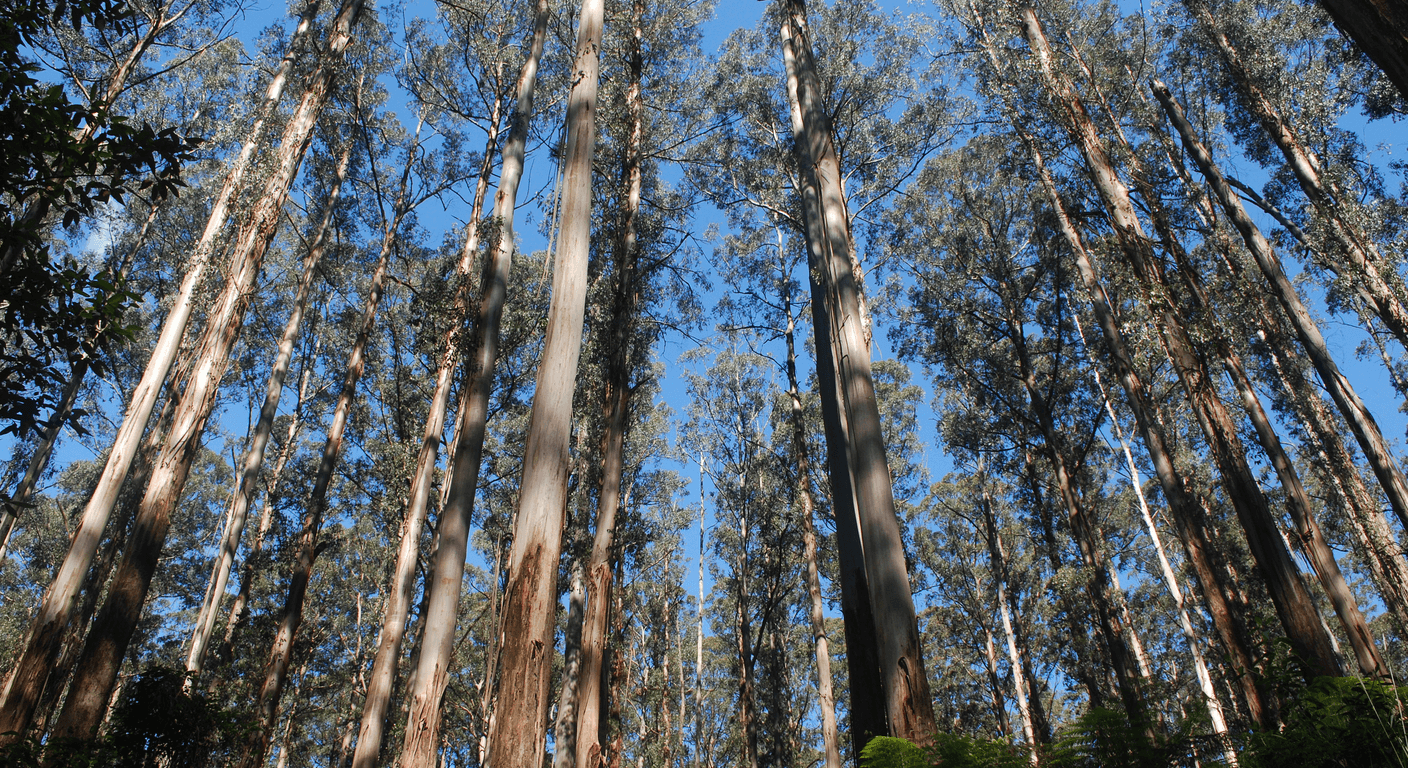
Sherbrooke Forest, within Dandenong Ranges National Park, sits about 35 kilometres east of the Melbourne CBD and is reachable by Belgrave-line train from Flinders Street Station — a journey of roughly an hour on the Belgrave line to Belgrave station, then a short taxi or rideshare to the forest. The forest is famous for its lyrebirds, which are often heard and sometimes seen in the quieter morning hours. Mountain ash trees here reach extraordinary heights, and the understorey of tree ferns creates a layered, cathedral-like atmosphere that rewards slow attention.
The Sherbrooke Picnic Area has accessible toilets and flat, well-maintained paths near the car park that suit travellers who prefer level ground. The Lyrebird Track is a moderate loop of around 6 kilometres with some undulation — perfectly manageable at a forest-bathing pace, meaning two to three hours rather than one. If the full loop feels like too much, there is no obligation to complete it; turning back at any point is entirely reasonable. Stick to the first kilometre or two of sealed and compacted path if mobility is a consideration.
Autumn and winter are particularly atmospheric here — mist hangs in the gullies, the light is softer, and the forest is quieter. Spring brings lyrebird activity and new fern growth. Mobile phone coverage is patchy in the deeper sections of the forest, so download an offline map via the Parks Victoria app before you leave home, and let someone know your plans if you are travelling solo.
The Redwood Forest at Warburton: a different kind of forest entirely
About 75 kilometres east of Melbourne, just outside the town of Warburton in the Upper Yarra Valley, there is a small plantation of Californian coastal redwoods that feels genuinely otherworldly. The trees are not native — they were planted in the mid-twentieth century — but that does not diminish the experience of standing among them. The trunks are rust-red and deeply furrowed, the canopy filters light into long shafts, and the floor beneath is soft with years of fallen needles. It is quiet in a way that feels almost deliberate.
The redwood grove itself is compact and flat, making it one of the most accessible forest-bathing sites in Victoria. The main loop through the grove takes perhaps fifteen to twenty minutes at a normal walking pace, but there is no reason not to spend an hour there simply sitting, circling slowly, or resting against one of the great trunks. There are no entry fees and no facilities within the grove itself, though Warburton township — a ten-minute drive — has cafes, public toilets, and a relaxed main street worth a gentle wander.
The Warburton Rail Trail, which runs through the valley, offers a flat, sealed path for those who want to extend the day with an easy walk or hire a bicycle. Driving from Melbourne takes roughly 75 minutes via the Maroondah Highway. There is no direct public transport to the redwood grove; the most practical option for non-drivers is to join a day tour from Melbourne, which several operators run, or to travel with a friend who drives. Mobile coverage in the grove is limited — treat it as an opportunity rather than an inconvenience.
Great Otway National Park: ancient forest meets the coast
The Otways, roughly two to three hours south-west of Melbourne along the Great Ocean Road, offer a different forest experience again — cooler, wetter, and laced with waterfalls and fern gullies. The park encompasses a vast area, so it helps to choose a specific focus. For forest bathing, the Melba Gully section near Lavers Hill is particularly recommended: it contains some of the largest myrtle beeches in Victoria, a short boardwalk loop of about 1.2 kilometres that is largely flat and accessible, and a resident population of glow-worms visible after dark.
The Maits Rest Rainforest Walk near Apollo Bay is another excellent option — a 30-minute loop through ancient forest on a well-maintained path with interpretive signage. Both walks are free and within the national park. Facilities at Melba Gully include picnic tables and toilets. Apollo Bay, about 20 minutes from Maits Rest, has a full range of cafes and accommodation if you choose to make this an overnight trip rather than a day visit.
The Otways are best visited in spring and early summer when rainfall has kept the ferns lush, or in autumn when the light through the canopy is golden. Winter visits are perfectly viable but pack a waterproof layer — the Otways receive significant rainfall and the tracks can be slippery. The road from Melbourne via the Great Ocean Road is scenic but winding in sections; if driving is not comfortable, coach tours departing Melbourne regularly include Otway stops and can be a relaxed alternative. Check Parks Victoria for current track conditions before any visit.
Toolangi State Forest: the quiet one that rewards the curious
Toolangi, about 60 kilometres north-east of Melbourne near Healesville, is the least visited of the forests in this guide and arguably the most rewarding for anyone seeking genuine solitude. The state forest contains some of the tallest mountain ash trees in the world — trees that have been growing for well over a century — and the Toolangi Rainforest Walk, a short loop of around 2.5 kilometres, passes through cool temperate rainforest with myrtle beech, tree ferns, and moss-covered logs. The path is mostly flat and well-maintained.
Toolangi was the home of C.J. Dennis, author of 'The Songs of a Sentimental Bloke', and there is a small heritage element to the area for those interested in that thread of Australian literary history. The forest itself, though, is the main event — particularly in the early morning when the birdlife is most active and the light through the canopy is at its most layered. There are no entry fees and no commercial facilities within the forest; bring your own food and water, and plan for no reliable mobile coverage.
Access is by car via Healesville — about 50 minutes from Melbourne — and the roads are sealed to the main walking area. Healesville itself, a 15-minute drive from Toolangi, has good cafes and the well-regarded Healesville Sanctuary (separate entry fee applies) if you want to combine the forest with a half-day at the sanctuary. Toolangi is not serviced by public transport, so a car or a lift with a friend is necessary.
Guided forest-therapy walks: when company and structure help
Solo forest bathing is deeply satisfying, but some travellers — particularly those new to the practice or those who simply prefer a little human company — find that a guided session adds real value. A trained forest therapy guide does not lead a bushwalk; they create a series of gentle 'invitations' — pauses, sensory prompts, quiet reflection activities — that help participants move out of their habitual thinking pace and into something slower. Sessions typically run two to three hours and cover relatively little ground.
In Victoria, guided shinrin-yoku sessions have been offered in the Dandenong Ranges and in pockets of the Otways, though availability and providers change. The best starting point is to search through the Association of Nature and Forest Therapy (ANFT) guide directory or through Eventbrite for current Victorian sessions. Prices for guided sessions are indicative at roughly $40–$90 per person; confirm directly with the operator as costs and availability vary. Some community health organisations and councils in Victoria's outer east have also offered subsidised or free guided nature-therapy sessions for older residents — worth checking with your local council.
If a guided walk is not available or not appealing, it is entirely possible to self-guide using the principles of shinrin-yoku: leave your phone in your pocket, walk more slowly than feels natural, stop every few minutes and notice what you can hear, smell, and feel. There are no rules and no wrong way to do it. The forest does most of the work.
What to bring, when to go, and how to make a full day of it
The beauty of forest bathing as a day trip is its simplicity. Comfortable, closed-toe shoes with some grip are the main practical requirement — trail runners or solid walking shoes rather than thongs or fashion sneakers. A light waterproof jacket is sensible year-round in Victoria's mountain forests. Bring more water than you think you need, a snack, and a small mat or folded jacket to sit on if you plan to rest on the ground. Sunscreen matters even in forest shade on bright days. A notebook is optional but often appreciated — many people find that time in the forest loosens thoughts they want to catch.
Seasons matter more in forest environments than in cities. Spring (September to November) brings new growth and birdlife. Autumn (March to May) offers golden light and quieter crowds. Winter visits to the Dandenongs and Otways are atmospheric and misty, but pack for cold and wet. Summer can be warm in the valleys — aim for morning starts and check fire danger ratings on the Vic Emergency website (emergency.vic.gov.au) before any summer visit; some parks close on days of extreme fire risk.
A good forest-bathing day does not need to be complicated. Drive or train to Belgrave, walk into Sherbrooke Forest for two hours, have lunch in Belgrave or nearby Sassafras, then sit in a cafe with a pot of tea and nowhere to be. Or combine the Warburton Redwood Forest with a slow walk along the Rail Trail and lunch in the town. The point is not distance covered but time genuinely spent — which is, in the end, the most sustainable kind of wellness practice there is.
Key takeaways
- Forest bathing (shinrin-yoku) requires no fitness level — slow, sensory time among trees is the entire practice.
- Victoria's best forest-bathing sites — Sherbrooke, Warburton, the Otways, and Toolangi — all have free entry.
- The Redwood Forest at Warburton and the Sherbrooke Picnic Area tracks are among the most accessible options for travellers with mobility considerations.
- Mobile coverage is limited or absent in most of these forests — download offline maps and tell someone your plans before heading out solo.
- Guided shinrin-yoku sessions in the Dandenongs and Otways run at roughly $40–$90 per person; confirm current availability and pricing directly with operators.
- Check Parks Victoria for track conditions and the Vic Emergency site for fire danger ratings before any summer or early-autumn forest visit.
Recommended partners and links
Indicative prices only — always confirm with the operator before booking.
Frequently asked questions
Is forest bathing just going for a walk in the bush?
Forest bathing shares the same setting as a bushwalk but has a different intention. Where a walk is about covering ground, forest bathing is about staying slow, using all five senses, and spending unhurried time among trees. You might walk only one or two kilometres in two hours, stopping frequently to listen, smell, and simply be present. No fitness target is involved.
Which Victorian forest-bathing spot is best for someone with limited mobility?
The Redwood Forest at Warburton has a compact, largely flat grove that is manageable for most mobility levels. The Sherbrooke Picnic Area in the Dandenong Ranges also has accessible, flat paths near the car park. The Maits Rest Rainforest Walk near Apollo Bay in the Otways is a well-maintained 30-minute loop on a relatively even path. Always check current track conditions with Parks Victoria before visiting, as conditions can change after rain.
Can you reach these forests without a car?
Sherbrooke Forest in the Dandenong Ranges is the most accessible by public transport: take the Belgrave train line from Flinders Street Station to Belgrave, then a short taxi or rideshare to the forest. The Warburton Redwood Forest and Toolangi are not practical by public transport and require a car or a lift. The Great Otway National Park can be reached by coach tour from Melbourne if driving is not an option.
Are there guided forest-therapy walks available in Victoria?
Yes, guided shinrin-yoku sessions have been offered in the Dandenong Ranges and in the Otways, though availability changes. Search the Association of Nature and Forest Therapy guide directory or Eventbrite for current Victorian sessions. Indicative cost is roughly $40–$90 per person; confirm pricing and availability directly with the operator, as these details change.
What should a solo traveller do to stay safe in these forests?
Tell someone your planned location and expected return time before you go. Download an offline map — the Parks Victoria app allows this — as mobile coverage is patchy or absent in most of these forests. Carry more water than you expect to need, wear grip-soled shoes, and in summer always check the fire danger rating on the Vic Emergency website (emergency.vic.gov.au) before leaving home, as parks may close on days of extreme fire risk.
Got a tip, a price update or a story from this route? The community would love to hear it.
Share your views on our Facebook page— Seniors and Solo Traveller Stories
- Parks Victoria — Dandenong Ranges National Park
- Parks Victoria — Great Otway National Park
- Parks Victoria — Toolangi and Cathedral Ranges State Park
- Visit Victoria — Yarra Valley and Dandenong Ranges
- Visit Victoria — Great Ocean Road and Otways
- Vic Emergency — fire danger ratings and park closures
- Great Ocean Road Regional Tourism