Darwin's Mindil Beach Sunset Market is one of the Northern Territory's most celebrated dry-season gatherings, drawing locals and visitors alike for food stalls, live music, and the famous Top End sunset over the Timor Sea. Pair it with a daytime visit to Darwin's Waterfront precinct — its wave pool and sheltered lagoon offer a gentle, accessible way to enjoy the tropics without the box jellyfish risk of open beaches. For couples who appreciate good food, a relaxed pace, and something genuinely different from southern Australia, this Darwin evening is hard to beat.
Why Darwin in the dry season makes sense for Victorian couples
For anyone based in Victoria, the idea of heading north between April and October has an obvious appeal: Melbourne is cooling down, Darwin is at its most liveable. The dry season brings low humidity, clear skies, and temperatures that sit comfortably in the high 20s to low 30s — warm enough to feel like a genuine escape, but not the punishing wet-season heat that can catch visitors off guard.
Darwin is also a city that rewards a slower pace. It is compact enough to navigate without a hire car, culturally layered in ways that often surprise first-time visitors, and the food scene — particularly at the markets — draws on Southeast Asian, Greek, and Indigenous culinary traditions in ways that feel authentic rather than curated. For a Greek-Australian traveller who appreciates food that has real story behind it, the market stalls here offer something genuinely worth sitting with.
The city suits couples who prefer to organise their own days rather than follow a tour group. You can build an evening around the market and a daytime around the Waterfront at whatever pace suits you, without rushing. That kind of flexibility is one of Darwin's quiet strengths.
What is Mindil Beach Sunset Market and when does it run?
Mindil Beach Sunset Market is an open-air market held on the beach at Mindil Beach, around two kilometres from Darwin city centre. It runs on Thursday and Sunday evenings during the dry season — typically late April through to late October, though the exact dates shift slightly each year. This is a firm seasonal event: it does not operate during the wet season, and it is worth confirming the current season's schedule on the official Mindil Beach Sunset Market website at mindil.com.au before you book flights.
The market draws well over 3,000 people on a good evening, yet it rarely feels chaotic. The layout spreads across a generous stretch of beachfront, with food stalls grouped together and arts, craft, and clothing stalls fanning out behind. There is live music at several points, but it is background rather than overwhelming — you can hold a conversation easily. Seating is mostly BYO (many locals bring folding chairs and mats), though there are some benches and low walls to perch on.
Entry to the market itself is free. You spend your money at the stalls. Food is the main draw, and the range is genuinely broad — Thai, Indonesian, Sri Lankan, Lebanese, Greek, Japanese, and plenty of local seafood and Territory-style barbecue. Most dishes are priced individually, and a couple can eat very well for a modest outlay. Indicative costs sit around $8 to $18 per dish, though prices shift with seasons and operators, so treat those figures as a rough guide and check current stall pricing on the night.
The sunset itself — what to expect and where to stand
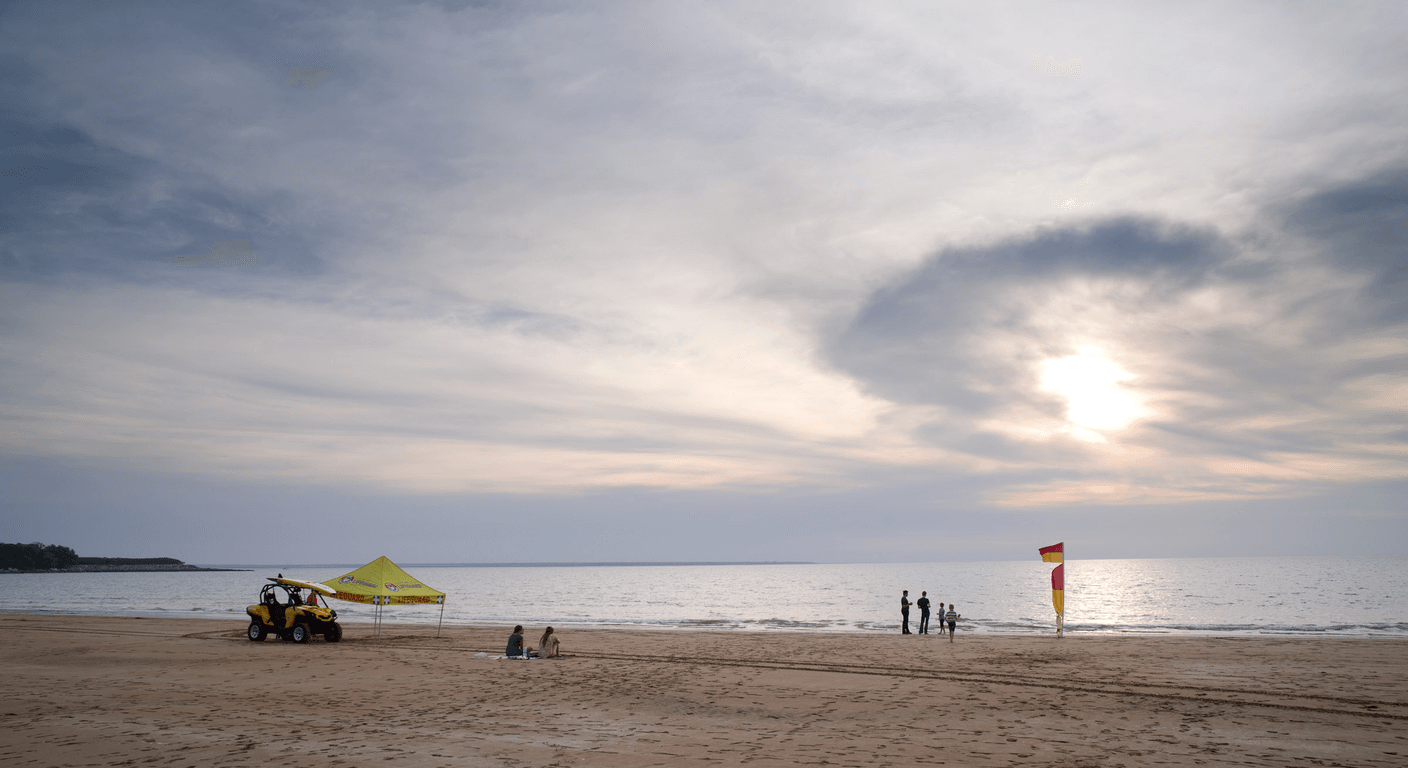
The sunset at Mindil Beach faces west over the Timor Sea, and in the dry season the light can be genuinely spectacular — deep oranges and pinks that hold for a good 20 to 30 minutes before the sky fades. There is no trick to it: you simply walk down to the waterline, find a spot in the sand or on the low rocks at either end of the beach, and watch. The crowd tends to gather along the water's edge as the sun drops, which creates a convivial, shared atmosphere without anyone needing to organise it.
If standing in sand for an extended period is uncomfortable — as it can be for travellers with knee or hip concerns — it is worth arriving 30 to 40 minutes before sunset to secure a spot on one of the benches near the market, or to set up close to the beach access path where the ground is firmer. The beach itself is relatively flat and the access paths are generally manageable, though thongs or supportive sandals are more practical than heavy shoes in the soft sand.
After the sunset, the market continues for another hour or so, which is a good time to browse the craft stalls or order something sweet — the coconut-based desserts and fresh fruit from several stalls are a reliable finish to the evening. The atmosphere quietens gradually rather than cutting off abruptly, so there is no need to rush away.
Darwin Waterfront precinct — a practical daytime complement
The Darwin Waterfront precinct sits at the southern end of the city centre, about a ten-minute walk from the CBD or a short bus ride. It was developed in the mid-2000s and has matured into a well-used local spot rather than a tourist-only attraction. The precinct's two main drawcards for visitors are the Wave Lagoon and the Recreation Lagoon — the latter is a sheltered, calm swimming area that sidesteps the box jellyfish and crocodile concerns that make open-water swimming in the Top End genuinely inadvisable for much of the year.
The Recreation Lagoon is free to enter and suitable for a gentle swim or simply sitting by the water. The Wave Lagoon generates artificial waves and has a more active atmosphere — entry costs around $8 to $12 per adult, though you should confirm current pricing at darwinwaterfront.com.au before you go. For couples who enjoy the water but want to swim safely without worrying about marine hazards, both lagoons offer a relaxed option that locals use regularly.
The precinct also has a strip of cafes and restaurants along the waterfront, ranging from casual takeaway to sit-down dining. Prices are broadly mid-range by Darwin standards. It is a comfortable place to spend a morning or early afternoon before the heat peaks, with shade structures and seating available along the waterfront walk. Accessibility is generally good — paths are paved and flat, and the area is designed with public use in mind — though it is worth noting that some sections of the lagoon beach area involve stepping over sand.
Getting to Mindil Beach and the Waterfront without a hire car
Neither destination requires a hire car, which is a practical advantage for travellers who prefer not to navigate unfamiliar roads or deal with parking. Darwin's public bus network covers both the city centre and key tourist areas, including a route that serves Mindil Beach on market evenings. The Darwin Bus Service is operated through the NT Government, and route and timetable information is available at nt.gov.au. Fares are low — indicatively around $2 to $3 per trip — but confirm current fares before you travel, as these can change.
A taxi or rideshare from the Darwin CBD to Mindil Beach takes around five to ten minutes and costs a modest amount — indicatively $10 to $15 depending on traffic and time of day, though again, treat that as a rough guide. On market evenings, taxis can be in demand as the market winds down, so it is worth either arranging a pick-up time in advance or being prepared to wait a short while. The walk from the CBD to Mindil Beach is around two kilometres along a flat path, which is pleasant in the cooler evening air if your pace and joints allow it.
The Darwin Waterfront precinct is walkable from the CBD — a ten-minute flat walk from the main shopping strip — and is also served by local buses. The precinct has its own car park if you do choose to hire a vehicle, but it is genuinely one of the easier spots in Darwin to reach on foot or by public transport.
Food highlights and honest advice on what to try
The food at Mindil Beach Sunset Market is the main reason most people go, and it earns its reputation. The stall operators are long-established — many have been at the market for years — and the quality is consistently solid. For a traveller with a Greek-Australian background and an appreciation for food made with care, the Lebanese and Middle Eastern stalls offer familiar flavours done well, while the Southeast Asian stalls — particularly the Thai and Indonesian options — are worth exploring. Local barramundi prepared in various ways appears at several stalls and is worth trying if you have not had it fresh.
Portions are generous by market standards, and it is easy to overorder. A practical approach for a couple is to choose two or three dishes to share as a first pass, then return for something else if you are still hungry. This also lets you try a broader range without wasting food. Most stalls are cash-friendly, though many now accept card — it is worth having some cash on hand regardless.
At the Waterfront precinct, the cafe and restaurant options are more conventional. A light lunch at one of the waterfront cafes — a seafood plate, a sandwich, or a cold drink and something sweet — is a comfortable way to spend the middle of the day. Prices are reasonable by tourist-area standards, though not cheap. The precinct is not the place for a special-occasion dinner; it is better suited to a casual, unhurried midday meal before you head back to your accommodation for a rest before the evening market.
Practical notes on pacing, comfort, and what to bring
Darwin's dry-season evenings are warm — typically 25 to 28 degrees at market time — but the sea breeze at Mindil Beach makes it comfortable. Light clothing is appropriate; a loose shirt or linen layer is enough. Mosquitoes can be present at dusk, particularly near the beach vegetation, so bringing repellent is sensible. Comfortable, flat footwear is worth thinking about: the market involves a fair amount of standing and slow walking on a mix of sand and grass.
If either of you uses a walking stick or has mobility considerations, the market is manageable but not perfectly even underfoot — the beach access involves soft sand, and some of the market paths can be uneven depending on where stalls are positioned. Arriving before the peak crowd (around 30 to 45 minutes before sunset) gives you time to get oriented without navigating through a thick crowd. The market does get busy, but it is not a jostling environment — people move at a relaxed pace.
Hydration matters more in the tropics than many Victorian travellers expect, even in the dry season. Carrying a water bottle is a straightforward habit to keep. Most stalls sell cold drinks, and fresh coconut water is available from several vendors at the market — a practical and enjoyable option. Sun protection is less critical at the evening market, but the Waterfront visit earlier in the day warrants sunscreen and a hat.
Key takeaways
- Mindil Beach Sunset Market runs Thursday and Sunday evenings in the dry season only — roughly late April to late October — so confirm dates at mindil.com.au before booking travel.
- Entry to the market is free; a couple can eat well across multiple stalls for an indicative total of $40 to $70, though confirm current stall prices on the night.
- Darwin's Waterfront Recreation Lagoon offers safe, jellyfish-free swimming in a sheltered, accessible setting — a practical daytime option before the evening market.
- Both Mindil Beach and the Darwin Waterfront precinct are reachable by public bus or a short, inexpensive taxi ride from the Darwin CBD — no hire car required.
- The dry season (April to October) aligns with Melbourne's cooler months, making Darwin a logical and well-timed escape for Victorian couples.
- Arrive at Mindil Beach 30 to 45 minutes before sunset to secure comfortable seating and get oriented before the peak crowd builds along the waterline.
Recommended partners and links
Indicative prices only — always confirm with the operator before booking.
Frequently asked questions
Does Mindil Beach Sunset Market run all year?
No. Mindil Beach Sunset Market is a dry-season event only, operating on Thursday and Sunday evenings from roughly late April to late October each year. It does not run during the wet season. Always check the current season's schedule at mindil.com.au before finalising travel plans.
Is the market suitable for older travellers with mobility concerns?
The market is generally manageable for older travellers, but involves walking on a mix of sand, grass, and uneven ground. Flat, supportive footwear is recommended. Arriving early before the crowd builds makes navigation easier, and there are benches and low walls near the beach for those who need to rest. The beach access itself involves soft sand, which can be challenging for anyone with significant mobility limitations.
Is it safe to swim at Darwin beaches near Mindil?
Open-water swimming at Darwin beaches, including Mindil Beach itself, carries real risks from box jellyfish (in season) and estuarine crocodiles. Most locals and experienced visitors swim at the sheltered lagoons at the Darwin Waterfront precinct rather than open beaches. The Recreation Lagoon at the Waterfront is a free, calm, and safe alternative.
How do you get to Mindil Beach Sunset Market from Darwin city centre?
The market is around two kilometres from the Darwin CBD. Options include the local public bus service (check routes and fares at nt.gov.au), a taxi or rideshare (indicatively $10 to $15 from the CBD, though confirm current rates), or a flat 20 to 25 minute walk along a path that is pleasant in the evening. On market nights, taxis can be in demand at the end of the evening, so plan your return in advance.
What is the best time to arrive at Mindil Beach Sunset Market?
Arriving 30 to 45 minutes before sunset is a practical approach. This gives you time to find a comfortable spot near the waterline for the sunset, browse the food stalls without navigating a peak crowd, and get oriented before the busiest period. The market continues for around an hour after sunset, so there is no need to rush either arrival or departure.
Got a tip, a price update or a story from this route? The community would love to hear it.
Share your views on our Facebook page— Seniors and Solo Traveller Stories