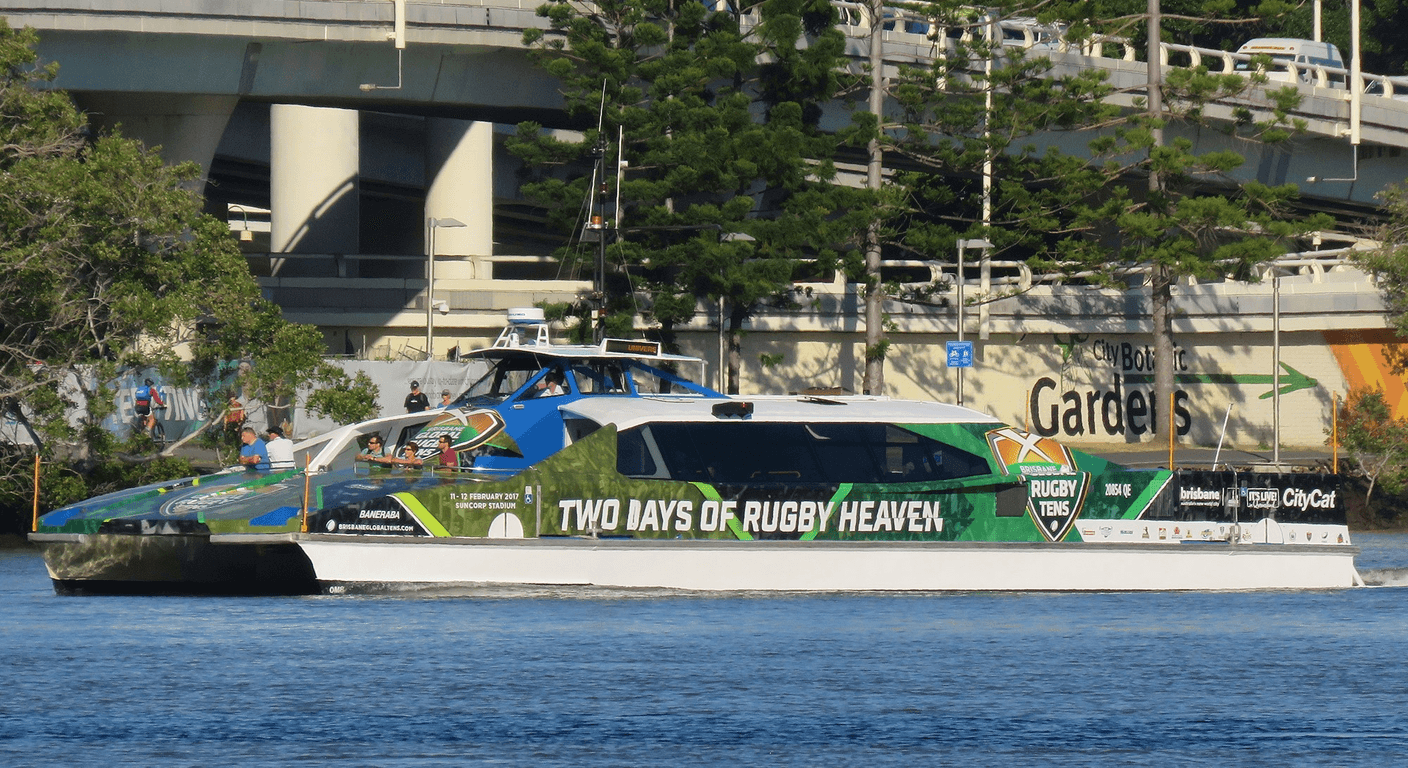
Brisbane's CityCat ferry is a legitimate sightseeing tool, not just a commuter service. A single go card loaded with a modest amount can carry you from the CBD past South Bank, New Farm Park, and the University of Queensland campus — all at public-transport prices. For travellers over 50 visiting from interstate, this is one of the most relaxed and cost-effective ways to read a river city at your own pace.
Why the CityCat is worth your attention as a visitor
Brisbane's CityCat is a high-speed catamaran service run by Translink on the Brisbane River. It is a scheduled public-transport route, not a tourist cruise, which means you pay the same fares as locals — and with a concession go card, those fares are genuinely modest. For a traveller coming from Melbourne or regional Victoria, that distinction matters: you are moving through the city on a working ferry, sitting alongside commuters and university students, not paying a tour-boat premium.
The river itself does the work. Brisbane bends and loops in a way that puts its best neighbourhoods — South Bank, Kangaroo Point, New Farm, and the leafy University of Queensland campus at St Lucia — right on the water's edge. A single journey from the CBD to UQ and back, with stops along the way, gives you a genuine cross-section of the city without requiring a hire car, a rideshare, or a single set of traffic lights.
For travellers who find walking long distances tiring or who prefer to sit and observe before committing to a destination, the CityCat offers a natural rhythm: ride, disembark, explore at your pace, re-board. The terminals themselves are flat and accessible, with seating on the vessels and on most wharves. It suits a measured day out rather than a rushed itinerary.
How does the go card work, and what does a concession fare mean for you?
The go card is Brisbane's reloadable transit card, equivalent to Melbourne's Myki. You tap on when you board and tap off when you leave — at the terminal gate or card reader. Fares are calculated by zone and distance. The CityCat runs within the inner-city zones, so a single trip is indicatively around $3 to $6 at full adult fare; confirm the exact current figure at translink.com.au before you travel, as fares are reviewed periodically.
Concession fares apply to holders of a Queensland Seniors Card, but Victorian travellers should note that an interstate seniors card does not automatically qualify for Queensland concession fares on public transport. Translink operates under Queensland government rules. However, the off-peak discount is available to all go card users: travel outside peak hours (roughly before 6 am, between 8:30 am and 3:30 pm, and after 7 pm on weekdays, or all day on weekends) and you receive a discount on the standard fare. For a visitor who can choose their own hours — which most retirees can — this is straightforward to use.
Go cards are available from Brisbane Airport, Central Station, convenience stores displaying the Translink logo, and many 7-Eleven outlets. You will need to load a minimum balance and pay a card deposit (indicatively around $10 deposit plus minimum top-up; confirm at translink.com.au). The card can be refunded at the end of your trip if you have a balance remaining. For a single day on the CityCat with one or two stops, a total spend of well under $20 on transport is a realistic expectation — though you should verify current fares directly with Translink.
Planning the loop: which direction, which stops?
The practical question for a day visitor is whether to travel upstream first or downstream. The most satisfying loop for a solo traveller based in the CBD tends to be: board at North Quay or Eagle Street Pier in the city centre, ride upstream to the University of Queensland (UQ Lakes terminal), then return downstream to New Farm Park wharf, and finish at South Bank before heading back to the city. This sequence means you see the quieter, tree-lined stretch of river in the morning when light is soft, and arrive at the livelier South Bank precinct in the afternoon.
The UQ stop is a pleasant surprise for visitors who have not been before. The St Lucia campus is one of Australia's older sandstone universities, and the walk from the UQ Lakes terminal through the grounds to the small lakes and the James and Mary Emelia Mayne Centre takes around 20 to 30 minutes on flat paths. There is a café on campus if you want to sit for a while. It is not a strenuous outing, and the architecture has genuine character — the kind of place you might spend an unhurried hour.
New Farm Park is a short, flat walk from the New Farm Park wharf. The park is known for its rose garden, which is at its best in spring (October–November) but remains a pleasant green space year-round. The Brisbane Powerhouse, a converted 1920s power station now used as an arts venue, sits right on the riverbank adjacent to the wharf — you can walk in, look around the heritage building, and sit by the water without buying a ticket to anything. Allow an hour here before re-boarding.
South Bank: the hop-off point that earns its reputation
South Bank Parklands is the most well-known stop on the CityCat route, and for good reason. The South Bank terminal puts you directly at the edge of the parklands, with the Queensland Art Gallery and Gallery of Modern Art (QAGOMA) a ten-minute flat walk along the riverfront. Entry to the permanent collections at both galleries is free, and the building that houses GOMA is architecturally interesting in its own right — generous light, river views, and seating throughout.
The parklands themselves have a free public swimming lagoon (Streets Beach), which is heated and lifeguard-patrolled. For a solo traveller who wants to sit by water without the logistics of a beach trip, this is a practical option — though you will want to check current opening hours and any entry requirements at southbank.com.au, as these can change seasonally. The parklands also have numerous shaded seating areas and flat, paved paths suitable for most mobility levels.
South Bank is also where you will find the most straightforward lunch options at a range of prices, from casual café fare to sit-down restaurants. Stanley Street Plaza runs along the inland edge of the parklands and has a density of cafés and restaurants. It can be busy on weekends, so if you prefer a quieter experience, a weekday visit is worth considering. The ferry back to the CBD from South Bank takes around ten minutes and runs frequently throughout the day.
What to know about accessibility and pacing on the ferry
CityCat terminals are generally accessible, with ramps or gangways connecting the wharf to the vessel. The vessels themselves have indoor and outdoor seating, and the indoor cabin is air-conditioned — a meaningful consideration in Brisbane's humidity. There are toilets on board. Boarding and alighting requires a short step that can move with the vessel's motion, so travellers who are less steady on their feet should allow time and ask crew for assistance if needed. Crew are routinely helpful.
The journey from the CBD to UQ is roughly 40 to 50 minutes without stops. If you are doing the full loop with two stops, budget a full day — not because the distances are vast, but because the pace of a comfortable day out at 68 is not the same as a 30-year-old's sprint through a city. The ferry timetable runs frequently (roughly every 15 to 30 minutes depending on the time of day and direction), so there is no pressure to rush back to a wharf at a specific time. Check the current timetable at translink.com.au before you go.
Sun protection matters more on the CityCat than on most city transit. The outdoor deck is exposed, and Brisbane's UV index is significantly higher than Melbourne's even in winter. A hat, sunscreen, and sunglasses are practical necessities, not optional extras. The indoor cabin is a comfortable alternative for the journey itself, with large windows that still give good river views.
Practical details: getting to the ferry from Brisbane CBD
The two most convenient boarding points for visitors staying in the CBD are North Quay (near the CBD end of Victoria Bridge, adjacent to South Bank) and Eagle Street Pier (in the financial district, near the Botanic Gardens). Both are walkable from central Brisbane hotels and from Roma Street and Central train stations. North Quay has the advantage of being very close to South Bank if you want to start there rather than end there.
If you are flying into Brisbane from Melbourne, the Airtrain connects Brisbane Airport to Central and Roma Street stations. From there, the CityCat wharves are a short walk or a single bus ride. You do not need a separate ticket — your go card covers both train and ferry on the same journey, though the fare is calculated per leg. Translink's journey planner at translink.com.au will map the whole trip for you including real-time departures.
Luggage storage is available at Brisbane Airport and at Roma Street station (check current providers and hours before you travel, as these services can change). If you are doing the CityCat as a day trip from a hotel, you obviously will not need this — but for travellers who arrive in the morning and want to head straight to the water before check-in, it is worth knowing the option exists.
Is a single day on the CityCat enough, or should you plan two?
One well-paced day covers the core loop comfortably — UQ in the morning, New Farm at midday, South Bank in the afternoon. If you want to add the Kangaroo Point Cliffs (a short walk from the Holman Street or Thornton Street wharves on the south bank) or explore the Fortitude Valley end of New Farm more thoroughly, a second half-day makes sense. But for a visitor from Victoria who is in Brisbane for two or three nights and wants one solid river day, the single-day loop is satisfying and complete.
The CityCat also connects to the broader Translink ferry network, including the CityFerry (slower, stopping more often) and the cross-river ferries. For travellers who want to extend into the Northshore Hamilton precinct — where the waterfront has been redeveloped with galleries and dining — the CityCat goes that direction too. It is worth looking at the full network map on the Translink website to see what else is within reach before you commit to an itinerary.
The honest answer is that the CityCat rewards a slow approach. This is not a day for ticking boxes quickly. It is a day for sitting on the water, watching the city go by, stopping when something catches your interest, and returning to your hotel pleasantly tired rather than exhausted. That is a different kind of travel value — and for many travellers over 60, it is precisely the kind of day that makes a trip memorable.
Key takeaways
- A go card used off-peak puts the CityCat river loop well within a $20 transport budget for the day — confirm current fares at translink.com.au.
- Victorian seniors cards do not qualify for Queensland concession fares, but the Translink off-peak discount is available to all go card users regardless of home state.
- The UQ Lakes terminal, New Farm Park wharf, and South Bank terminal form a natural one-day loop that avoids doubling back on the same stretch of river.
- QAGOMA's permanent collection at South Bank is free to enter and sits a ten-minute flat walk from the South Bank CityCat terminal.
- CityCat vessels have indoor air-conditioned seating and toilets on board, and terminals are generally accessible with crew assistance available for boarding.
- Brisbane's UV index is significantly higher than Melbourne's year-round — sun protection on the open deck is a practical necessity, not a suggestion.
Recommended partners and links
Indicative prices only — always confirm with the operator before booking.
Frequently asked questions
Can Victorian seniors use their Seniors Card for a concession fare on the CityCat?
No. Queensland's public transport concession fares apply to Queensland Seniors Card holders, not interstate cards. Victorian travellers pay the standard adult fare. However, the Translink off-peak discount applies to all go card users and is available throughout the day on weekends and during off-peak windows on weekdays — check the current off-peak hours at translink.com.au.
How much does a go card cost to set up for a one-day visit?
Indicatively, you pay a card deposit (roughly $10) plus a minimum top-up when you purchase. For a single day on the CityCat with a couple of stops, a total balance of around $20 to $25 should be more than sufficient — but confirm current fares and minimum balances at translink.com.au before you travel, as these figures are reviewed periodically. Unused balance can be refunded at the end of your trip.
How long does the CityCat take from the CBD to the University of Queensland?
The journey from North Quay or Eagle Street Pier in the CBD to the UQ Lakes terminal at St Lucia takes roughly 40 to 50 minutes. Services run frequently, generally every 15 to 30 minutes depending on direction and time of day. Check the live timetable at translink.com.au before you go.
Is the CityCat suitable for travellers with limited mobility?
Generally yes, with some caveats. Terminals have ramps or gangways, and the vessels have indoor seating and toilets. Boarding involves a short step that moves with the vessel, which can be unsteady — crew are available to assist and are accustomed to helping passengers who need it. If you use a walking frame or have significant balance concerns, it is worth calling Translink ahead of your visit to confirm the current accessibility arrangements at the specific wharves you plan to use.
Where is the best place to buy a go card when arriving from Melbourne?
Go cards are available at Brisbane Airport (domestic and international terminals), at Central and Roma Street stations, and at convenience stores and 7-Eleven outlets displaying the Translink logo throughout the city. The airport is the most convenient first point of purchase if you are arriving by air. Check translink.com.au for a current list of retail outlets.
Got a tip, a price update or a story from this route? The community would love to hear it.
Share your views on our Facebook page— Seniors and Solo Traveller Stories