Ubud sits in the cool hills of central Bali, well away from the beach-club scene, and it has quietly become one of the most practical wellness destinations in Southeast Asia for Australian travellers in their 50s, 60s and 70s. Gentle walks, affordable spa treatments, yoga studios that welcome absolute beginners, and a cafe culture built around whole food make it a genuinely restorative place to spend one to three weeks. This guide covers the practical detail — honest costs in AUD, realistic effort levels, and the things nobody mentions until you're already there.
Why Ubud works so well as a wellness base for over-50s
Ubud is not a resort town in the conventional sense. It is a working Balinese cultural hub — full of temples, rice paddies, artisan workshops and morning offerings — that has layered a thoughtful wellness industry on top of a life that was already oriented around ritual, food and the pace of the natural world. For travellers who find beach resorts a little hollow, that distinction matters.
The altitude helps, too. Sitting at around 300 to 600 metres above sea level, Ubud is noticeably cooler than the coast. Mornings can feel almost mild by Bali standards, and the air carries a humidity that feels refreshing rather than oppressive, at least outside of the wet season. For anyone who finds the coastal heat draining, the hill town climate is a genuine relief.
For a group of women travelling together — the kind of trip where the goal is connection, decent sleep and coming home feeling better than when you left — Ubud hits a particular sweet spot. It is compact enough to navigate on foot in the centre, has enough variety to keep a group happy across different energy levels, and is affordable enough that spending up on a good villa or a well-regarded spa does not feel reckless.
Getting there: flights and what to expect on arrival
Bali's Ngurah Rai International Airport is in Denpasar, on the southern coast. From Melbourne, Sydney, Brisbane, Adelaide and Perth, multiple carriers operate direct services; flight times range from around six hours from the east coast to under four hours from Perth. It is worth checking both full-service and low-cost carriers, as pricing and baggage policies differ significantly. Confirm current schedules and fares directly with airlines or through a travel agent.
Ubud is roughly 90 minutes to two hours by road from the airport, depending on traffic — and Bali traffic can be unpredictable. The most practical option for a group is a pre-arranged private transfer, which your villa or hotel can usually organise, or through a reputable local transport app such as Grab. Metered taxis from the airport rank are another option. Expect to pay somewhere in the range of AUD $25–$50 for a private car transfer; confirm pricing before you travel as rates change.
Arrival formalities are straightforward for Australian passport holders, with a visa-on-arrival available for stays up to 30 days. Fees apply and should be confirmed on the Indonesian immigration authority's official website before you travel, as they are subject to change. Have some US dollars or Indonesian rupiah available, as the visa-on-arrival fee is collected at a dedicated counter before the immigration queue.
Where to stay: villa versus hotel for a quieter experience
For a group of four to six women travelling together, a private villa in or just outside Ubud's centre offers a quality of quiet that a hotel corridor simply cannot match. Many villas come with a small pool, an open-air living area, a housekeeper and breakfast included. Splitting the cost across a group can make a villa genuinely competitive with individual hotel rooms, and the shared space becomes part of the trip — somewhere to debrief over a pot of Balinese ginger tea after a long walk.
If a villa feels like too much organisation, Ubud has a good range of boutique hotels and guesthouses with genuine character. Look for properties set back from Jalan Raya Ubud and the main Monkey Forest Road, as the central streets carry steady scooter traffic that can make street-facing rooms noisy. Properties in the Penestanan, Sayan or Bisma areas tend to offer more tranquillity while remaining close enough to the centre to walk in.
Accessibility varies considerably between properties. If anyone in the group has mobility considerations — knee issues, difficulty with stairs, uneven ground — it is worth contacting properties directly and asking specific questions rather than relying on general descriptions. Many beautiful Balinese properties involve steps, narrow paths and uneven stone surfaces that are not immediately obvious from photographs.
Yoga and spa: what beginner-friendly actually looks like in Ubud
Ubud has more yoga studios per square kilometre than almost anywhere outside of a Californian wellness resort, and the quality is genuinely high. The key for over-50 beginners is to look for classes specifically described as 'gentle', 'restorative', 'yin' or 'hatha' rather than vinyasa or ashtanga, which move at a pace that assumes a reasonable base of practice. Studios such as Intuitive Flow, which has operated in Ubud for many years, offer structured class schedules with clear level descriptions. Drop-in class fees are a fraction of Australian equivalents — indicatively around AUD $15–$25 per class, though you should confirm current pricing directly as it changes.
Spa treatments are one of Ubud's most compelling practical offerings. A traditional Balinese massage — long, flowing strokes with moderate pressure, using coconut or frangipani oil — runs to something in the range of AUD $15–$40 for a 60 to 90-minute treatment at a reputable mid-range spa. These are indicative figures only; prices vary considerably between a simple day spa and a luxury resort, and they change regularly, so confirm before you book. The experience at a well-regarded spa in Ubud is genuinely therapeutic and not a lesser version of what you would find at home — the training is specific and the technique is its own tradition.
For a longer, more immersive experience, several retreat centres in and around Ubud offer multi-day programs combining yoga, meditation, spa treatments and meals. Prices and formats vary widely — from a few hundred AUD for a weekend program to considerably more for a week-long residential stay. It is worth reading recent reviews from travellers in your age group and contacting the centre directly to ask about the physical demands of the program before committing.
Getting outside: gentle walks and what to expect on the ground
The Campuhan Ridge Walk is the most frequently recommended gentle walk in the area, and it earns the recommendation. Starting near the Ibah hotel on the western edge of central Ubud, the path follows a narrow ridge between two river valleys through open grassland and small shrines before arriving at the village of Bangkiang Sidem. The full walk is around four to five kilometres one way, with modest elevation change — it is not flat, but it is not strenuous for someone with a reasonable level of fitness. The path is paved for most of its length, though some sections are uneven. Starting before 8am avoids the heat and the groups.
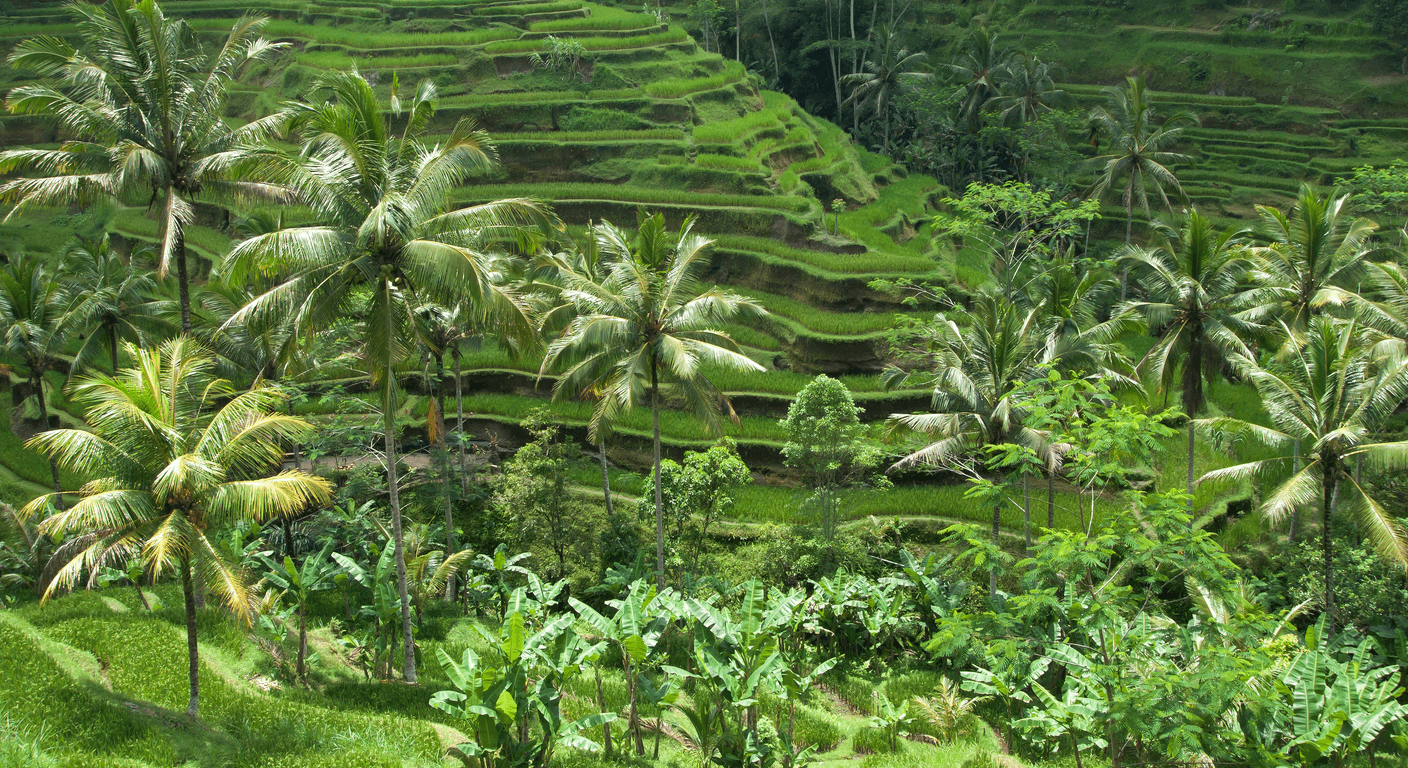
The Tegallalang rice terraces, about eight kilometres north of central Ubud, are one of Bali's most photographed landscapes. The terraces themselves involve a fair amount of stair climbing and uneven ground, so assess your own comfort level honestly. There is a modest entry fee charged at the main viewing area. The site is busiest in the late morning; arriving early or in the late afternoon makes for a more peaceful experience.
Beyond these two well-known options, the rice paddies around Penestanan and Sayan offer quieter walking on village paths where you are more likely to encounter a farmer and a duck than another tourist. A local guide is genuinely useful here, both for navigation and for the cultural context they add — many hotels and guesthouses can recommend someone reliable, and the cost for a half-day guided walk is indicatively around AUD $30–$60, though you should confirm current rates directly.
Food, cooking classes, and keeping your stomach happy
Ubud's cafe and restaurant scene has matured considerably over the past decade, with a strong emphasis on whole food, local produce and thoughtful vegetarian and vegan menus sitting alongside traditional Balinese cooking. For travellers who want to eat well without spending a great deal, warungs — small, family-run eateries — serve nasi campur (rice with small portions of various dishes) and fresh juices at prices that feel almost implausibly reasonable by Australian standards. A satisfying lunch at a reputable warung might cost the equivalent of AUD $5–$10, though confirm current pricing as exchange rates and local prices shift.
A Balinese cooking class is one of the most enjoyable half-days you can spend in Ubud, particularly for a group. Most classes begin with a market visit to buy ingredients, move through the preparation of four to six dishes, and finish with a shared meal of what you have cooked. The physical demands are minimal — mostly standing at a bench — and the skills translate directly into what you cook at home. Operators such as Lobong Culinary Experience have been running structured classes for many years and have a reputation for being genuinely welcoming to older beginners. Prices are indicatively around AUD $60–$90 per person; confirm directly.
Bali belly — traveller's diarrhoea — is a real consideration and worth taking seriously rather than dismissing. The practical steps that reduce risk are well established: drink only bottled or filtered water, be cautious with raw vegetables and fresh salads at smaller establishments, eat at places with visible turnover of food, and wash hands consistently. This is not a reason to avoid Ubud; it is a reason to make considered choices rather than eating anywhere that looks convenient. If you do become unwell, oral rehydration salts are widely available at pharmacies, and Ubud has medical clinics accustomed to treating travellers.
Practical matters: traffic, etiquette, insurance and health
Bali's scooter traffic is not a reason to avoid the island, but it does require a clear-eyed approach. For over-50 travellers, the practical guidance is straightforward: do not rent a scooter. The traffic in and around central Ubud is dense, the road rules operate on a different logic to Australian driving, and the consequences of a fall or collision are serious. Use a driver — either through your accommodation, a local app such as Grab, or a fixed arrangement with a reliable local driver for the duration of your stay. Having a dedicated driver for day trips to sites outside Ubud is comfortable, flexible and not expensive by Australian standards.
Bali is a deeply religious Hindu island, and Ubud is at the cultural heart of that. Temple visits require a sarong and sash, which can be borrowed or purchased at the entrance to most sites. Ceremonies happen frequently and are not tourist performances — if you encounter a procession or a ceremony in progress, step aside, lower your camera and let it pass. This is not complicated, but it does require a level of attentiveness that rewards a slower pace of travel.
Travel insurance is not optional for a trip to Bali, and this is especially true for travellers over 60. Confirm that your policy covers medical evacuation, pre-existing conditions (read the fine print carefully), and the activities you plan to do — some policies exclude yoga, cycling or trekking. Before you travel, see your GP to discuss any recommended vaccinations for Indonesia; this guide is not medical advice, but a travel health consultation is a sensible part of the preparation for any trip to Southeast Asia. Smartraveller (smartraveller.gov.au) is the Australian government's official source for current travel advisories and registration.
Key takeaways
- Ubud's cooler altitude, compact centre and established wellness infrastructure make it one of the most practical short-haul destinations for Australian travellers in their 50s, 60s and 70s.
- Balinese massages at reputable mid-range spas run indicatively around AUD $15–$40 for 60–90 minutes — a fraction of equivalent Australian prices, though you should confirm current rates directly.
- The Campuhan Ridge Walk is around four to five kilometres of mostly paved, moderate-grade path through rice fields and is well suited to travellers with a reasonable fitness level.
- A private villa split between a group of four to six can be cost-competitive with individual hotel rooms and provides a level of quiet and shared space that suits a wellness-focused trip.
- Do not rent a scooter in Bali; arrange a local driver through your accommodation or a reputable app for any travel beyond walking distance.
- Travel insurance that covers medical evacuation and pre-existing conditions is essential, and a GP visit for a travel health consultation is a sensible step before any trip to Southeast Asia.
Recommended partners and links
Indicative prices only — always confirm with the operator before booking.
Frequently asked questions
Is Ubud suitable for over-60 travellers who are not particularly fit?
Ubud suits a wide range of fitness levels. The centre of town is walkable, the Campuhan Ridge Walk is gentle by trekking standards, and most yoga studios offer restorative or yin classes that require no prior experience or flexibility. The main challenges are uneven footpaths, occasional steps, and heat in the middle of the day — pacing yourself and starting activities early in the morning addresses most of these.
How much should I budget per day for a wellness-focused trip to Ubud?
A comfortable mid-range budget for accommodation, meals, a daily spa treatment or yoga class, and local transport is indicatively around AUD $120–$200 per person per day, depending on your accommodation choice and activity spending. These are indicative figures only — exchange rates, accommodation standard and personal spending habits all affect the actual cost. Confirm current prices for specific services before you travel.
What is the best time of year for Australians to visit Ubud?
The dry season, broadly April to October, offers the most reliable weather for walking and outdoor activities. July and August are the busiest months, with more visitors and slightly higher accommodation prices. The shoulder months of April to June and September to October offer a balance of good weather and fewer crowds. The wet season, November to March, brings afternoon rain and occasionally heavy downpours, but mornings are often clear and prices are lower.
Do I need to speak Indonesian or Balinese to get around Ubud?
English is widely spoken in Ubud's tourist areas — in hotels, restaurants, yoga studios, spas and at most visitor sites. Learning a few basic phrases in Indonesian (Bahasa Indonesia) is appreciated and courteous, but it is not necessary for practical navigation. Away from the tourist centre, English is less common, which is another reason a local guide or driver adds real value for day trips.
How do I avoid Bali belly on a trip to Ubud?
Drink only bottled or filtered water, including for brushing teeth. Be cautious with raw salads and fresh-cut fruit at smaller establishments. Eat at warungs and restaurants with a visible turnover of fresh food. Wash hands consistently, particularly before eating. Carry oral rehydration salts. These steps significantly reduce risk but do not eliminate it entirely — if you become unwell, Ubud has medical clinics familiar with treating travellers.
Got a tip, a price update or a story from this route? The community would love to hear it.
Share your views on our Facebook page— Seniors and Solo Traveller Stories